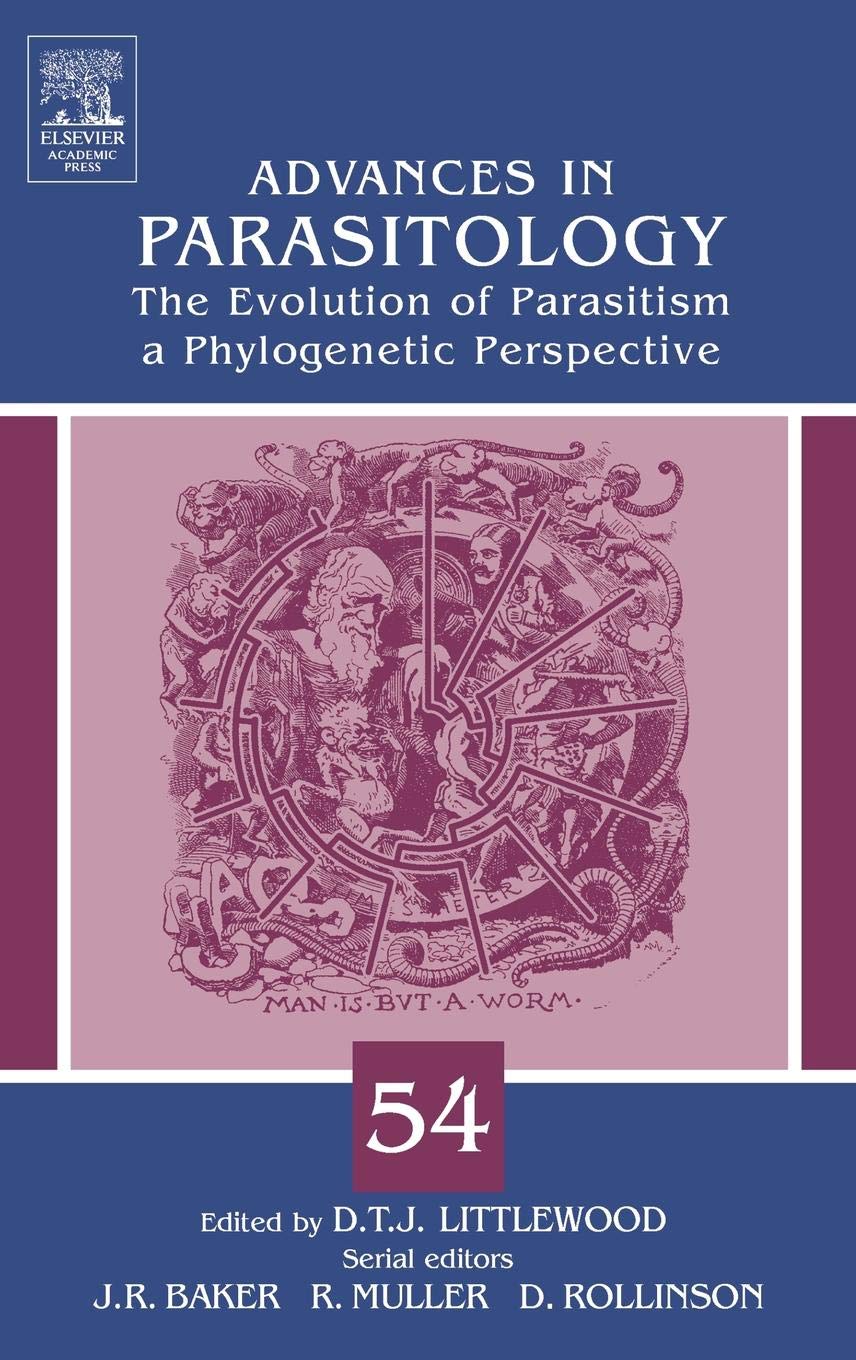
The Evolution of Parasitism - A Phylogenetic Perspective (Volume 54) (Advances in Parasitology, Volume 54)
$117.27
by Tim Littlewood



Parasitology continues to benefit from taking an evolutionary approach to its study. Tree construction, character-mapping, tree-based evolutionary interpretation, and other developments in molecular and morphological phylogenetics have had a profound influence and have shed new light on the very nature of host-parasite relations and their coevolution. Life cycle complexity, parasite ecology and the origins and evolution of parasitism itself are all underpinned by an understanding of phylogeny. The Evolution of Parasitism - A Phylogenetic Perspective aims to bring together a range of articles that exemplifies the phylogenetic approach as applied to various disciplines within parasitology and as applied by parasitologists. Unified by the use of phylogenies, this book tackles a wide variety of parasite-specific biological problems across a diverse range of taxa. Includes important contributions from leading minds in the field such as Serge Morand, Francisco Ayala and Mark Blaxter, among others - Second in the ISI Parasitology List in 2002 with an Impact Factor of 4.818 - Series encompasses over 35 years of parasitology coverage "...indispensable source for students, teachers, and research workers." -- ANNALS OF TROPICAL MEDICINE AND PARASITOLOGY This thematic volume of Advances in Parasitology features reviews on the phylogenetic approach as applied to parasitology. D. Timothy J. Littlewood is a Merit Researcher and currently Head of Life Sciences Department at the Natural History Museum, London. His main research interests include the systematics of platyhelminths (flatworms), and other phyla, particularly with a view to revealing patterns of diversity and diversification associated with parasitism. This thematic volume of Advances in Parasitology features reviews on the phylogenetic approach as applied to parasitology.