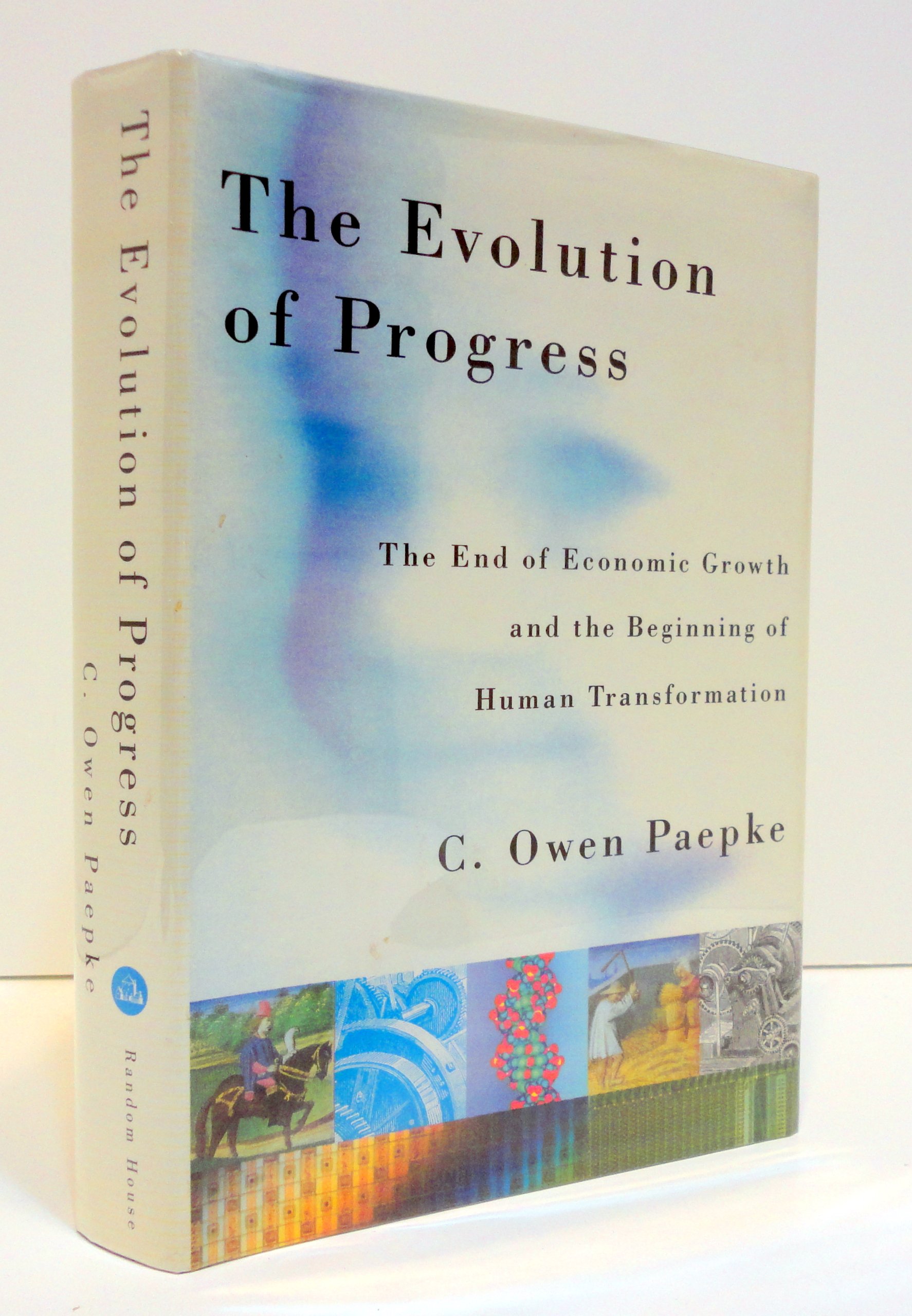
The Evolution of Progress: The End of Economic Growth and the Beginning of Human Transformation
$23.98
by Owen Paepke



The Evolution of Progress is about the revolution that is happening before our eyes. It is a revolution that most have overlooked and some have denied. In illuminating and startlingly clear terms, author C. Owen Paepke explains why it is inevitable. Economic progress is coming to an end, exhausted by its own success. Poised to replace it, argues Paepke, is a radical new vision of human progress: the transformation of people themselves through advances in neurobiology, genetic engineering, and gerontology. Drawing on history, economics, science, and sociology, Paepke traces the rise and fall of material progress and explains why economic growth, our nearly constant companion of over two hundred years, is dying. Not hibernating, not moving to Japan, not waiting for the right industrial, educational, or fiscal policies, but dying. Economic progress remained virtually stagnant until the Industrial Revolution, when the development of free markets and capital, and advances in technology and transportation, produced rapid economic growth. By the 1990s, Paepke argues, those forces have been spent. The evidence transcends the current economic slump. In fact, wages and productivity gains have been declining throughout the industrialized world for more than a decade. In the United States, wages and productivity have been flat since 1973. In the coming decades, Paepke says, we will not be wealthier, but our grandchildren will be smarter and healthier, our lives will be longer, and our computers will be thinking for themselves. Exploring the frontiers of the latest scientific research, Paepke maps the contours of a new paradigm for progress and offers a vision of how these fields will transform the way we live. Erudite and brilliantly argued, The Evolution of Progress is a penetrating analysis of the factors driving the world economy, a probing examination of today's cutting-edge biotechnology research - and a bracing look into the future. It offers nothing less than a new way of understanding the vital new forces sweeping through the world. As the subtitle of this book suggests, Paepke, a chemist and attorney, predicts the end of material progress as we have known it in the 19th and 20th centuries. He sees the stagnation of living standards as postindustrial capitalism continues to do away with jobs, saturates its markets, and exhausts its capital. His work is thus reminiscent of Christopher Lasch's The True and Only Heaven: Progress and Its Critics ( LJ 12/90), which also projected the end of material progress. But unlike Lasch, who urged that it was time to lead simpler lives, Paepke predicts a kind of brave new world in which human mortality, intelligence, and physical health will be greatly enhanced by genetic engineering, neuroscience, and artificial intelligence. Why such scientific advances might not also increase material progress is not satisfactorily explained. A strictly optional choice for academic and public libraries. - Jeffrey R. Herold, Bucyrus P.L., Ohio Copyright 1992 Reed Business Information, Inc.