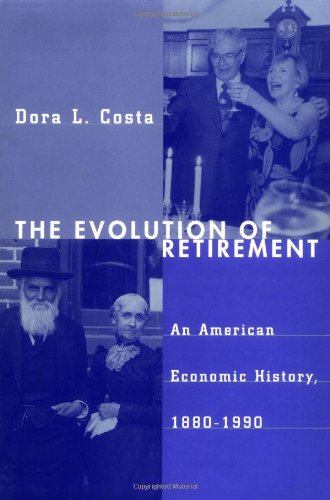
The Evolution of Retirement: An American Economic History, 1880-1990 (National Bureau of Economic Research Series on Long-Term Factors in Economic
$99.00
by Dora L. Costa



Winner of the 1998 Paul A. Samuelson Award given by TIAA-CREF, The Evolution of Retirement is the first comprehensive economic history of retirement in America. With life expectancies steadily increasing, the retirement rate of men over age 64 has risen drastically. Dora L. Costa looks at factors underlying this increase and shows the dramatic implications of her findings for both the general public and the U.S. government. Using statistical, and demographic concepts, Costa sheds light on such important topics as rising incomes and retirement, work and disease, the job prospects of older workers, living arrangements of the elderly, the development of a retirement lifestyle, and pensions and politics. "[Costa's] major contribution is to show that, even without Social Security and Medicare, retirement would have expanded dramatically."—Robert J. Samuelson, New Republic "An important book on a topic which has become popular with historians and is of major significance to politicians and economists."—Margaret Walsh, Business History In 1880, more than 75 percent of men over age 64 were working; in 1900, 65 percent; in 1950, 47 percent; and today, less than 20 percent. Costa, a Massachusetts Institute of Technology economics professor, explores American workers' retirement trends in a demanding but cogent history of retirement. Transfer payments--Union army pensions before social security was established--matter, but "over time, men's retirement decision has become less sensitive to increases or decreases in income." Today, more retirees can remain (at least relatively) independent of their families and can choose from a variety of relatively inexpensive leisure-time activities; retirement thus exerts a strong pull , rather than meaning the worker has been pushed out the door. Given current political concern about the future of the social security and medicare systems, Costa's analysis of how U.S. men's retirement behavior has changed over the past century--older women were still more concerned about widowhood than about retirement into the '70s--is timely. Mary Carroll The Evolution of Retirement is the first comprehensive economic history of retirement in America. With life expectancies steadily increasing, the retirement rate of men over age 64 has risen drastically. Dora L. Costa looks at factors underlying this increase and shows the dramatic implications of her findings for both the general public and the U.S. government. Costa argues that the rise of retirement is the result of a culmination of historical trends initiated more than a century ago, not the consequence of abrupt social or institutional change. She attributes much of the long-term increase in retirement rates to steadily rising income, but argues that increased income is not the sole explanation. Over the course of this century, men's retirement decision has become less sensitive to increases or decreases in income, perhaps because retirement has become a time of discovery and personal fulfillment, rather than a time of withdrawal from activities and dependence on family. Using statistical and demographic concepts, Costa explains trends in retirement data. Her examination sheds light on such important topics as rising incomes and retirement, work and disease, the job prospects of older workers, living arrangements of the elderly, the development of a retirement lifestyle, and pensions, and politics. She concludes with a look into the future and further evolution of retirement, addressing perhaps the most vexing problem of retirement policy, the impact of the aging Baby Boom generation on the Social Security System. Dora L. Costa is professor of economics at the University of California, Los Angeles; associate director of the California Population Research Center; and a research associate and director of the Cohort Studies Working Group at the NBER.