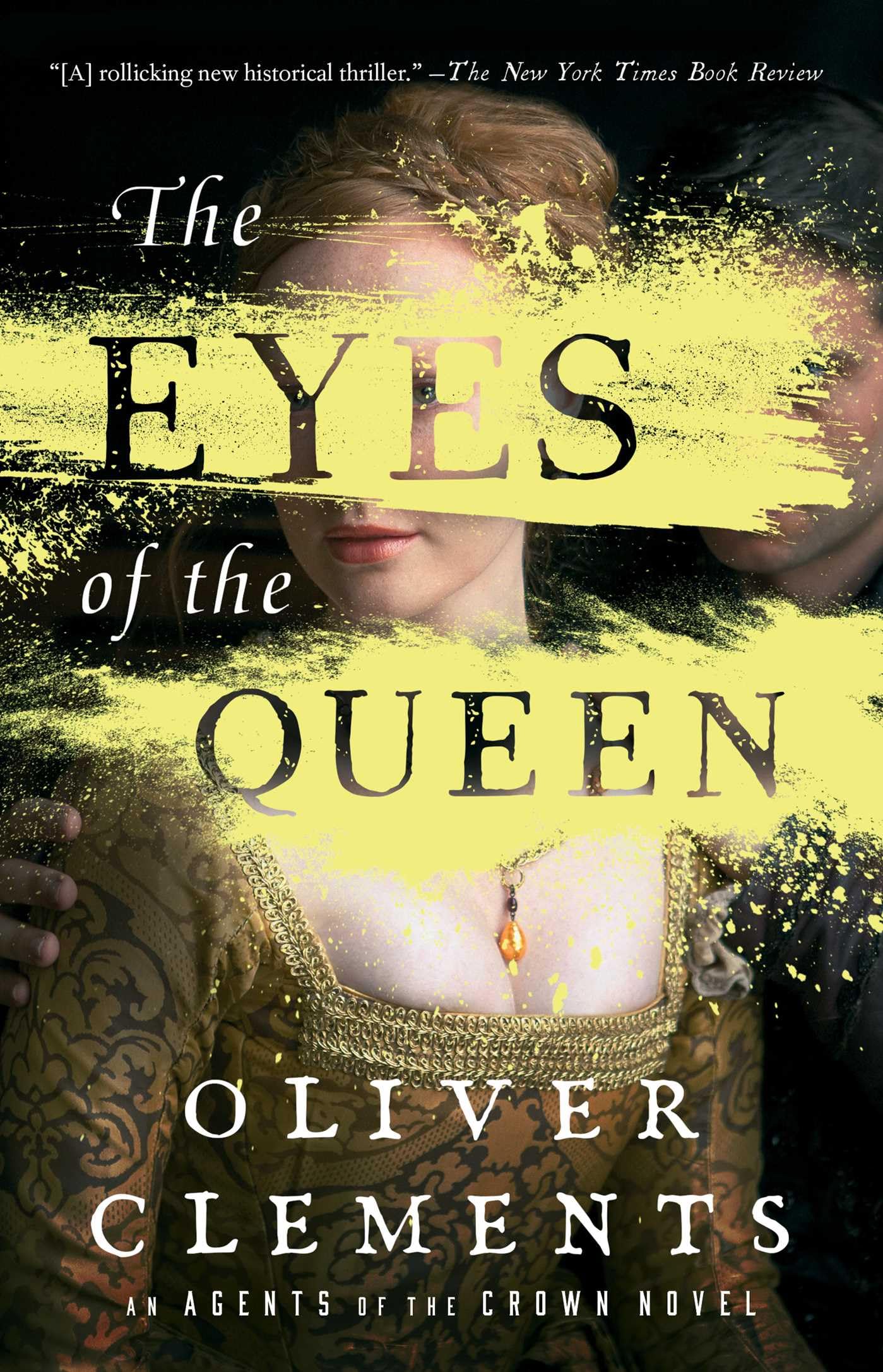



In this first novel of the “rollicking” ( The New York Times Book Review ) Agents of the Crown series, the man who will become the original MI6 agent protects England and Queen Elizabeth I from Spain’s nefarious plan to crush the Age of Enlightenment. After centuries locked in an endless cycle of poverty, persecution, and barbarity, Europe has finally emerged into the Age of Enlightenment. Scientists, philosophers, scholars, and poets alike believe this to be a new era of reason and hope for all. But the forces of darkness haven’t completely dissipated, as Spain hunts and butchers any who dare to defy its ironclad Catholic orthodoxy. Only one nation can fight the black shadow that threatens this new age, and that is Britain, now ruled by a brilliant young Queen Elizabeth I. But although she may be brave and headstrong, Elizabeth knows she cannot win this war simply by force of arms. Elizabeth needs a new kind of weapon forged to fight a new kind of war, in which stealth and secrecy, not bloodshed, are the means. In this tense situation, Her Majesty’s Secret Service is born with the charismatic John Dee at its head. A scholar, a soldier, and an alchemist, Dee is loyal only to the truth and to his Queen. And for her, the woman he’s forbidden from loving, he is prepared to risk his life in this “twisty, fast-paced debut” ( Publishers Weekly ). "In The Eyes of the Queen , Oliver Clements conjures a remarkable hero: John Dee, an Elizabethan James Bond who dives headlong into a mystery sinister enough to make Le Carré green with envy." — Keith Thomas, author of The Clarity and Dahlia Black “[A] twisty, fast-paced debut.” — Publishers Weekly "[A] rollicking new historical thriller . . . . taut, made-for-movie-theater tension and delicious, snickering-from-the-back-row wit." —New York Times Book Review Oliver Clements is a novelist and screenwriter based in Mortlake, London. Chapter One CHAPTER ONE Saint-Marceau, Paris, August 24, 1572 It starts with a bell in the night, just as he always knew it would. “Oh, what is it now, for the love of all that is holy?” his wife says, sighing. “I’ve not slept a wink and already it is dawn.” “Shhhh,” he whispers. “It’s not yet daybreak. Go back to sleep. It’ll soon stop.” But it doesn’t. The bell rings on, dismal and insistent, and after a while Francis Walsingham leaves his wife, very hot and already grown overlarge with child, in the bed, and he makes his way to the window. He lowers the shutter and looks north, over his neighbors’ modest rooftops, toward the city itself, whence comes the bell’s toll. “It’s Saint Germain’s,” his daughter tells him. She is awake in her truckle bed, by the side of the big bed, down by his ankle. “You have good ears,” he whispers. “What’s happening?” she asks. “I have been having bad dreams.” He soothes her with some vague words and fumbles for his doublet. “Francis?” his wife asks. “I will be back by dawn,” he tells her. He goes out into the corridor where he finds Oliver Fellowes, his intelligencer, already awake in doublet and breeches, with a candle lit. He is a young man—the son of Walsingham’s old friend John Fellowes—twenty to Walsingham’s forty, handsome, with reddish hair and a neatly barbered beard. “Well met, Oliver,” Walsingham starts. “Are you just up from down, or in from out?” Despite the anxiety the bell is causing, Fellowes laughs. “Working, sir,” he lies. Walsingham laughs too. It is the last time he will do so for many days. “What do you think it is?” Fellowes asks. “Nothing good.” They descend the narrow steps where the porter—a stocky Frenchman of the Reformed faith—waits with a bull’s-eye lamp, ready to unbar the door. When they meet the warm August air of the courtyard, all three stare into the star-speckled darkness over Paris. “Is no fire,” the porter says. “A fire, you see from many leagues at night, and smell, too.” “What then?” Fellowes asks. “Some saint’s day?” “Is Bartholomew’s in the morning,” the porter tells them. “But no, is not that.” Then Fellowes speaks quietly. “It cannot be Coligny, can it?” he asks. “Not so soon?” That had been Walsingham’s first fear too: that Gaspard de Coligny—the leader of France’s Protestant Huguenots—had died of his wounds. Someone had tried to kill him two days ago, with an arquebus, from an upstairs window, but had only managed to cap Coligny’s elbow and blow off his finger. Unless and until the wound became infected, he was not thought likely to die. Unless now he has? And if so, then there is no knowing what will happen. Will the Huguenots seek revenge against the Catholics? Or will the Catholics preempt the Huguenots and come for them? Paris is a tinderbox. France is a tinderbox. The whole of Christendom is a tinderbox. “No,” Walsingham tells Fellowes. “Listen: my daughter is right. That bell: it is Saint Germain’s, the king’s chapel. The Catholics would never mourn Coligny.” Fellowes agrees, but kno