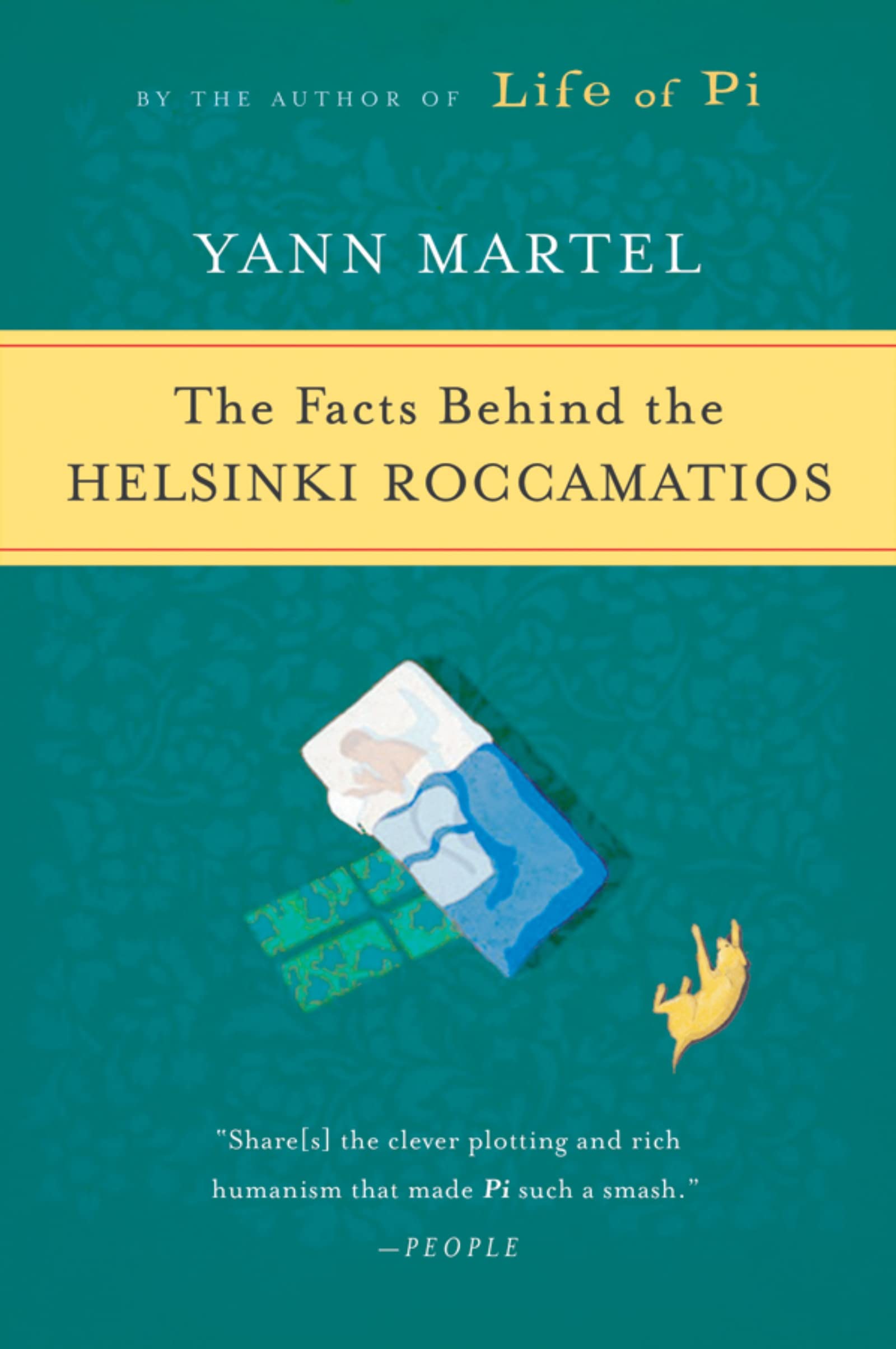
The Facts Behind The Helsinki Roccamatios: Literary Short Stories of Life, Loss, and Human Depth
$9.70
by Yann Martel



Here are four unforgettable stories by the author of Life of Pi. Written earlier in Martel's career, these tales display that startling mix of dazzle and depth that have made Yann Martel an international phenomenon. Inventive in form and timeless in content, each story is moving and thought-provoking. A Canadian university student visiting Washington, D.C., experiences the Vietnam War through an intense musical encounter. Variations of a warden's letter to the mother of a man he has just executed reveal how each life is contained in its end. A young man's fascination with the mirror-making machine he finds in his grandmother's attic is juxtaposed with the reminiscences it evokes from his grandmother. And, in the exquisite title story, a young man dying of AIDS joins his friend in fashioning a story of the Roccamatio family of Helsinki, set against the yearly march of the twentieth century. PRAISE FOR LIFE OF PI "A story to make you believe in the soul-sustaining power of fiction." -Los Angeles Times Book Review "Readers familiar with Margaret Atwood, Mavis Gallant, Alice Munro, Michael Ondaatje and Carol Shields should learn to make room on the map of contemporary Canadian fiction for the formidable Yann Martel."-Chicago Tribune YANN MARTEL was born in Spain in 1963 of Canadian parents. Life of Pi won the 2002 Man Booker Prize (among other honors) and was adapted to the screen in the Oscar-winning film by Ang Lee. Martel is also the author of the novels The High Mountains of Portugal, Beatrice and Virgil, and Self, the collection of stories The Facts Behind the Helsinki Roccamatios, and a collection of letters to the prime minister of Canada, What Is Stephen Harper Reading?. He lives in Saskatchewan, Canada. The Facts Behind the Helsinki Roccamatios By Yann Martel Harvest Books Copyright © 2005 Yann Martel All right reserved. ISBN: 9780156032452 Chapter One The Facts behind the Helsinki Roccamatios I hadn’t known Paul for very long. We met in the fall of 1986 at Ellis University, in Roetown, just east of Toronto. I had taken time off and worked and travelled to India: I was twenty-three and in my last year. Paul had just turned nineteen and was entering first year. At the beginning of the year at Ellis, some senior students introduce the first-years to the university. There are no pranks or mischief or anything like that; the seniors are there to be helpful. They’re called “amigos” and the first-years “amigees”, which shows you how much Spanish they speak in Roetown. I was an amigo and most of my amigees struck me as cheerful, eager and young — very young. But right away I liked Paul’s laidback, intelligent curiosity and his sceptical turn of mind. The two of us clicked and we started hanging out together. Because I was older and I had done more things, I usually spoke with the authority of a wise guru, and Paul listened like a young disciple — except when he raised an eyebrow and said something that threw my pompousness right into my face. Then we laughed and broke from these roles and it was plain what we were: really good friends. Then, hardly into second term, Paul fell ill. Already at Christmas he had had a fever, and since then he had been carrying around a dry, hacking cough he couldn’t get rid of. Initially, he — we — thought nothing of it. The cold, the dryness of the air — it was something to do with that. Slowly things got worse. Now I recall signs that I didn’t think twice about at the time. Meals left unfinished. A complaint once of diarrhea. A lack of energy that went beyond phlegmatic temperament. One day we were climbing the stairs to the library, hardly twenty-five steps, and when we reached the top, we stopped. I remember realizing that the only reason we had stopped was because Paul was out of breath and wanted to rest. And he seemed to be losing weight. It was hard to tell, what with the heavy winter sweaters and all, but I was certain that his frame had been stockier earlier in the year. When it became clear that something was wrong, we talked about it — nearly casually, you must understand — and I played doctor and said, “Let’s see . . . breathlessness, cough, weight loss, fatigue. Paul, you have pneumonia.” I was joking, of course; what do I know? But that’s in fact what he had. It’s called Pneumocystis carinii pneumonia, PCP to intimates. In mid-February Paul went to Toronto to see his family doctor. Nine months later he was dead. AIDS. He announced it to me over the phone in a detached voice. He had been gone nearly two weeks. He had just got back from the hospital, he told me. I reeled. My first thoughts were for myself. Had he ever cut himself in my presence? If so, what had happened? Had I ever drunk from his glass? Shared his food? I tried to establish if there had ever been a bridge between his system and mine. Then I thought of him. I thought of gay sex and hard drugs. But Paul wasn’t gay. He had never told me so outright, but I knew h