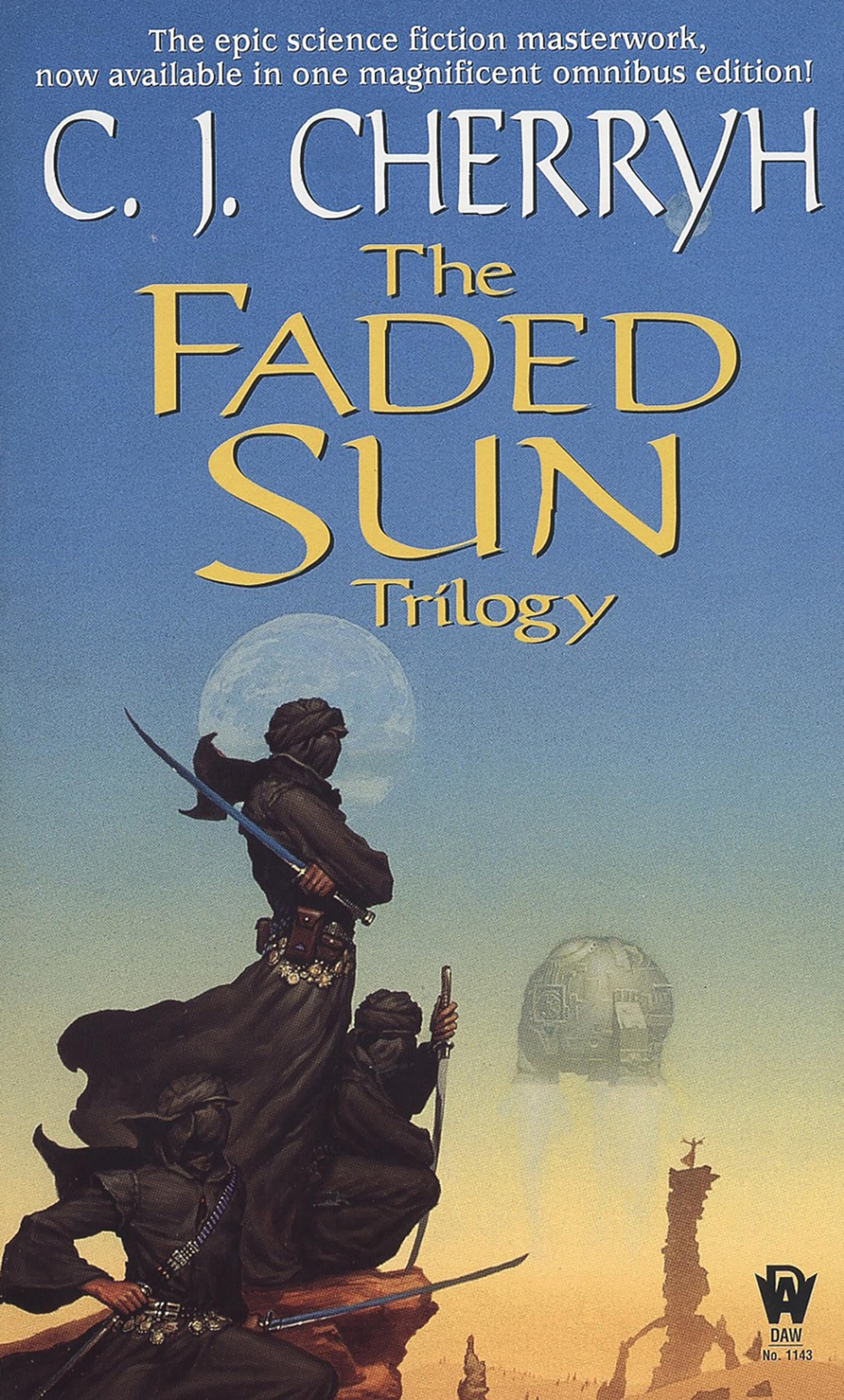



Now in trade paperback, all three books of the epic science fiction Faded Sun trilogy— Kesrith , Shon'jir , and Kutath —collected in one volume. They were the mri—tall, secretive, bound by honor and the rigid dictates of their society. For aeons this golden-skinned, golden-eyed race had provided the universe mercenary soldiers of almost unimaginable ability. But now the mri have faced an enemy unlike any other—an enemy whose only way of war is widespread destruction. These "humans" are mass fighters, creatures of the herb, and the mri have been slaughtered like animals. Now, in the aftermath of war, the mri face extinction. It will be up to three individuals to save whatever remains of this devastated race: a warrior—one of the last survivors of his kind; a priestess of this honorable people; and a lone human—a man sworn to aid the enemy of his own kind. Can they retrace the galaxy-wide path of this nomadic race back through millennia to reclaim the ancient world that first gave them life? Praise for the Faded Sun trilogy: "This is a powerful story... inspiring in its determination and feeling of strange loyalties and stranger courage. It sticks in the mind long after the last page is finished." — Analog " Carefully wrought ... Cherryh demonstrates an almost clinical eye for detail, creating an alien race in depth." — Publishers Weekly “The Faded Sun Trilogy has an air of being something that was, that is, that could still be. This book is timeless and enduring .” —SF Site “Cherryh is a master of world-building .... Faded Sun has everything: well-defined alien cultures that are actually alien, some intriguing philosophical questions, a Soft SF look at cultural integration and extinction, a fluid struggle of political intrigue, developed planetary ecology, and a proper epic backdrop of intergalactic war for this amazing space opera.” —Battered, Tattered, Yellowed, & Creased Blog C. J. Cherryh planned to write since the age of ten. When she was older, she learned to use a typewriter while triple-majoring in Classics, Latin, and Greek. With more than seventy books to her credit, and the winner of three Hugo Awards, she is one of the most prolific and highly respected authors in the science fiction field. Cherryh was recently named a Damon Knight Memorial Grand Master by the Science Fiction Writers of America. She lives in Washington state. She can be found at cherryh.com. Chapter One Wind-child, sun-child, what is Kath? Child-bearers, laugh-bringers, that is Kath. It was a game, shon’ai, the passing-game, Kel-style, in the dim round hall of the Kel, the middle tower of the House—black-robed men and a black-robed woman, a circle of ten. Warriors, they played the round not like children, with a pair of stones, but with the spinning blades of the as’ei, that could wound or kill. On the name-beat, the snap of fingers, the as’ei flew across the seated circle of players, and skilled hands seized the hilts in mid-turn, to beat the time and hurl the blades on in the next name-beat. Fire-child, star-child, what is Kel? Sword-bearers, song-weavers, that is Kel. They played without words, with only the rhythm of their hands and the weapons, flesh and steel. The rhythm was as old as time and as familiar as childhood. The game had more meaning than the act, more than the simplicity of the words. The Game of the People, it was called. Dawn-child, earth-child, what is Sen? Rune-makers, home-leaders, that is Sen. A kel’en who flinched, whose eye failed or whose wits wandered, had no value in the House. The boys and girls and women of the Kath played with stones to learn their skill. Those who became kel’ein played thereafter with edged steel. The Kel, like the mothers and children of the gentle Kath, laughed as they played. They of Kel-caste were brief and bright as moths. They enjoyed life, because they knew this. Then-child, now-child, what are we? Dream-seekers, life-bearers, we are— A door opened, echoing, the sound rolling through the hollows and depths of the tower. Sen Sathell broke in upon them, suddenly and without warning or courtesies. The rhythm ceased. The blades rested in the hands of Niun, the youngest kel’en. The Kel as a whole inclined their heads in respect to Sathell s’Delas, chief of Sen-caste, the scholars. Gold-robed he was, like light breaking into the dark hall of the martial Kel, and he was very old—the oldest man of all in the House. “Kel’anth,” he said quietly, addressing Eddan, his counterpart in the Kel, “—kel’ein—news has come. The rumor is the war has ended. The regul have asked the humans for peace.” There was utter silence. An abrupt move. The as’ei whirred and buried points in the painted plaster of the far wall. The youngest