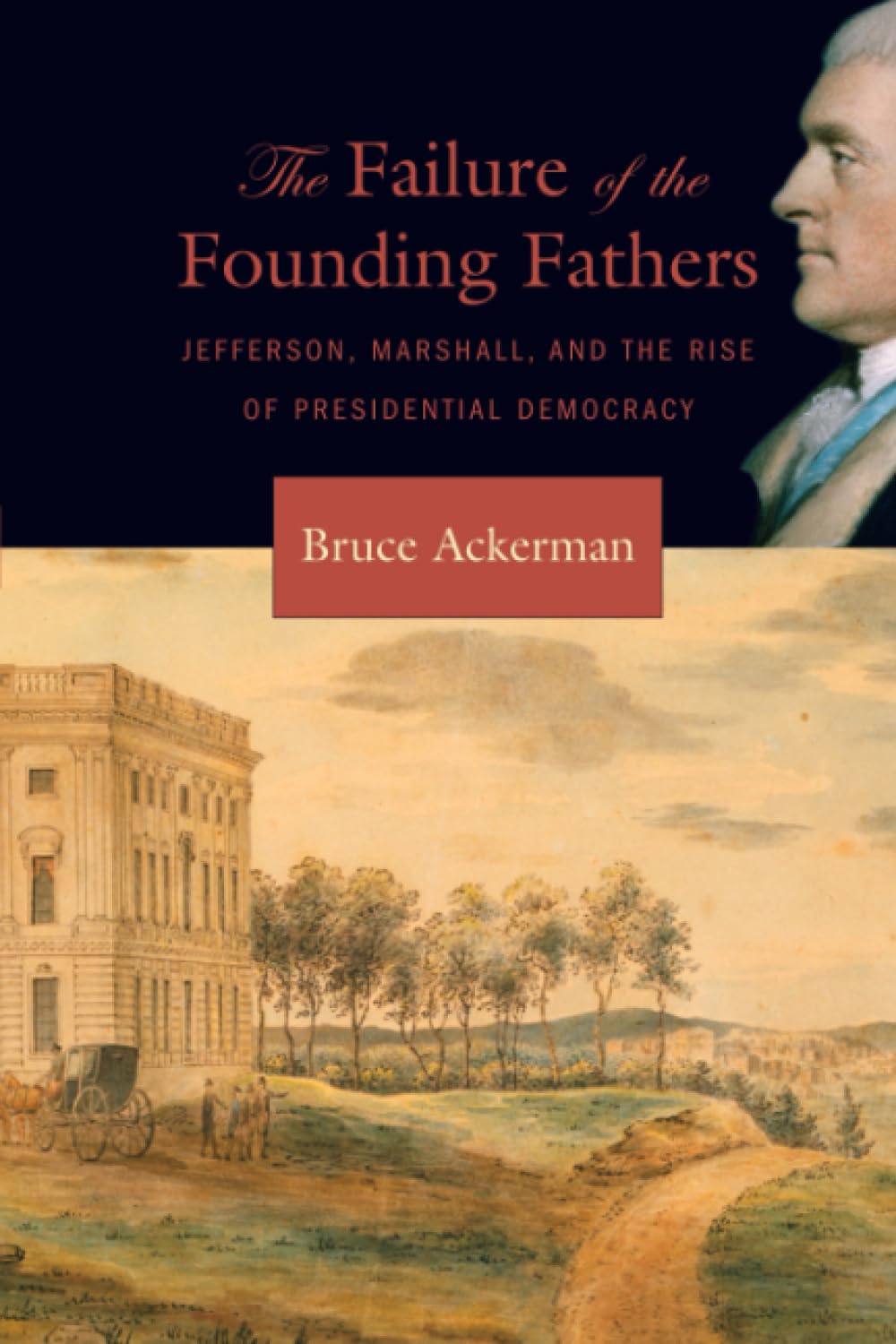
The Failure of the Founding Fathers: Jefferson, Marshall, and the Rise of Presidential Democracy
$32.00
by Bruce Ackerman



The ink was barely dry on the Constitution when it was almost destroyed by the rise of political parties in the United States. As Bruce Ackerman shows, the Framers had not anticipated the two-party system, and when Republicans battled Federalists for the presidency in 1800, the rules laid down by the Constitution exacerbated the crisis. With Republican militias preparing to march on Washington, the House of Representatives deadlocked between Thomas Jefferson and Aaron Burr. Based on seven years of archival research, the book describes previously unknown aspects of the electoral college crisis. Ackerman shows how Thomas Jefferson counted his Federalist rivals out of the House runoff, and how the Federalists threatened to place John Marshall in the presidential chair. Nevertheless, the Constitution managed to survive through acts of statesmanship and luck. Despite the intentions of the Framers, the presidency had become a plebiscitarian office. Thomas Jefferson gained office as the People's choice and acted vigorously to fulfill his popular mandate. This transformation of the presidency serves as the basis for a new look at Marbury v. Madison, the case that first asserted the Supreme Court's power of judicial review. Ackerman shows that Marbury is best seen in combination with another case, Stuart v. Laird, as part of a retreat by the Court in the face of the plebiscitarian presidency. This "switch in time" proved crucial to the Court's survival, allowing it to integrate Federalist and Republican themes into the living Constitution of the early republic. Ackerman presents a revised understanding of the early days of two great institutions that continue to have a major impact on American history: the plebiscitarian presidency and a Supreme Court that struggles to put the presidency's claims of a popular mandate into constitutional perspective. “Just like with his magnificent We the People , Bruce Ackerman has intertwined well researched history with an unparalleled skill as a constitutional theorist. The Failure of the Founding Fathers describes the maneuvering that validated Thomas Jefferson's claim to the presidency that then created a decade-long confrontation between the Jeffersonians in the elected branches of the Federalists in the judiciary. This is constitutional history at its finest.” ― Lucas A. Powe, Jr., University of Texas at Austin, and author of The Warren Court and American Politics “Bruce Ackerman has written a provocative account of the impact upon America's political future of the Jeffersonian opposition to the Federalists. Completely levitating himself out of the historiography of party formation, Ackerman in The Failure of the Founding Fathers demonstrates just how powerful the vexed election of 1800 proved to be.” ― Joyce Appleby, University of California, Los Angeles, and author of Inheriting the Revolution: The First Generation of Americans “Many fine historians have written about the presidential election of 1800. But only Bruce Ackerman has placed all of the events surrounding the election into the context of American constitutional development. With his usual mixture of careful historical exegesis, narrative sweep, and bold interpretive imagination, Ackerman enables us to see a number of aspects of our constitutional history as if for the first time (beginning with the fact that the almost unknown case of Stuart v. Laird, was far more significant that Marbury v. Madison, decided a week earlier). Anyone interested in the development of American constitutionalism--and American political institutions--should be fascinated by this book.” ― Sanford Levinson, University of Texas Law School, author of Wrestling With Diversity “Ackerman innovatively recasts the histories of parties, constitutional interpretation and presidential politics...Rarely has a study of American history been more timely.” ― Publishers Weekly “[Ackerman] goes against the fashion to produce this major reinterpretation of the immediate post-1787 history of America's charter.” ― Robert F. Nardini , Library Journal “Bruce Ackerman, who teaches at Yale Law School, might be expected to advocate for either the Jeffersonians or their opponents, the Federalists. Instead he dishes blame all around to make the point that the mistakes of 1787 have shaped our politics. He sees American constitutionalism as a work in progress over two centuries. This liberal jurisprudence opposes the originalism of Antonin Scalia and other conservative jurists who insist that the true meanings of a law or decision are simply the literal ones right there in the text if you read them the right (Right?) way. The historical approach favored by Ackerman stresses continual reinterpretation of constitutional articles, legislation, presidential orders, and judicial decisions. Like the landmark Brown v. Board of Education decision that still inspires its practitioners, it needs a lot of detailed history to back up the argument. And t