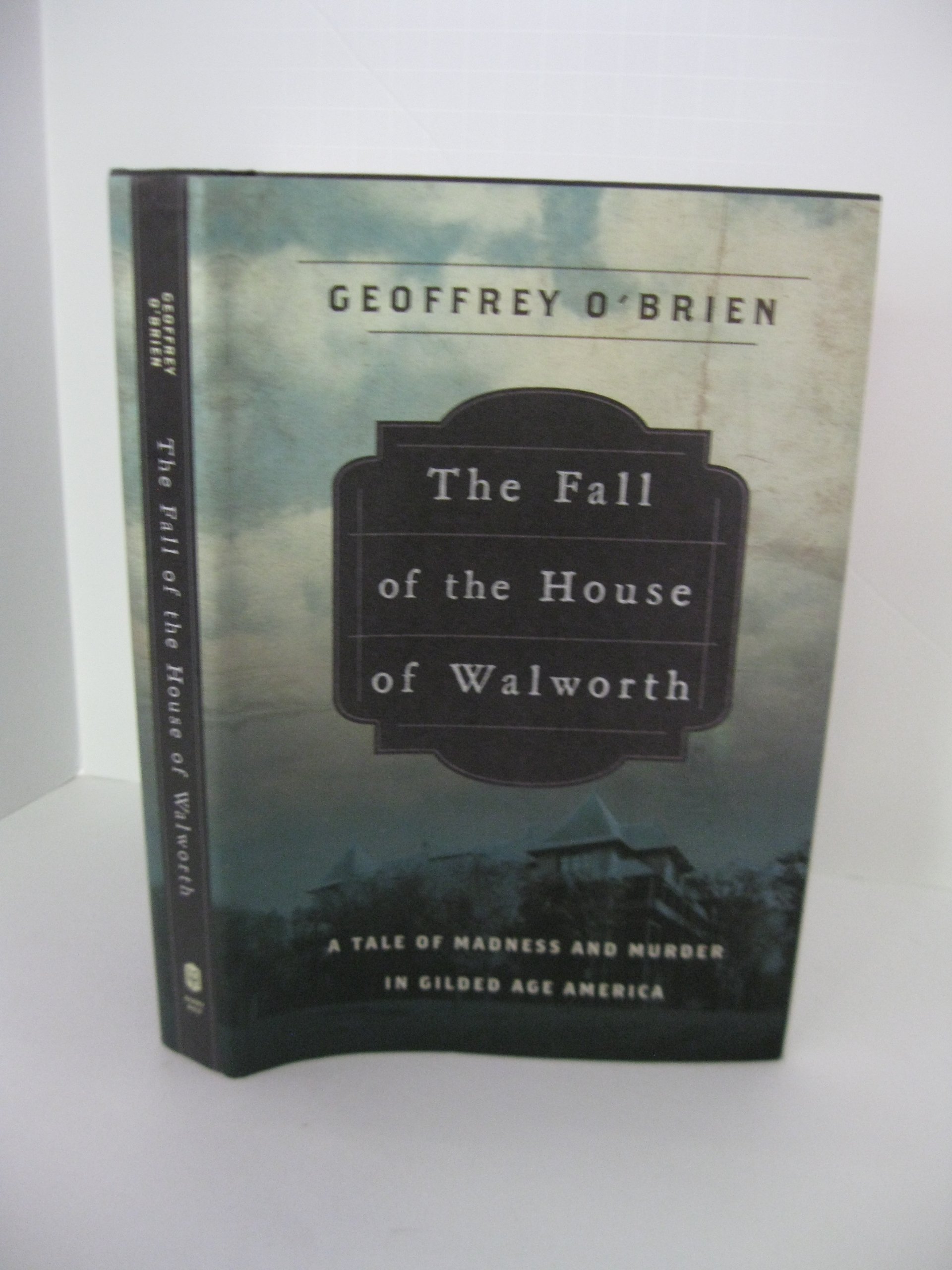
The Fall of the House of Walworth: A Tale of Madness and Murder in Gilded Age America
$30.00
by Geoffrey O'Brien



In the tradition of The Devil in the White City comes a spell-binding tale of madness and murder in a nineteenth century American dynasty On June 3, 1873, a portly, fashionably dressed, middle-aged man calls the Sturtevant House and asks to see the tenant on the second floor. The bellman goes up and presents the visitor's card to the guest in room 267, returns promptly, and escorts the visitor upstairs. Before the bellman even reaches the lobby, four shots are fired in rapid succession. Eighteen-year-old Frank Walworth descends the staircase and approaches the hotel clerk. He calmly inquires the location of the nearest police precinct and adds, "I have killed my father in my room, and I am going to surrender myself to the police." So begins the fall of the Walworths, a Saratoga family that rose to prominence as part of the splendor of New York's aristocracy. In a single generation that appearance of stability and firm moral direction would be altered beyond recognition, replaced by the greed, corruption, and madness that had been festering in the family for decades. Reviewers unanimously agreed that The Fall of the House of Walworth , billed as a true-crime story, is an enthralling book and that O'Brien is uniquely qualified to write it. Critics were universally impressed with the way O'Brien takes a 19th-century family that most people have probably never heard of and not only builds a gripping, multilayered, and thoroughly researched narrative about them but also uses them to illuminate much of their rapidly changing period in American history. O'Brien's background as a cultural historian, literary critic, and poet are all brought to bear in this impressive achievement. In this darkly mesmerizing true-crime tale, cultural critic and historian O’Brien turns a telescopic lens on the moral and economic collapse of the Walworths, a socially prominent Saratoga Springs, New York, clan. While tracing the rise and fall of the Walworths over the course of the nineteenth century, he also exposes signs of insanity festering in various family members across several generations. The downward spiral of this once-proud family culminates in 1873 when 18-year-old Frank Walworth calmly and deliberately shot and killed his father. O’Brien makes the most of this gripping saga by steeping the narrative in descriptive Gilded Age details. This authentic American Gothic is perfect for discerning true crime buffs, who prefer analysis and atmosphere to guts and gore. --Margaret Flanagan "A hybrid of pulp and Poe . . . . [O’Brien’s] saga of this prominent 1800s family of Saratogians has enough moments of melodramatic excess—religious fanaticism! inherited insanity! parricide!––to rival the most extravagant Gothic novels of the day. . . He combines an enthusiast’s zeal for the potboiler and the penny press and a memoirist’s almost melancholy fascination for the varnished-away traces of the past. O’Brien elaborates the denouement of the Walworth world with the same humor and insight that he applies to the particular mid-1800s knack for a sort of ‘inflated, poeticized, oratorically cadenced language’ that was a mirror of how the Warworths regarded themselves. . . . Red Smith wrote that to get to Saratoga Springs from New York City, ‘you drive north for about 175 miles, turn left on Union Avenue and go back 100 years.’ In his felicitous cultural history, O’Brien neatly pulls off the time-travel trick with no need to gas up the tank."--Eric Banks, The Chicago Tribune "Geoffrey O'Brien's eloquent The Fall of the House of Walworth vividly resurrects the idiosyncratic and ultimately tragic malcontents who for four generations lived at Pine Grove. . . . Mr. O'Brien writes that Clara's mother and grandmother ‘almost succeeded in sweeping from the house all traces of quarrels and ravings, of murder and of judicial punishment that killed the soul if not the body . . . [but] pieces of what had been left out were eventually to be found hidden in diaries, scrapbooks, letters.’ These fragments, cast up like the shards from a wreck, Mr. O'Brien puts to brilliant use in reconstructing the tangled tale of the grand but dysfunctional Walworth dynasty."--Edward J. Renehan, Jr., The Wall Street Journal "O'Brien salts his story of Walworth's arrest and murder trial with an anatomy of the Walworth family's bizarre cast of characters and the history of Saratoga Springs and its notoriety as a spa destination. But it is the sordid details of the marriage of Mansfield and his wife Ellen that had tongues wagging in 19th century New York that gives this history the spark of a modern-day suspense novel.... Readers will quickly turn pages in anticipation of the verdict in Frank’s trial. O'Brien's cinematic prose is laced with society gossip, history and scandal. It's a perfect end-of-summer read."--Carol Memmott, USA Today "Delicious and deceptively intricate. . . . Just as Madame Bovary is both a romance novel and a lucid critique of one, Geoffrey O’