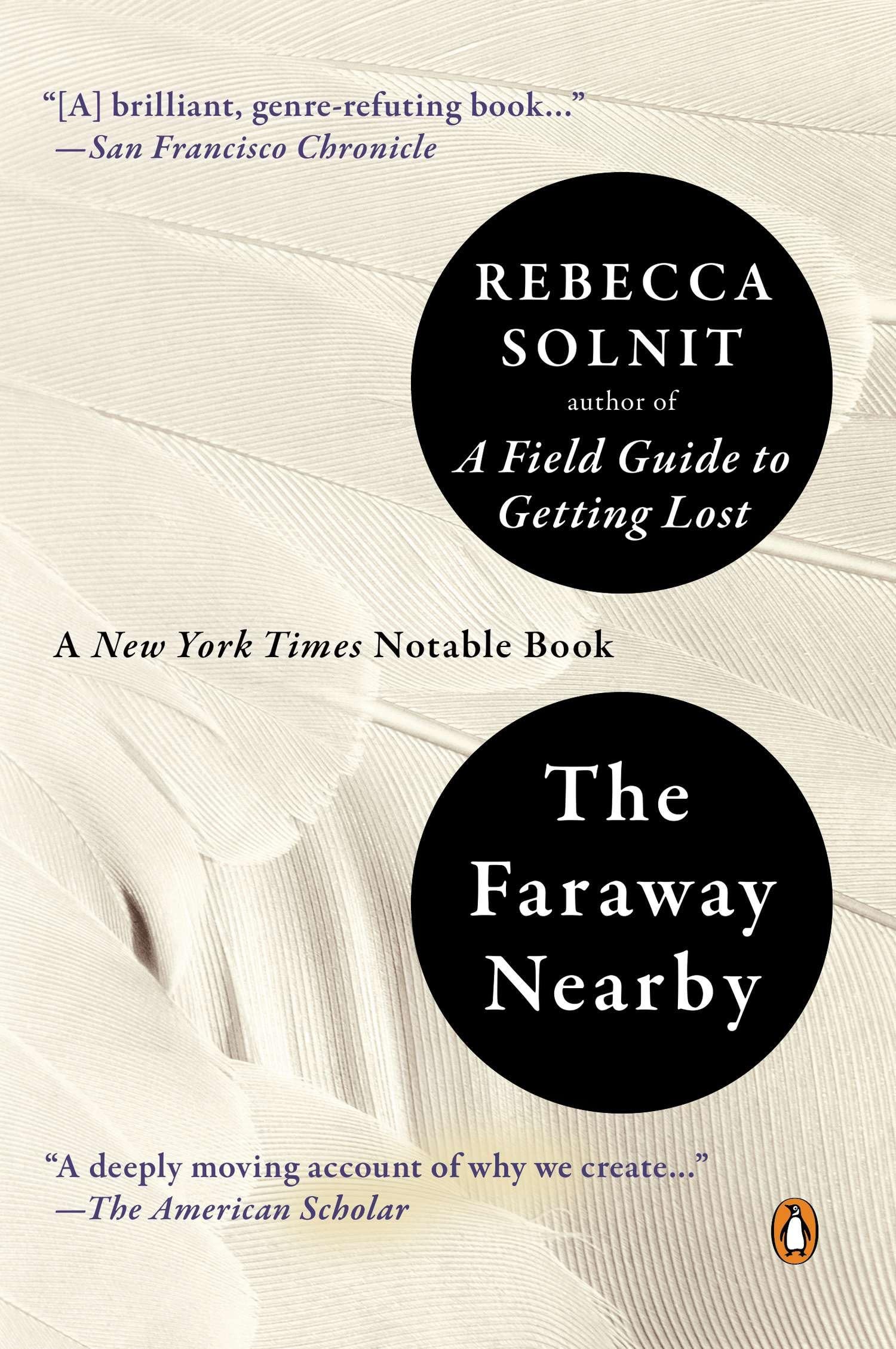



A New York Times Notable Book Finalist for the National Book Critics Circle Award A personal, lyrical narrative about storytelling and empathy, from the author of Orwell's Roses Apricots. Her mother's disintegrating memory. An invitation to Iceland. Illness. These are Rebecca Solnit's raw materials, but The Faraway Nearby goes beyond her own life, as she spirals out into the stories she heard and read—from fairy tales to Mary Shelley's Frankenstein —that helped her navigate her difficult passge. Solnit takes us into the lives of others—an arctic cannibal, the young Che Guevara among the leprosy afflicted, a blues musician, an Icelandic artist and her labyrinth—to understand warmth and coldness, kindness and imagination, decay and transformation, making art and making self. This captivating, exquisitely written exploration of the forces that connect us and the way we tell our stories is a tour de force of association, a marvelous Russian doll of a book that is a fitting companion to Solnit's much-loved A Field Guide to Getting Lost . Praise for The Faraway Nearby : "In her famously lyrical prose, Solnit writes about her own life, her family, and her reading, and she revisits the myths and ideas from art and history that have shaped her world." —The New Yorker "What Solnit offers us, I think, is the future of memoir. Not the story of the self . . . but the ways in which one's story opens into other stories . . . literary nonfiction doesn't get more beautiful and compelling." —The American Scholar "A beautiful and profound book of essayistic reflection on memory, family, grief, travel, and storytelling." —The Millions "The product of a remarkable mind at work, one able to weave a magnificent number of threads into a single story, demonstrating how all our stroies are interconnected." —Bookforum "[A] brilliant, genre-refuting book. The power of The Faraway Nearby , as in Solnit's previous writing, lies in its juxtaposition, its clusters of narrative nerves. . . . Solnit is a wanderer who collapses distance." —San Francisco Chronicle Writer, historian, and activist Rebecca Solnit is the author of seventeen books about environment, landscape, community, art, politics, hope, and feminism, including three atlases, of San Francisco in 2010, New Orleans in 2013, and New York in 2016; Men Explain Things to Me ; The Faraway Nearby ; A Field Guide to Getting Lost ; Wanderlust: A History of Walking ; and River of Shadows: Eadweard Muybridge and the Technological Wild West (for which she received a Guggenheim, The National Book Critics Circle Award in Criticism, and the Lannan Literary Award). She is a columnist at Harper's and a regular contributor to The Guardian . She lives in San Francisco. In Praise of Darkness (and Light) One summer some years ago, on a peninsula jutting off another peninsula off the west coast of Iceland, I lived among strangers and birds. The birds were mostly new species I got to know a little, the golden plovers plaintively dissembling in the grass to lead intruders away from their nests, the oystercatchers who flew overhead uttering unearthly oscillating cries, the coastal fulmars, skuas, and guillemots, and most particularly the arctic terns. The impeccable whiteness of their feathers, the sharpness of their scimitar wings, the fierceness of their cries, and the steepness of their dives were all enchanting. Terns were once called sea swallows for their deeply forked tails and grace in the air, and in Latin, arctic terns were named sterna paradisaea by a pietist Danish cleric named Erik Pontoppidan, at the end of a turbulent career. It’s not clear why in 1763 he called the black-capped, white-feathered arctic terns sterna paradisaea: birds -- or terns -- of paradise. He could not have known about their extraordinary migration, back in the day when naturalists -- and Pontoppidan himself in his book on Norway -- thought swallows buried themselves in the mud in winter and hibernated, rather than imagining they and other birds flew far south to other climes. Of all living things, arctic terns migrate farthest and live in the most light and least darkness. They fly tens of thousands of miles a year as they relocate from farthest north to farthest south. When they are not nesting, they rarely touch ground and live almost constantly in flight, like albatrosses, like their cousins the sooty terns who roam above the equatorial seas for years at a time without touching down. Theirs is a paradise of endless light and endless effort. The lives of angels must be like this. The far north is an unearthly earth, where much of what those of us in temperate zones were told is universal is not true. Everyone walks on water, which is a solid. In winter, you can build palaces out of it, or houses out of snow. Ice is blue. Snow insulates. Water crystallizes into floating mountains that destroy whatever collides with them. Many other things turn hard as rock in the cold. Not