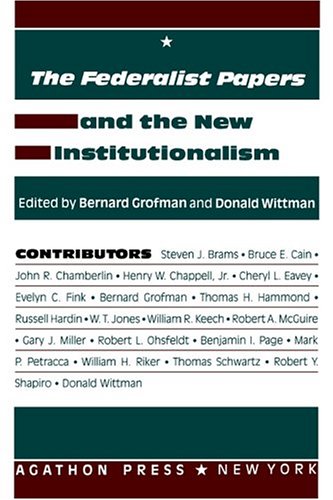
The Federalist Papers And The New Institutionalism (Representation)
$26.00
by Bernard Grofman



In The Federalist Papers and the New Institutionalism , the writers examine the intricate relationship between the foundational documents of American democracy and the contemporary theories that continue to shape our understanding of political representation. This book serves as an essential resource for scholars, students, and anyone interested in the evolution of political theory, particularly through the lens of the influential "Federalist Papers." The Madisonian Approach: The book examines the Madisonian approach to institutional design, providing insights into how the framers of the Constitution viewed representation and governance. Grofman highlights how James Madison and his contemporaries sought to create a balanced government that could effectively represent diverse interests while safeguarding against tyranny. Through a careful analysis of the Federalist Papers, readers are invited to consider how these principles still resonate today in modern political discourse. Bridging the Past and Present: Grofman's journey through the "Federalist Papers" is not merely academic; it is deeply personal. He recounts how teaching a course on representation compelled him to revisit these seminal texts with fresh eyes. This experience deepened his appreciation for Madison and the authors of the "Federalist Papers" but also led him to invite other leading scholars to contribute to this volume. Their essays collectively underscore the continuing relevance of the Federalist Papers in understanding contemporary institutional challenges. The Public Choice School: A significant focus of this work is the public choice school of thought, which Grofman argues embodies the true legacy of Madisonian political theory. He asserts that public choice theorists, with their emphasis on rational choice and individual incentives, have become the heirs of the principles articulated in the Federalist Papers. However, Grofman raises a critical point: essential aspects of Madisonian theory, such as deliberation, justice, and civic virtue, are often overlooked in public choice literature. This gap highlights the need for a more holistic approach to understanding institutions and governance. The Role of Institutions: One of the book's central themes is the importance of institutions in shaping political outcomes. Grofman contends that institutions matter—far from being mere structures, they embody the values and norms that guide political behavior. By exploring the Madisonian vision of governance, he invites readers to reflect on how contemporary institutions can either promote or hinder the public good. An Invitation to Revisit the Constitution: Grofman’s work is also a call to action for political theorists and scholars to rediscover the Constitution's relevance in modern times. He emphasizes the necessity of integrating insights from the Federalist Papers into contemporary discussions of governance and representation. The volume serves as a starting point for this vital conversation, encouraging readers to engage with the foundational ideas that underpin our democratic institutions. Conclusion: A Rich Dialogue: The Federalist Papers and the New Institutionalism is more than an academic text; it is a rich dialogue between past and present, theory and practice. Grofman's exploration of Madison's principles provides valuable lessons for today’s political landscape. This book will resonate with anyone looking to deepen their understanding of political representation, the role of institutions, and the ongoing impact of the Federalist Papers on American democracy. By weaving together historical analysis and contemporary theory, Grofman not only honors the legacy of the Founding Fathers but also challenges us to reflect on the values that guide our political lives today. Whether you are a seasoned scholar or a curious newcomer to the field, this work offers a thought-provoking perspective on the enduring complexities of political representation. The most ambitious attempt to date to reread The Federalist in the light of modern social science. --Publius, Summer, 1991 The editor of this volume, Bernard Grofman, is an authority on American politics, comparative election systems, and social choice theory. He has served as an expert witness or court-appointed consultant in state legislative and congressional lawsuits in 11 states. Grofman has been a Professor of Political Science at the University of California Irvine since 1980. He has been a fellow at the Center for Advanced Study in the Behavioral Sciences, Stanford, visiting professor at the University of Michigan and at the University of Washington, and guest scholar at the Brookings Institution, and at a number of universities outside the U.S. His past research has dealt with mathematical models of group decision making, legislative representation, electoral rules, and redistricting. He has also been involved in modeling individual and group information processing and decision heuristics,