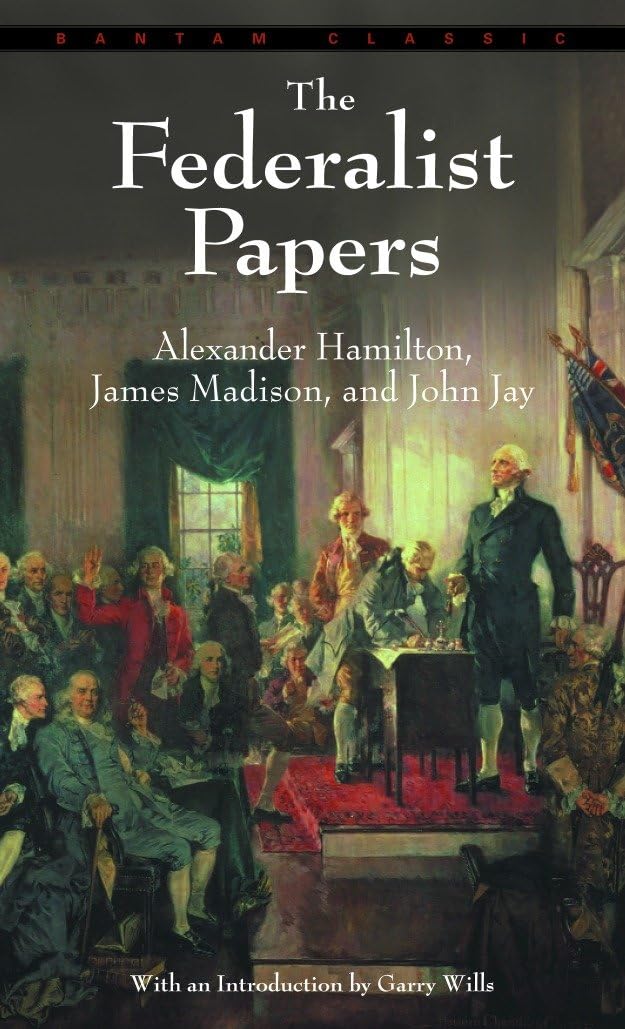



Originally published anonymously, The Federalist Papers first appeared in 1787 as a series of letters to New York newspapers exhorting voters to ratify the proposed Constitution of the United States. Still hotly debated, and open to often controversial interpretations, the arguments first presented here by three of America’s greatest patriots and political theorists were created during a critical moment in our nation’s history, providing readers with a running ideological commentary on the crucial issues facing democracy. Today The Federalist Papers are as important and vital a rallying cry for freedom as ever. This edition features the original eighteenth-century text, with James Madison’s fascinating marginal notations, as well as a complete text of the Constitution. "This country and this people seem to have been made for each other, and it appears as if it was the design of Providence, that an inheritance so proper and convenient for a band of brethren ... should never be split into a number of unsocial, jealous, and alien sovereignties." So wrote John Jay, one of the revolutionary authors of The Federalist Papers, arguing that if the United States was truly to be a single nation, its leaders would have to agree on universally binding rules of governance--in short, a constitution. In a brilliant set of essays, Jay and his colleagues Alexander Hamilton and James Madison explored in minute detail the implications of establishing a kind of rule that would engage as many citizens as possible and that would include a system of checks and balances. Their arguments proved successful in the end, and The Federalist Papers stand as key documents in the founding of the United States. Alexander Hamilton was born in the West Indies in 1757, the illegitimate child of a Scottish merchant. He came to the American colonies to study at King’s College (now Columbia University), and became an early and ardent supporter of the Revolutionary cause. During the Revolutionary War he was aide-de-camp to George Washington and a member of the Continental Congress. He was a leading figure at the Constitutional Convention (1787) and a principal author of The Federalist Papers . At first Secretary of the Treasury he articulated a policy of protection for manufacturing interests, strong central government, and establishment of a national bank. After leaving the Cabinet, he practiced law in New York. His personal attacks hindered the political career of the volatile Aaron Burr, who finally challenged him to a duel in 1804. Hamilton was shot, and died of his wounds. John Jay (1747-1829) was a conservative lawyer who became a leading patriot. He was a minister to Spain (1780-82), the first Chief Justice of the U.S. Supreme Court (1789-95), and he negotiated the treaty of 1795 between the U.S. and Britain. His contributions to The Federalist Papers concern foreign affairs. James Madison was born in 1751, the son of a Virginia planter. He worked for the Revolutionary cause as a member of the Continental Congress and the Virginia House of Delegates. The leader of deliberations at the Constitutional Convention, he fought for the adoption of the Constitution and the Bill of Rights. Through an ally of Hamilton on the Constitution he was a supporter of Jefferson’s agrarian policies. He was Jefferson’s Secretary of State (1801-9) and his successor as president (1809-17), but his presidency was marred by the unpopular War of 1812. Madison died in 1836 The Federalist No. 1: Hamilton October 27, 1787 To the People of the State of New York. After an unequivocal experience of the inefficacy of the subsisting Federal Government, you are called upon to deliberate on a new Constitution for the United States of America. The subject speaks its own importance; comprehending in its consequences, nothing less than the existence of the Union, the safety and welfare of the parts of which it is composed, the fate of an empire, in many respects, the most interesting in the world. It has been frequently remarked, that it seems to have been reserved to the people of this country, by their conduct and example, to decide the important question, whether societies of men are really capable or not, of establishing good government from reflection and choice, or whether they are forever destined to depend, for their political constitutions, on accident and force. If there be any truth in the remark, the crisis, at which we are arrived, may with propriety be regarded as the æra in which that decision is to be made; and a wrong election of the part we shall act, may, in this view, deserve to be considered as the general misfortune of mankind. This idea will add the inducements of philanthropy to those of patriotism to heighten the solicitude, which all considerate and good men must feel for the event. Happy will it be if our choice should be directed by a judicious estimate of our true interests, unperplexed and unbiassed by considerations not connected