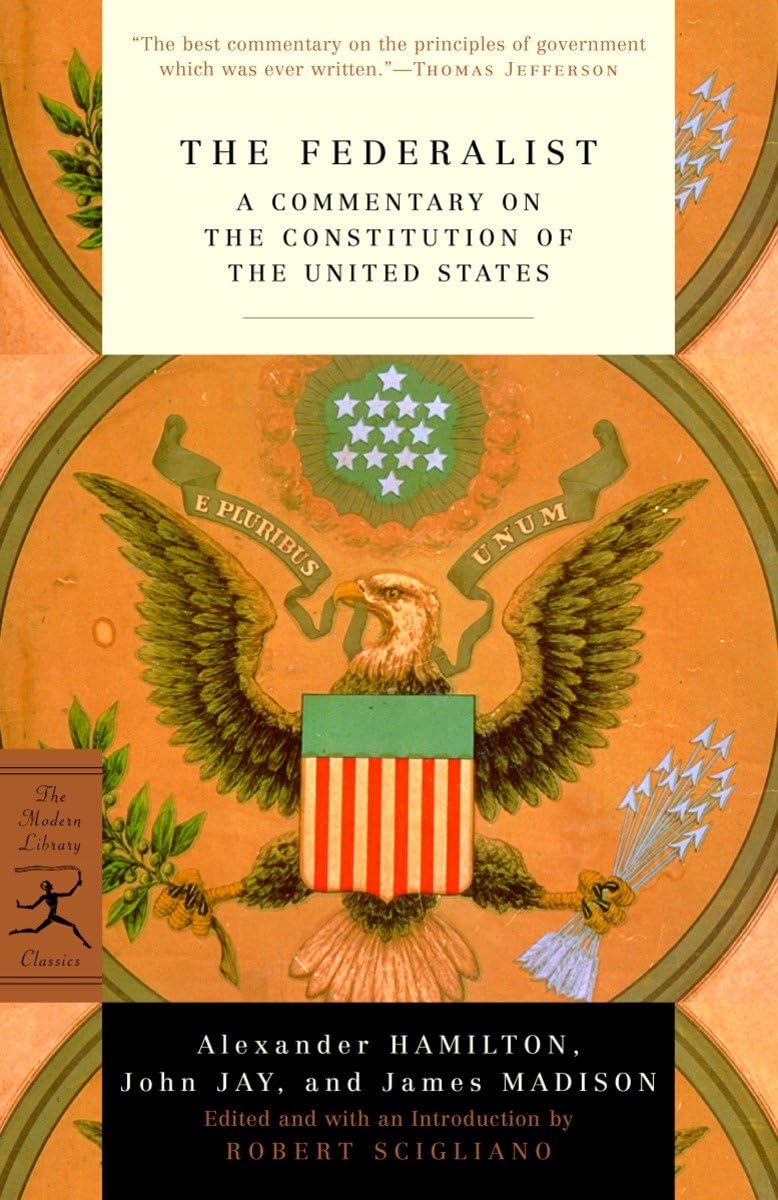
The Federalist: A Commentary on the Constitution of the United States (Modern Library Classics)
$13.74
by Alexander Hamilton



The series of essays that comprise The Federalist constitutes one of the key texts of the American Revolution and the democratic system created in the wake of independence. Written in 1787 and 1788 by Alexander Hamilton, James Madison, and John Jay to promote the ratification of the proposed Constitution, these papers stand as perhaps the most eloquent testimonial to democracy that exists. They describe the ideas behind the American system of government: the separation of powers; the organization of Congress; the respective positions of the executive, legislative, and judiciary; and much more. The Federalist remains essential reading for anyone interested in politics and government, and indeed for anyone seeking a foundational statement about democracy and America. This new edition of The Federalist is edited by Robert Scigliano, a professor in the political science department at Boston College. His substantive Introduction sheds clarifying new light on the historical context and meaning of The Federalist . Scigliano also provides a fresh and definitive analysis of the disputed authorship of several sections of this crucial work. "The best commentary on the principles of government which was ever written." --Thomas Jefferson The series of essays that comprise The Federalist constitutes one of the key texts of the American Revolution and the democratic system created in the wake of independence. Written in 1787 and 1788 by Alexander Hamilton, James Madison, and John Jay to promote the ratification of the proposed Constitution, these papers stand as perhaps the most eloquent testimonial to democracy that exists. They describe the ideas behind the American system of government: the separation of powers; the organization of Congress; the respective positions of the executive, legislative, and judiciary; and much more. The Federalist remains essential reading for anyone interested in politics and government, and indeed for anyone seeking a foundational statement about democracy and America. This new edition of The Federalist is edited by Robert Scigliano, a professor in the political science department at Boston College. His substantive Introduction sheds clarifying new light on the historical context and meaning of The Federalist . Scigliano also provides a fresh and definitive analysis of the disputed authorship of several sections of this crucial work. The series of essays that comprise The Federalist constitutes one of the key texts of the American Revolution and the democratic system created in the wake of independence. Written in 1787 and 1788 by Alexander Hamilton, James Madison, and John Jay to promote the ratification of the proposed Constitution, these papers stand as perhaps the most eloquent testimonial to democracy that exists. They describe the ideas behind the American system of government: the separation of powers; the organization of Congress; the respective positions of the executive, legislative, and judiciary; and much more. The Federalist remains essential reading for anyone interested in politics and government, and indeed for anyone seeking a foundational statement about democracy and America. This new edition of The Federalist is edited by Robert Scigliano, a professor in the political science department at Boston College. His substantive Introduction sheds clarifying new light on the historical context and meaning of The Federalist. Scigliano also provides a fresh and definitive analysis of the disputed authorship of several sections of this crucial work. Robert Scigliano is a professor in the political science department at Boston College and a leading authority on the Constitution. The Federalist No. 1 Hamilton October 27, 1787 To the People of the State of New York: After a full experience of the insufficiency of the existing federal government, you are invited to deliberate upon a new Constitution for the United States of America. The subject speaks its own importance; comprehending in its consequences nothing less than the existence of the UNION, the safety and welfare of the parts of which it is composed, the fate of an empire in many respects the most interesting in the world. It has been frequently remarked that it seems to have been reserved to the people of this country, to decide by their conduct and example, the important question, whether societies of men are really capable or not of establishing good government from reflection and choice, or whether they are forever destined to depend for their political constitutions on accident and force. If there be any truth in the remark, the crisis at which we are arrived may with propriety be regarded as the period when that decision is to be made; and a wrong election of the part we shall act may, in this view, deserve to be considered as the general misfortune of mankind. This idea by adding the inducements of philanthropy to those of patriotism, will heighten the solicitude which all considerate and good men must