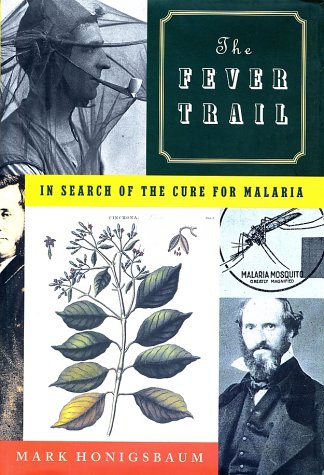



Part science, part riveting historical adventure about one of the great scourges to afflict mankind Every year malaria kills 1.5 to 2.7 million people -- more than half of those deaths are children -- and 300 to 500 million people fall ill with the disease. As of yet, there is no cure. Malaria is a deadly virus with a vicious ability to mutate; it has, over the centuries, changed the course of history as epidemics swept through countries and devastated armies. Until the middle of the seventeenth century, little was understood about the nature of the disease, or how to treat it. But there was a legend about a beautiful Spanish countess, the Condesa de Chinchón, who was cured of malaria during her stay in Peru by drinking a medicine made from the bark of a miraculous tree. This is the story of the search for the elusive cinchona tree - the only source of quinine - and the trio of British explorers who were given the task of transporting it to the colonies. On a quest that was to absorb the rest of their lives, Spruce, Ledger and Markham endeavored to rid the world of malaria. But although quinine, and its chemical successors, managed to control malaria for a time, no method of prevention has been proven to be 100% effective. In laboratories and research facilities, the hunt continues - this time for a vaccine. The Fever Trail is a story of courage, of geopolitical rivalry, of the New World against the Old, of the fabled curse of the cinchona tree - and of a disease that eludes all efforts to contain it. Few young Americans have felt malaria's debilitating chills and fever or realize that it is still one of the world's major killers. This first book by British journalist Honigsbaum follows the adventures of the 19th century English naturalists and their Indian guides, who braved Andean peaks and fever ridden jungles to obtain quinine, a malaria cure derived from the bark of the rare cinchona tree. As British and Dutch colonists pushed into the tropics, the need for quinine exploded, and over harvested South American trees could not meet international demand. Honigsbaum dramatically recounts the quest to break the Andean monopoly and transport cinchona cuttings and seeds to India and Indonesia. Although quinine and its synthesized substitues are now widely available, 1.5 to 2.7 million people, most of them African children, die from malaria each year. Quinine's side effects and emerging drug resistant parasites make the development of a malaria vaccine an urgent mission, and Honigsbaum concludes with a parallel story of determined scientists who explore this modern "fever trail." Both a gripping adventure tale and a sobering reminder of malaria's continuing impact, this book is recommended for both public and academic libraries. Kathy Arsenault, Univ. of South Florida Lib. at St. Petersburg. Copyright 2002 Reed Business Information, Inc. Guadalcanal, November 1942. Another night of war. Aboveground, the air buzzed with mosquitoes and enemy ordnance. In foxholes, weary men in boots, fatigues and steel helmets sifted restlessly, counting the hours until dawn. If a soldier on Guadalcanal wanted to stay in one piece, a hole in the ground was the safest place to spend the night. But nocturnal refuge had its price: disease-bearing Anopheles mosquitoes. For proof, one need only to have visited the hospital field tent. There, by flickering electric lanterns, medics tended delirious patients whose blood swarmed with the delicate rings, crescents and clusters we know as malaria. During World War II, nearly half a million American servicemen came down with malaria. Atabrine, a drug that stained skin yellow and could also trigger psychosis, was the main defense. Why was real quinine, still the world's leading cure for malaria in the 1940s, so precious in the Pacific theater? Because 80 years earlier, cinchona--the natural source of quinine--was abducted from its native habitat in the Andean cloud forest. By the 20th century, virtually all the world's cinchona bark came from the island of Java. And by 1942, Java lay in Japanese hands. How the elusive cinchona, renowned for "febrifugal" powers since the 1600s, journeyed from South America to Dutch plantations in Java is a major thread of The Fever Trail. Lovingly researched and written by Mark Honigsbaum, former chief reporter for the Observer in London, this book is an adventure story cum historical account of dreams and schemes to steal the valuable tree with the crimson-lined leaf. In its closing chapters, The Fever Trail fast-forwards to malaria today: the stalled race to create a vaccine, the politics of new drug development and distribution, and, most troubling of all, the continued toll of Plasmodium falciparum. Falciparum is the malarial strain that killed in World War II and still kills one million to two million of the world's poor every year, especially in Africa. But first the back story, starring three leading cinchona hunters of the 19th century.