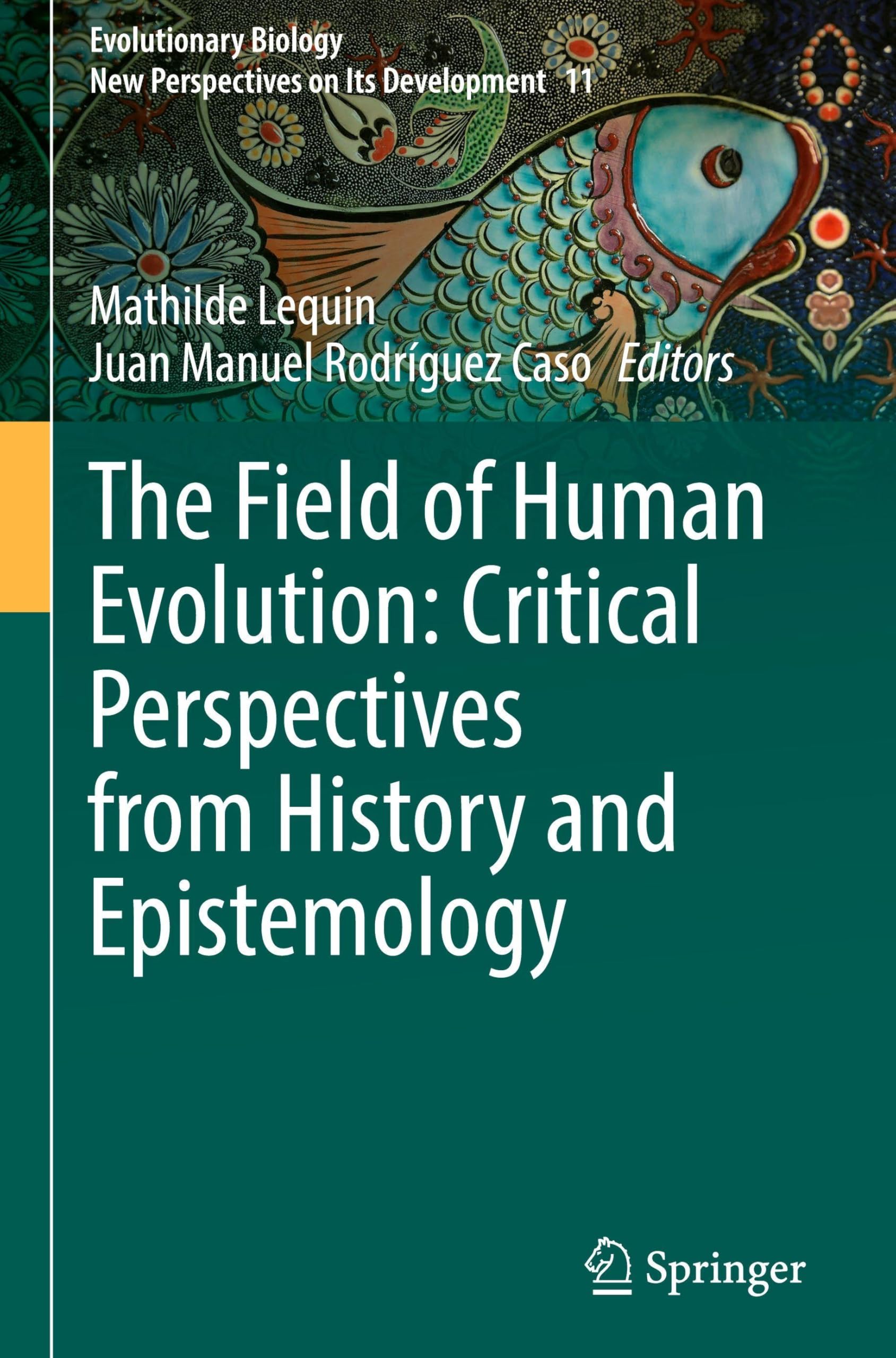
The Field of Human Evolution: Critical Perspectives from History and Epistemology (Evolutionary Biology – New Perspectives on Its Development, 11)
$219.99
by Mathilde Lequin



In recent years, the study of human evolution has made substantial advances—from major fossil and archaeological discoveries to breakthroughs in paleogenetics and analytical methods. Yet, does more data necessarily lead to better science? This volume challenges this assumption, arguing that advances in understanding human origins require critical reflection. Transforming scarce and incompete data into claims about the distant past demands also deeper insights into how such knowledge is constructed, validated, and questioned. Bringing together leading scholars from across disciplines, this volume examines the historical, philosophical, and epistemological foundations of human evolutionary research—from paleoanthropology and prehistoric archaeology to molecular anthropology and primatology. Rather than resolving long-standing debates, the authors illuminate the complexities behind them, encouraging a richer diversity of thought and method. Ideal for researchers, students, and readers in both the sciences and humanities, this book invites a deeper, more inclusive engagement with the human past. In recent years, the study of human evolution has made substantial advances—from major fossil and archaeological discoveries to breakthroughs in paleogenetics and analytical methods. Yet, does more data necessarily lead to better science? This volume challenges this assumption, arguing that advances in understanding human origins require critical reflection. Transforming scarce and incompete data into claims about the distant past demands also deeper insights into how such knowledge is constructed, validated, and questioned. Bringing together leading scholars from across disciplines, this volume examines the historical, philosophical, and epistemological foundations of human evolutionary research—from paleoanthropology and prehistoric archaeology to molecular anthropology and primatology. Rather than resolving long-standing debates, the authors illuminate the complexities behind them, encouraging a richer diversity of thought and method. Ideal for researchers, students, and readers in both the sciences and humanities, this book invites a deeper, more inclusive engagement with the human past. Mathilde Lequin holds a PhD in Philosophy of Science from the University of Paris Nanterre, France. She is currently a CNRS Junior Researcher at the University of Bordeaux, where she works within the PACEA laboratory alongside paleoanthropologists and archaeologists. Her research focuses on the epistemology of paleoanthropology, with particular attention to its intersections with the philosophy of biology and philosophical anthropology. Juan Manuel Rodriguez Caso obtained his PhD in History and Philosophy of Science (HPS) from the University of Leeds, UK. Previously, he studied Biological Sciences at the National Autonomous University of Mexico. He is currently Visiting Researcher at Universidad Autónoma Metropolitana (Xochimilco), and a part-time lecturer at the UNAM Faculty of Sciences. He is also a member of the National System of Researchers of Mexico. His primary areas of interest are the history of Darwinism, the dialogue between science and religion, and the development of Victorian anthropology.