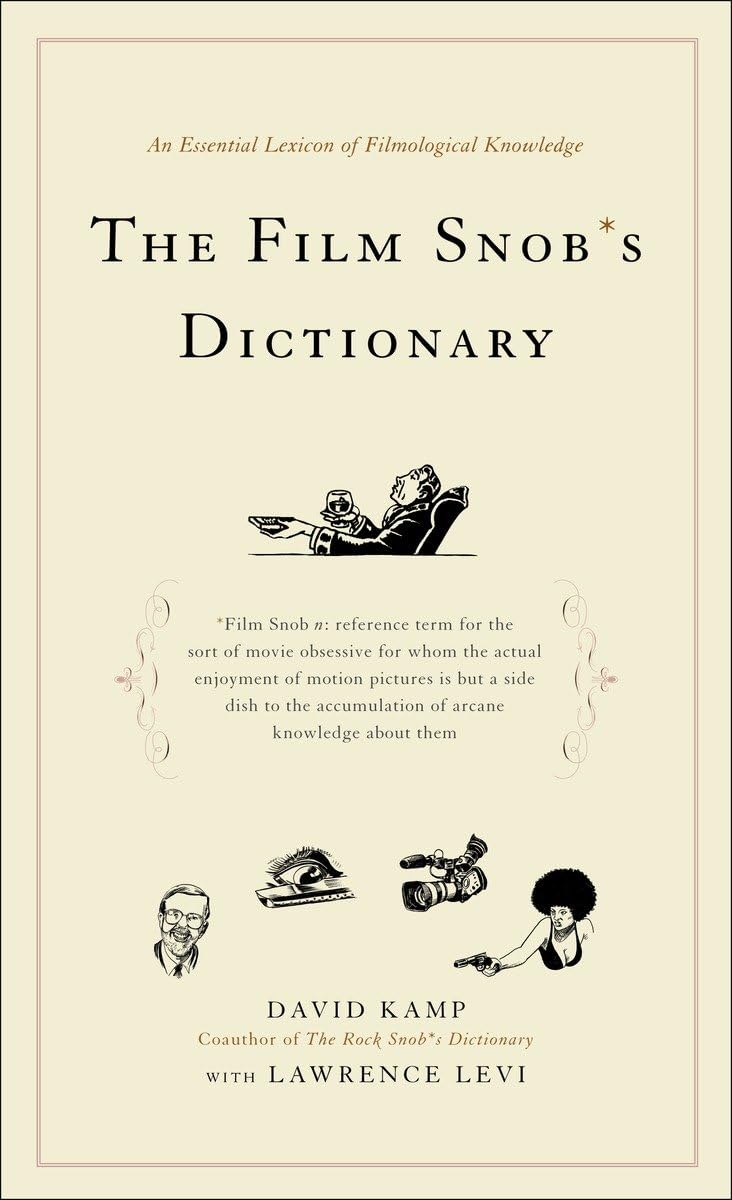
The Film Snob*s Dictionary: An Essential Lexicon of Filmological Knowledge
$11.34
by David Kamp



From the same brain trust that brought you The Rock Snob*s Dictionary , the hilarious, bestselling guide to insiderist rock arcana, comes The Film Snob*s Dictionary , an informative and subversively funny A-to-Z reference guide to all that is held sacred by Film Snobs, those perverse creatures of the repertory cinema. No longer must you suffer silently as some clerk in a “Tod Browning’s Freaks ” T-shirt bombards you with baffling allusions to “wire-fu” pictures, “Todd-AO process,” and “Sam Raimi.” By helping to close the knowledge gap between average moviegoers and incorrigible Snobs, the dictionary lets you in on hidden gems that film geeks have been hoarding (such as Douglas Sirk and Guy Maddin movies) while exposing the trash that Snobs inexplicably laud (e.g., most chop-socky films and Mexican wrestling pictures). Delightfully illustrated and handily organized in alphabetical order for quick reference, The Film Snob*s Dictionary is your fail-safe companion in the video store, the cineplex, or wherever insufferable Film Snobs congregate. “A witty, often devastatingly funny, ultra-sophisticated guide for the uninitiated, the would-be cinephile’s equivalent to decrypting the Rosetta Stone. Even I had no idea that Clint Howard was a cult figure.” —Bruce Goldstein, Repertory Program Director, Film Forum (New York) and founder, Rialto Pictures DAVID KAMP is a longtime writer for Vanity Fair , where short versions of The Film Snob*s Dictionary and the The Rock Snob*s Dictionary first appeared, and also contributes regularly to GQ . LAWRENCE LEVI has written about films and film culture for The New York Times , The Nation , and many other publications, and was a colleague of Kamp’s at Spy , the much-missed satirical magazine. Both Kamp and Levi live in New York. ROSS MacDONALD’s illustrations have graced many major periodicals, including The New Yorker and Rolling Stone. He lives in Connecticut. The Film Snob*s Dictionary A * symbol indicates a Snob Vanguard item, denoting a person or entity held in particular esteem by Film Snobs. Agee, James . Fast-living, Southern-born journalist-novelist-poet (1909-55) whose 1940s film criticism for Time and The Nation --posthumously compiled in the books Agee on Film and Agee on Film, Volume II --is better known to Snobs than his Depression-era masterwork, Let Us Now Praise Famous Men , or his Pulitzer-winning novel, A Death in the Family . Presciently recognizing movies as something more than disposable diversion for moony housewives, Agee was among the first writers to take the film beat seriously, glorying in the works of the silent-comedy masters at a time when they couldn't get arrested (and almost singlehandedly spearheading the resuscitation of HARRY LANGDON's reputation) and loosing zingers in print back when PAULINE KAEL was still vaguely girlish. (On Random Harvest : "I would like to recommend this film to those who can stay interested in Ronald Colman's amnesia for two hours and who could with pleasure eat a bowl of Yardley's shaving soap for breakfast.") Forming a mutual admiration society with John Huston, Agee collaborated with the director on the screenplay for The African Queen . Ai No Corrida . High-toned Japanese skin flick from 1976, featuring actual intercourse, that dragged pornography from the GRINDHOUSE to the art house. Putatively the story of a 1930s brothel servant's affair with the madam's husband, the film legitimized the Snob's furtive desire for smut by allowing him to watch coitus out in the open under the guise of taking in "a study of desire." In the United States, the film carried the repertory-cinema-friendly title In the Realm of the Senses , rather than the direct translation, Bullfight of Love . AIP . Commonly used shorthand for American International Pictures, a crank-'em-out production company, founded in 1954, that was among the first institutions to be exalted as a font of Important Kitsch; as far back as 1979, AIP was the subject of an adoring retrospective at the Museum of Modern Art. Unabashedly chasing the whims of fickle teens, AIP's mandate switched from Westerns (ROGER CORMAN's Apache Woman ) to teen horror ( I Was a Teenage Werewolf ) to Vincent Price's Poe movies ( House of Usher , The Pit and the Pendulum ) to the Annette-and-Frankie Beach Party movies--though, in later years, AIP's output skewed ever more exploitatively toward GRINDHOUSE fare (e.g., PAM GRIER in Black Mama, White Mama ). Kutcher exudes the bland hunkiness of a juvenile lead in an old AIP feature. Aldrich, Robert . Tough-guy director (1918-83) who, despite his machismo-infused CV ( Kiss Me Deadly , The Dirty Dozen , The Longest Yard ), enjoys unlikely godhead status among Camp Snobs for his two hyper-macabre Bette Davis horror-melodramas, What Ever Happened to Baby Jane? (1962) and Hush, Hush, Sweet Charlotte (1965), which begat a whole movement of using aging female studio-system refugees as clown-make