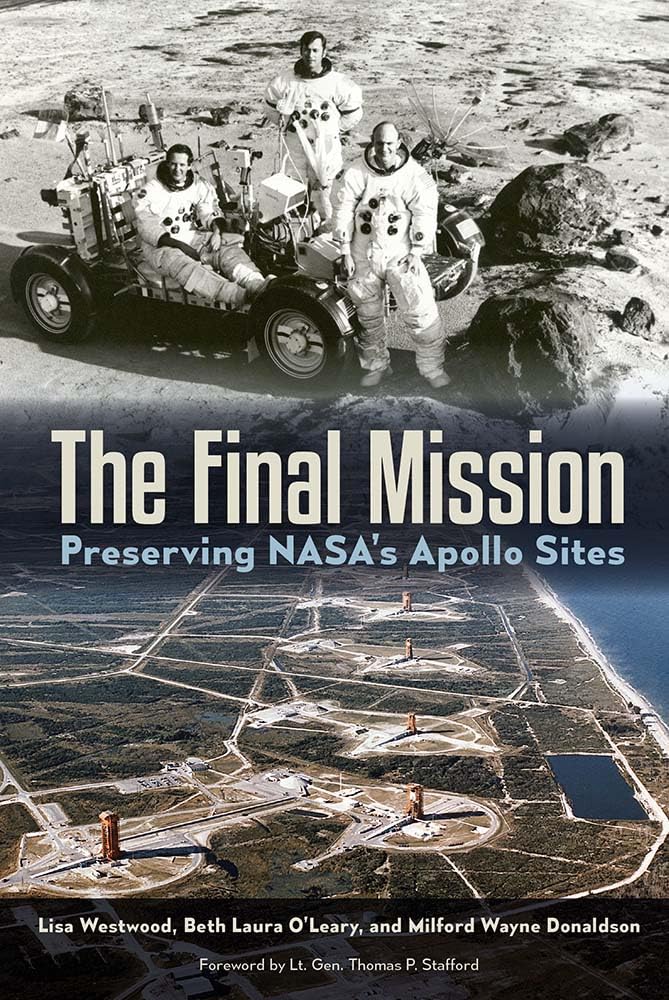



The world will always remember Neil Armstrong and Buzz Aldrin for their first steps on the moon, yet few today hold in respect the sites that made these and other astronauts' journeys possible. Across the American landscape and on the lunar surface, many facilities and landing sites linked to the Apollo program remain unprotected. Some have already crumbled to ruins--silent and abandoned. The Final Mission explores these key locations, reframes the footprints and items left on the moon as cultural resources, and calls for the urgent preservation of this space heritage. Beginning with the initiation of the space race, the authors trace the history of research, training, and manufacturing centers that contributed to lunar exploration. From the early rocket test stands of Robert H. Goddard, to astronaut instruction at Meteor Crater, to human and primate experiments at Holloman Air Force Base, innumerable places proved critical to developing the equipment for exploring space, surviving the journey, and returning to Earth safely. Despite their significance to the history of human spaceflight, many landmarks face the threat of damage or destruction. Most alarming is that the rapid advancement of technology renders stations obsolete long before they are deemed worthy of preservation. Moreover, the lack of precedence for protecting off-planet artifacts poses a unique challenge for space archaeology. While NASA's 2011 recommendations for spacefarers suggest avoiding close proximity to this cultural landscape, the authors advocate stronger routes of preservation and present models for safeguarding space history--both on Earth's surface and beyond. "A powerful case in favor of the need for the identification and preservation of the places that played a role in one of the greatest achievements in history."-- Space Times "Details how various sites in New Mexico, Texas, California, and Florida contributed to the successful Apollo missions."-- USA Today "A solid exploration of the issues at play in the preservation of historic sites associated with the Moon landings, by far the best such work available."-- Public Historian "Explain[s] the necessity of preserving these sites for future generations, and the ways in which the launch facilities, test sites, and even lunar sites can be properly tended."-- Publishers Weekly "By highlighting the Apollo program and the breadth of sites involved in developing America’s space capabilities up through the moon landings, the authors have demonstrated that the material culture of federal programs in particular should be evaluated within a far broader scope than is normally practiced."-- H-Net Reviews "Explore[s] the archaeological perspective of preserving sites related to the Project Apollo and moon missions. . . . thoroughly covers the details of the lunar missions and describes how many key landmarks, such as launch pads and other facilities, may no longer exist because of damage and neglect."-- Choice "An excellent overview of artifacts and sites in both terrestrial and extra-terrestrial environments."--P. J. Capelotti, author of The Human Archaeology of Space "Artfully blends archaeology and historic preservation into a history of the Cold War space race. A compelling argument for preserving America's twentieth-century space heritage."--Todd A. Hanson, author of The Archaeology of the Cold War Lisa Westwood is director of cultural resources at ECORP Consulting, Inc., and a professional archaeologist. Beth Laura O’Leary , professor emerita of anthropology at New Mexico State University, is coeditor of Handbook of Space Engineering, Archaeology, and Heritage . Milford Wayne Donaldson is president of the firm Architect Milford Wayne Donaldson, FAIA. He is chairman of the national Advisory Council on Historic Preservation and the former state historic preservation officer for the state of California. Introduction Human Culture and Space Heritage In the most fundamental terms, space heritage is a reflection of past human culture. In 1871, British anthropologist Edward B. Tylor first used the term culture to embrace “the complex whole, which includes knowledge, belief, art, morals, law, customs, and any other capabilities and habits acquired by [humans] as a member of society” (Tylor 1871: 1). Many other definitions of culture have been advanced over the decades since then, but they all generally speak to the concept of “the complex whole.” This idea evolved into a recognition by the field of anthropology that the study of human culture requires a holistic approach―one that takes into account human behavior from multiple perspectives. The concept of holism recognizes that human societies are best studied as the systematic sums of their parts; human culture is composed of various aspects of sociology, psychology, linguistics, biology, archaeology, history, political science, and religion. In other words, human culture is a multifaceted coagulation of ideas, worldview