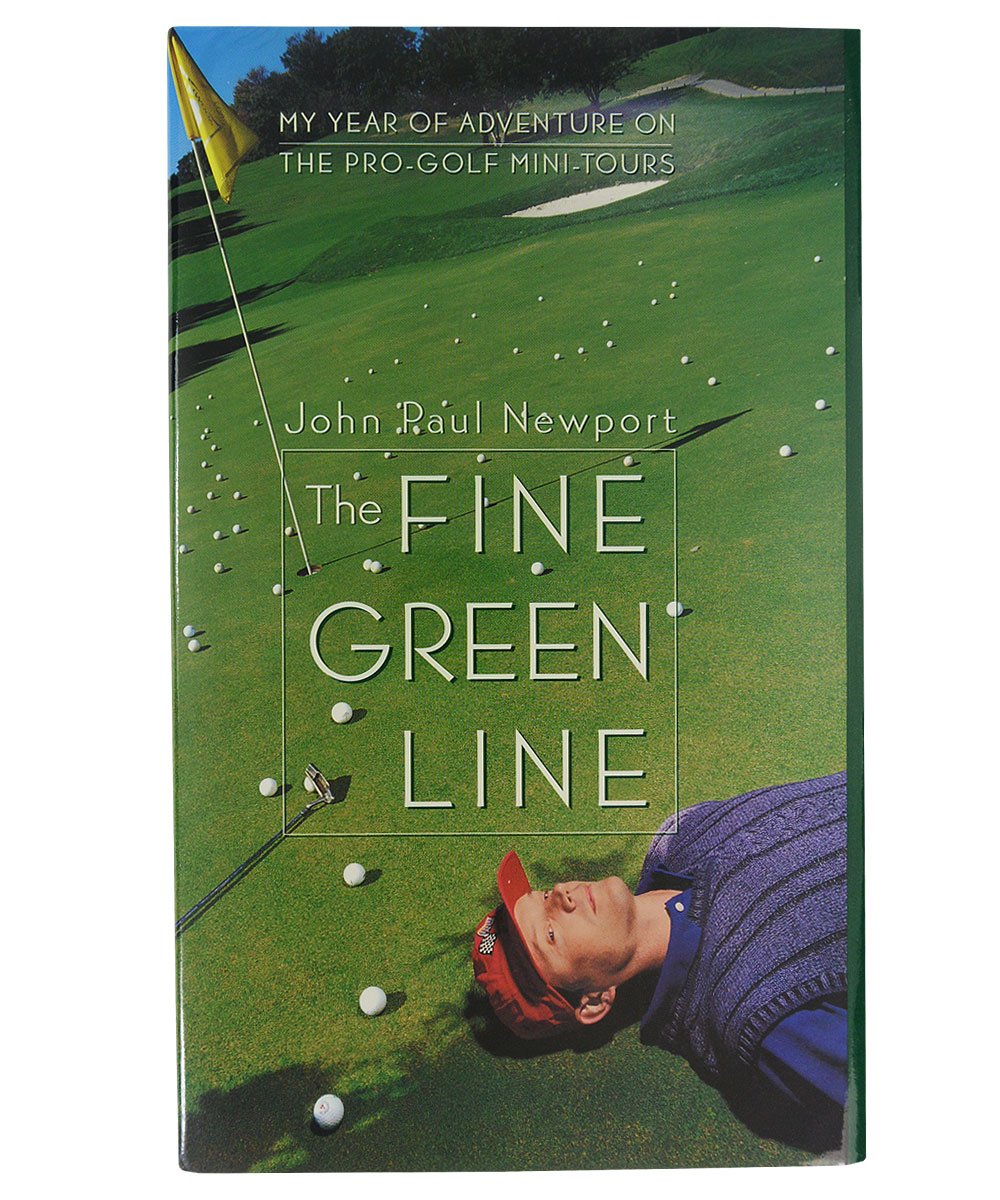
The Fine Green Line: My Year of Adventure on the Pro-Golf Mini-Tours
$19.81
by John Newport



What happens when a man obsessed with golf leaves home for a year to pursue his dream? This is the story of that journey. One day when John Paul Newport was in his mid-thirties, he attended a corporate outing at a golf course. He had hacked around on the fairways for a couple of summers as a kid, but had always found other sports, especially football, more compelling. Golf was a game he had played only a handful of times in the past twenty years. But that day on the course he more or less accidentally nailed a drive more than 300 yards. The feeling he had as he watched the ball soar was incredible—grace, power, and purity combined. Much to his surprise, he was hooked. Within a month he had bought a set of clubs—the first he'd ever owned—and discovered he had a knack for the game. With practice, his scores improved steadily, until one day two years later, he miraculously shot a three-under-par 69. This amazing experience triggered all sorts of questions in his mind: How was such a round possible? Having shot 69 once, what prevented him from shooting 69 every time? In golf, as elsewhere in life, why is one so consistently incapable of fulfilling one's clearly established potential? Projecting into the world of professional golf, he wondered what was it that allowed some pros to stay at the top of the PGA Tour golf rankings year after year while others with seemingly just as much talent got stuck in the bush leagues? In pursuit of some answers, John Paul Newport spent a year playing in the bush leagues himself, the dark, comic underbelly of professional golf. This is a world in which even highly talented players sometimes live out of their cars, sneak food from country clubs, and gamble away their meager earnings in an attempt to stay afloat. But it is also the world many top pros—including John Daly, Paul Azinger, and Tom Lehman—first had to conquer before becoming the stars they did. Newport's year culminated in a bold, some might say ill-advised effort to make it through the PGA Tour's infamous Q School. Traveling and competing throughout Florida, the Northeast, the Dakotas, and California, refining his game and consulting numerous "head coaches" and psychologists, Newport realized his number one goal was to solve the mystery of what he calls the Fine Green Line—that infinitely subtle yet critical difference that separates golf's top players from their nearest pursuers, but that also applies to golfers all up and down the ability spectrum. He also struggled to find meaning in the game that had become his obsession. As he questioned the people he encountered—from Eastern consciousness guru Michael Murphy to successful young Tour players like Kevin Sutherland—about practicing better golf, Newport realized that the answers he was given were also about practicing better life. A compelling personal journey that captures many of the fears, frustrations, and elations of midlife, both on and off the course, The Fine Green Line is also a rich, honest, rollicking narrative set in a golf world few people know. It will appeal to anyone either afflicted or confounded by golf's mysterious tug. Some stories regularly refresh themselves. The Walter Mittyesque tale of the dreamer chasing the dream is one of them. In The Fine Green Line , John Paul Newport's dream is a golf dream, and he relates it with good grace and humor, quite willing to analyze its inherent improbability and interpret the mysteries at its core. In his mid-30s, recently remarried, a new father, and playing to a handicap of less than 3, he sets out to focus on his game for a year, take his lumps on the minor-league tours, see how much he can improve, and finally test how he and his game stand up by trying to qualify for the PGA Tour via the murderous Q School tournament in the fall. Like all worthwhile journeys, the destination is of less consequence than the trip itself. Newport's is a long and strange one, filled with small successes, big humiliations, reality checks, the kindness of strangers, and a colorful cast of wannabes on the golfing fringe, guys who live from week to week out of the back of their cars. Ultimately, Newport must come to terms with his own obsession with the game as he tries to figure out exactly where the fine green line of his title falls. He searches on and off the course for this abstract and invisible--and, he finally accepts, insurmountable--barrier that keeps the game's aristocracy on one side and those who can post the occasional 69 on the other. It's a search that takes him within himself and to anyone--such as Golf in the Kingdom 's Michael Murphy , respected teaching pro Michael Hebron , swing doctors, and psychologists--who might be able to shed enlightenment, improve his swing, or focus his mind with laserlike intensity. It also sets off on some pretty memorable rounds of golf and the kind of grip-it-and-rip-it soul-searching that every hacker who's ever hit a ball with purpose--and shanked it anyway--i