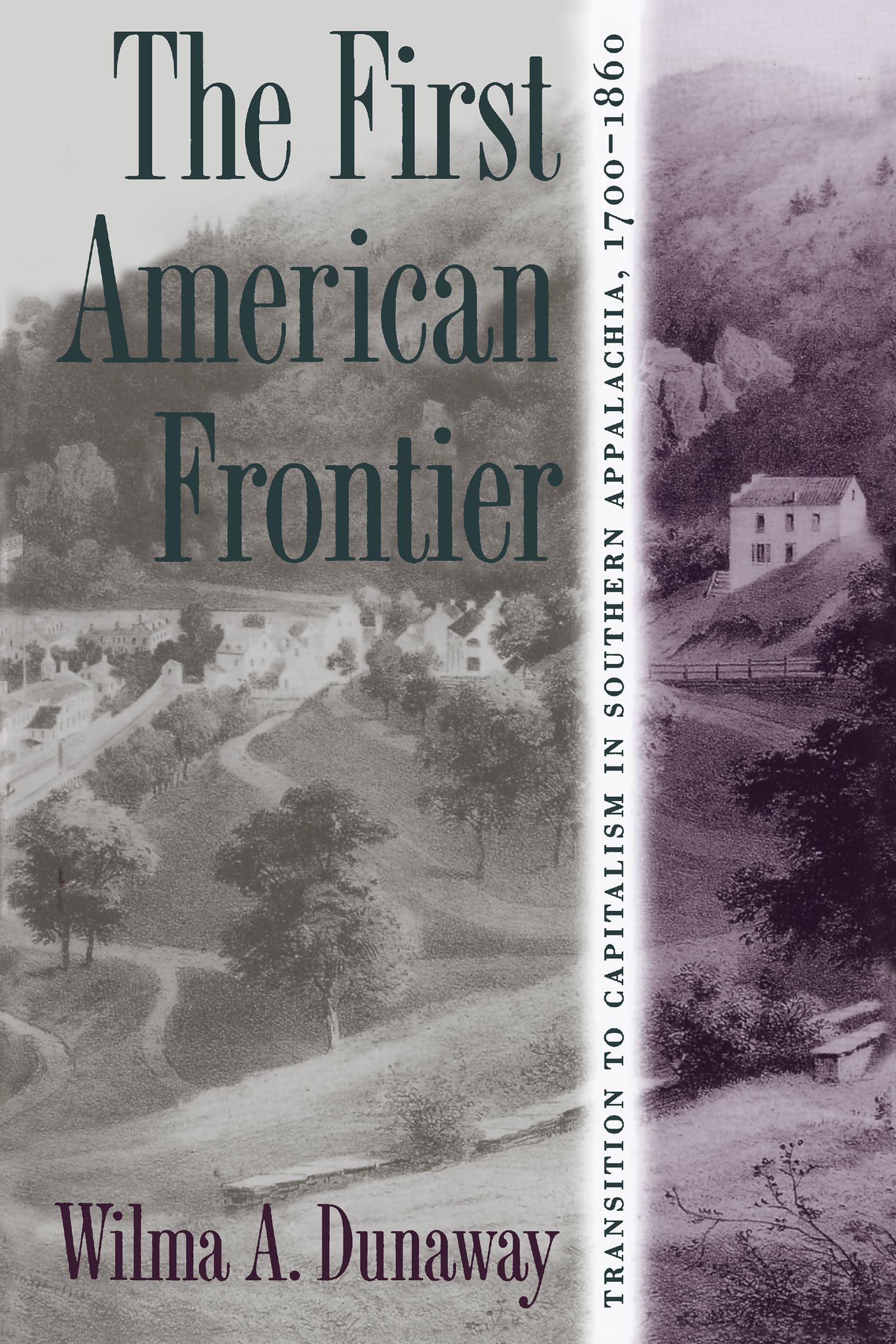
The First American Frontier: Transition to Capitalism in Southern Appalachia, 1700-1860 (The Fred W. Morrison Series in Southern Studies)
$55.00
by Wilma A. Dunaway



In The First American Frontier , Wilma Dunaway challenges many assumptions about the development of preindustrial Southern Appalachia’s society and economy. Drawing on data from 215 counties in nine states from 1700 to 1860, she argues that capitalist exchange and production came to the region much earlier than has been previously thought. Her innovative book is the first regional history of antebellum Southern Appalachia and the first study to apply world-systems theory to the development of the American frontier. Dunaway demonstrates that Europeans established significant trade relations with Native Americans in the southern mountains and thereby incorporated the region into the world economy as early as the seventeenth century. In addition to the much-studied fur trade, she explores various other forces of change, including government policy, absentee speculation in the region’s natural resources, the emergence of towns, and the influence of local elites. Contrary to the myth of a homogeneous society composed mainly of subsistence homesteaders, Dunaway finds that many Appalachian landowners generated market surpluses by exploiting a large landless labor force, including slaves. In delineating these complexities of economy and labor in the region, Dunaway provides a perceptive critique of Appalachian exceptionalism and development. “No Appalachian stereotype seems immune from Dunaway’s research agenda. . . . This book will serve as a treasury of sources and research questions for many, many years.” — West Virginia History “Excepting the West, no United States region is currently undergoing a more heated reinterpretation than southern Appalachia. This book will add fuel to the fire. Wilma A. Dunaway’s revisionism is the brashest so far, but her documentation is the best.” — Journal of American History “The most provocative and ambitious examination of the region prior to the Civil War yet published. The author challenges virtually every stereotype produced on early Appalachia through the prism of world-systems theory, sophisticated methodological techniques, and prodigious data gathering. One has to admire the sweep of her scholarship and the power of her arguments.” — Georgia Historical Quarterly “Essential reading for anyone in the field and offers to others an instructive account of regional economic development.” — American Historical Review “[Dunaway] has provided us with an interpretive framework that challenges many of the old assumptions about the mountain region before 1860. . . . This is a remarkable accomplishment that will only be truly appreciated in the years to come by scholars who wrestle with the questions she raises.” — Gordon McKinney, Appalachian Journal “This work will undoubtedly set the standard for the future studies of the region and should be consulted by any serious student of antebellum Southern Appalachian affairs.” — Tennessee Historical Quarterly “ The First American Frontier is concerned with extremely interesting and controversial questions regarding the social and economic changes in Appalachia from the colonial era to the Civil War. Based upon extensive use of primary data, the debate on the transition to capitalism is analyzed in great detail, both theoretically and empirically, with a fine sense of the broader implications of the regional study.” — Stanley L. Engerman, University of Rochester “Not only the first systematic and region-wide social history of antebellum Appalachia, Wilma Dunaway’s The First American Frontier is also a probing examination of the growth of an American peripheral region in the context of world-wide capitalist development and a superb exemplification of the value of comparative and historical sociology. Readers of this book will never think of Appalachian history and society in the same old stereotypical ways again.” — Dwight B. Billings, University of Kentucky “Not only the first systematic and region-wide social history of antebellum Appalachia, Wilma Dunaway’s The First American Frontier is also a probing examination of the growth of an American peripheral region in the context of world-wide capitalist development and a superb exemplification of the value of comparative and historical sociology. Readers of this book will never think of Appalachian history and society in the same old stereotypical ways again.” — Dwight B. Billings, University of Kentucky Wilma A. Dunaway is assistant professor of sociology at Colorado State University.