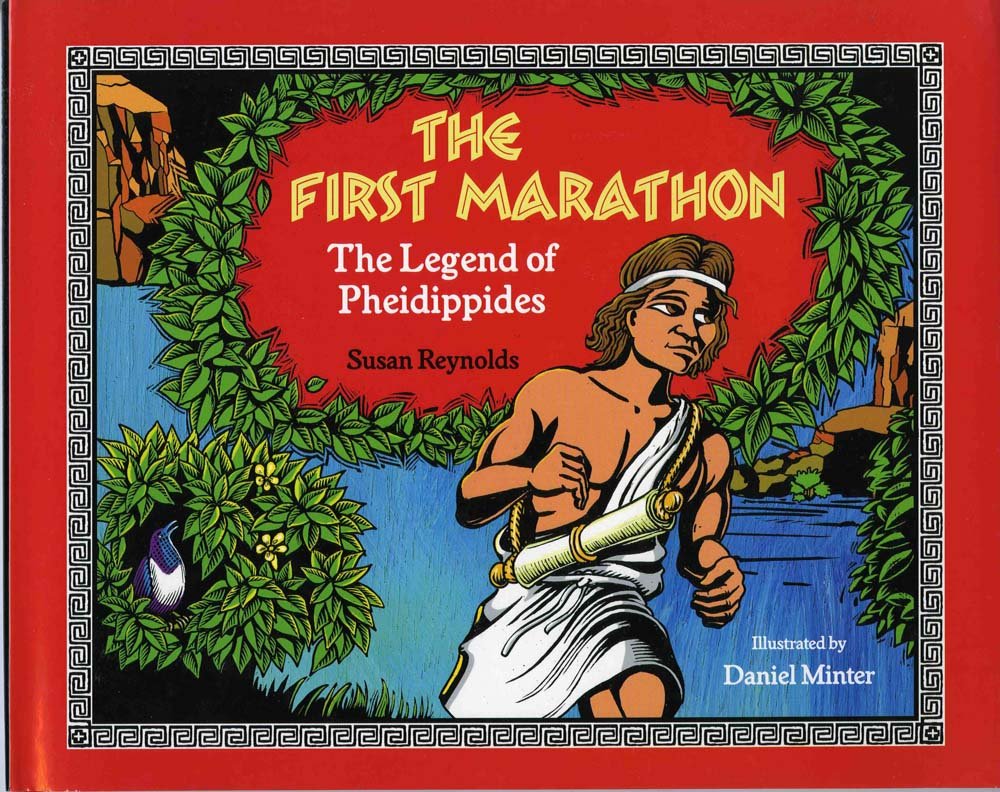



Twenty-five hundred years ago Greek soldiers faced the Persian army on the plain of Marathon. Pheidippides ran to neighboring Sparta, 140 miles away, to ask for the Spartans' aid. Afterwards he sped back to the battle, where he helped defeat the enemy. Grade 3-5–Twenty-five hundred years ago, a small band of Greeks faced the huge Persian army. Given the horrendous odds, help was a necessity, so a young runner named Pheidippides ran 140 miles to Sparta to request aid, and then ran back to report that the Spartans were on their way, albeit in their own good time. The boy stayed to help the Athenians defeat the Persians, and then ran to Athens to relate the news of the victory. Completely spent by his superhuman efforts, he collapsed and died–but he left a legacy in the 26-mile race named after the battle he reported on. This rather heavily fictionalized picture-book recounting presents an engaging young hero in readable, if slightly gee whiz prose. The facts of the story, as they are known, are set out clearly within the context of a tale, and the book would read aloud quite well. Minters illustrations are reminiscent of Ashley Wolffs work, with the strong black outlines and blocks of solid color. The map of Greece and the Persian Empire on the endpapers is most helpful in laying a framework for the story. An afterword includes detailed information on the historical sources the author used to inform her story. A sound addition for most collections. –Ann Welton, Grant Elementary School, Tacoma, WA Copyright © Reed Business Information, a division of Reed Elsevier Inc. All rights reserved. Gr. 2-4. Reynolds goes back 2,500 years to tell the exciting story of how the Greeks fought off the mighty Persian army on the plains of Marathon, and how the young long-distance runner Pheidippides ran 140 miles in 36 hours to Sparta to ask for help, then ran back without stopping, fought in the battle, ran to tell Athens of the victory, and died. Now marathons are named for his heroic run. The dramatic, full-color, double-page illustrations, with heavy black accents, show the strong, rhythmic movement of the brave young athlete, the battle scenes, and then runners across the world today. Reynolds is sometimes too exclamatory, but her opening sentence, about a time "long before there were telephones, cars or computers," makes clear the crucial role of the ancient messenger. A long, fascinating afterword for older readers offers information about the research, the line between legend and history, and the struggle of women to participate in marathons. Hazel Rochman Copyright © American Library Association. All rights reserved "A sound addition for most collections." School Library Journal Twenty-five hundred years ago Greek soldiers faced the Persian army on the plain of Marathon. Pheidippides ran to neighboring Sparta, 140 miles away, to ask for the Spartans' aid. Afterwards he sped back to the battle, where he helped defeat the enemy. The First Marathon The Legend of Pheidippides By Susan Reynolds, Daniel Minter ALBERT WHITMAN & Company Copyright © 2006 Susan Reynolds All rights reserved. ISBN: 978-0-8075-0867-1 CHAPTER 1 Before there were telephones, cars, or computers, there was a boy named Pheidippides (Fi-DIP-un-deez). He lived twenty- five hundred years ago in Athens, the biggest of the Greek Cities both then and now. Pheidippides loved to run from the time he was young. The merchants in the marketplace would hear his mother fuss at him while she shopped. "Son, slow down! You're getting too far ahead!" But Pheidippides would just laugh and race in circles so that he could stay close to his mother but still get to run. The country of Greece is rocky and full of hills and mountains. Pheidippides grew up running those hills, and they made his legs strong and his feet sure. All Greek boys were encouraged to be athletes, and they spent hours running and jumping and wrestling. Pheidippides was fast and won many races. But even more than running fast, Pheidippides loved to run for miles and miles. He would run for hours and still feel like he could run forever. When his parents asked him why he ran so far, he would say in a most serious way, "Who knows, someday I might have to run clear across Greece!" It was common then for each of the major cities to have its own army, and Pheidippides, as was expected of young men, joined the Athenian army. He was a soldier but often ran as a herald, delivering messages for the generals. (Runners were used instead of riders on horseback when the route was too rocky for horses to traverse.) Armies then didn't have tanks or trucks or any other way of getting their soldiers around. So the soldiers marched. They often marched and marched for days. Sadly, there were lots of wars, and so the soldiers did a lot of marching. They were lean and strong from all that marching. Persia was a mighty empire to the east of Greece. Many Athenians had moved to Persian settlements, and w