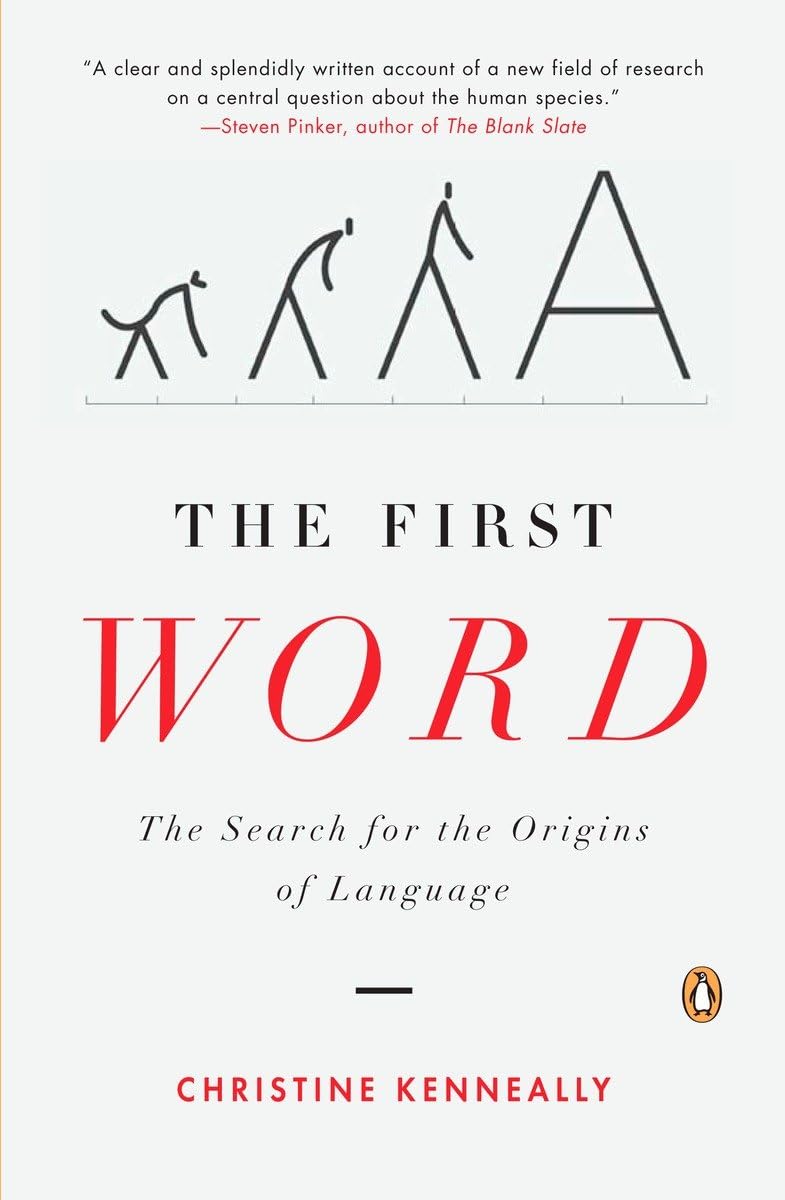



An accessible exploration of a burgeoning new field: the incredible evolution of language The first popular book to recount the exciting, very recent developments in tracing the origins of language, The First Word is at the forefront of a controversial, compelling new field. Acclaimed science writer Christine Kenneally explains how a relatively small group of scientists that include Noam Chomsky and Steven Pinker assembled the astounding narrative of how the fundamental process of evolution produced a linguistic ape-in other words, us. Infused with the wonder of discovery, this vital and engrossing book offers us all a better understanding of the story of humankind. ? A clear and splendidly written account of a new field of research on a central question about the human species.? ?Steven Pinker, author of "The Blank Slate" ? A crash course on imitation, gesture, abstract thought, and speech. . . . It is eminently worthy of attention.? ?"Psychology Today" ? Scientists who study the origins of language are a passionate, fractious bunch, and you don?t have to be an egghead to be tantalized by the questions that drive their research: how and when did we learn to speak, and to what extent is language a uniquely human attribute? What [Kenneally] describes is fascinating.? ?"The New York Times Book Review" A clear and splendidly written account of a new field of research on a central question about the human species. Steven Pinker, author of "The Blank Slate" A crash course on imitation, gesture, abstract thought, and speech. . . . It is eminently worthy of attention. "Psychology Today" Scientists who study the origins of language are a passionate, fractious bunch, and you don t have to be an egghead to be tantalized by the questions that drive their research: how and when did we learn to speak, and to what extent is language a uniquely human attribute? What [Kenneally] describes is fascinating. "The New York Times Book Review" a A clear and splendidly written account of a new field of research on a central question about the human species.a aSteven Pinker, author of "The Blank Slate" a A crash course on imitation, gesture, abstract thought, and speech. . . . It is eminently worthy of attention.a a"Psychology Today" a Scientists who study the origins of language are a passionate, fractious bunch, and you donat have to be an egghead to be tantalized by the questions that drive their research: how and when did we learn to speak, and to what extent is language a uniquely human attribute? What [Kenneally] describes is fascinating.a a"The New York Times Book Review" It never hurts to begin with a genius, so the author opens by declaring, "the story of language evolution studies is unavoidably the story of the intellectual reign of Noam Chomsky." Before Chomsky, linguists searched for new languages, wrote down vocabulary and grammar and compared them to other languages. They never addressed questions about the origin of language because conventional wisdom declared such questions could not be answered. Sixty years ago, Chomsky pointed out that infants learn to talk merely by interacting with those around them for a few years. Since conversation contains too little information to provide rules for this incredibly complex skill, humans must be born with the unique ability to learn to speak. This assertion galvanized a generation of researchers who turned their attention to the roots of language. Since Chomsky asserted that language is a uniquely human phenomenon, he doubted evolution played a role in its origin. So great was his influence that scientists have only recently overcome their inhibitions and turned up fascinating evidence to the contrary. Readers will blink as the author describes studies demonstrating that animals use language and can be taught more. Early, highly publicized experiments with apes gave the field a bad reputation because the animals seemed to be responding to trainers' cues, but careful studies make it clear that many animals can employ syntax and vocabulary at the level of a three-year-old human. Despite our vastly superior language abilities, researchers have yet to find any speech areas in the human brain that are not present elsewhere in the animal kingdom. Kenneally's book features a steady stream of brilliant, opinionated people expressing ideas that often contradict those of other brilliant people, but she channels this flood of frequently technical arguments into a comprehensible and stimulating narrative. Lively portrait of a fascinating new scientific field. "Kirkus" All branches of science search for origins. Biologists want to know how life on earth began. Astronomers want to know how the universe got started. Even in mathematics, questions about how different numerical systems came to be constitute a legitimate line of inquiry. Linguists are different. In the middle of the 19th century, the main professional bodies governing linguistic resea