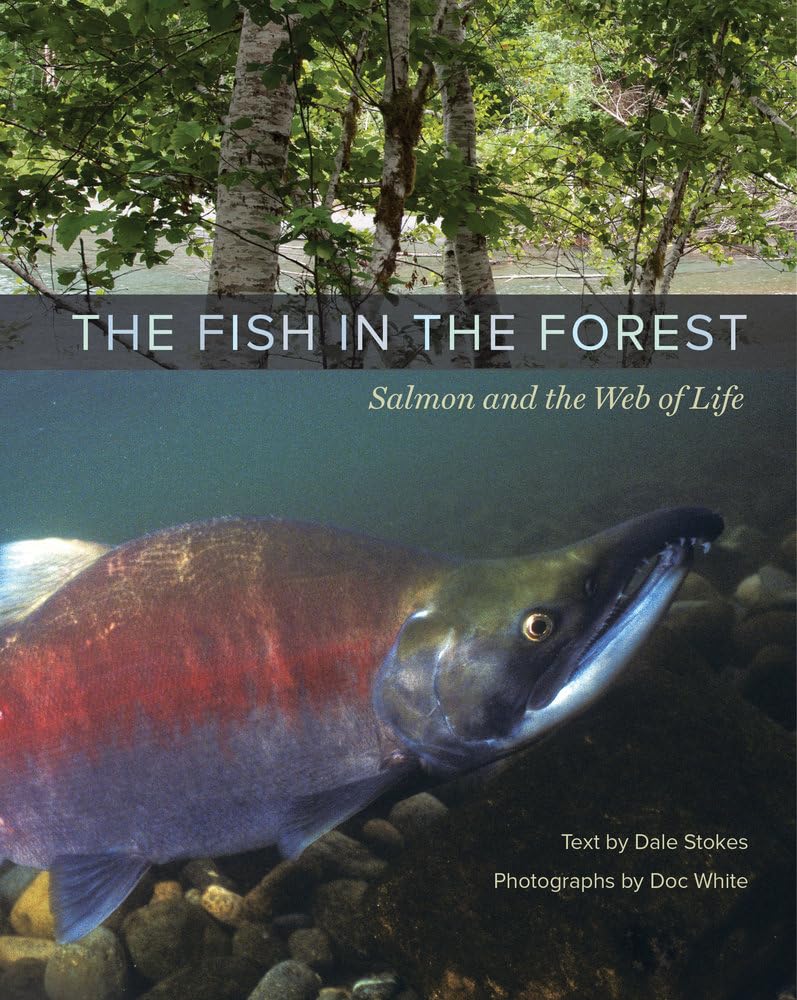



The Fish in the Forest is an elegantly written, beautifully illustrated exploration of the complex web of relationships between the salmon of the Pacific Northwest and the surrounding ecosystem. Dale Stokes shows how nearly all aspects of this fragile ecosystem―from streambeds to treetops, from sea urchins to orcas to bears, from rain forests to kelp forests―are intimately linked with the biology of the Pacific salmon. Illustrated with 70 stunning color photographs by Doc White, The Fish in the Forest demonstrates how the cycling of nutrients between the ocean and the land, mediated by the life and death of the salmon, is not only key to understanding the landscape of the north Pacific coast, but is also a powerful metaphor for all of life on earth. The health and vitality of the Pacific Northwest forest ecosystem depends on the vigor of seven species of salmon, according to Scripps Institute oceanographer Stokes. Opportunistic bears, wolves, and eagles are not the only beneficiaries from the annual salmon runs, during which the fish swim upstream to spawn and die. The region’s forest and all of its residents are enriched by the tremendous load of nutrients and minerals that the salmon bring up from the ocean to the land when they return. Noting that insects, wildflowers, and trees are more plentiful near healthy salmon streams than along streams whose fisheries have been depleted by environmental disturbances or industrial fishing, the author seeks readers’ support in protecting the salmon, which are revered by the region’s Native tribes. Aimed at the general public, this natural-history and environmental essay is a fairly quick read and a good addition to science collections at public libraries. --Rick Roche "Clearly explains why salmon are important to the ecology of the Pacific Northwest and why the habitats should be protected to keep the species healthy and prolific. . . . Ideal for readers who are concerned with understanding the environment on a deeper level and as a tool with which to inform decision makers." ― Library Journal Published On: 2014-09-15 "Eminently readable." -- T. E. Reinchen ― Quarterly Review of Biology Published On: 2015-06-01 "This book is an excellent guide to the realm (and the fascinating natural history) of the salmon along the northern Pacific coast of North America, known as the “salmon forest.”" ― Conservation Biology "Clearly explains why salmon are important to the ecology of the Pacific Northwest and why the habitats should be protected to keep the species healthy and prolific. . . . Ideal for readers who are concerned with understanding the environment on a deeper level and as a tool with which to inform decision makers." ― Library Journal Published On: 2014-09-15 "Eminently readable." -- T. E. Reinchen ― Quarterly Review of Biology Published On: 2015-06-01 "This book is an excellent guide to the realm (and the fascinating natural history) of the salmon along the northern Pacific coast of North America, known as the “salmon forest.”" ― Conservation Biology "Salmon were the most important keystone vertebrates in the history of the North Pacific until we arrived. Stokes intelligent text and White s luscious pictures will explain why--and why they must be saved." John E. McCosker, Chair of Aquatic Biology, California Academy of Sciences. "This is a truly lovely, entertaining, and informative book. It pays homage to the intricacies of salmon, from molecules to ecosystems, with accurate, readable text and great photos. With subtle passion, it makes the case for preserving the amazing salmon-forest connection. Buy a copy for yourself and for a local policy maker; help make Pacific Coast society more salmon-centric." Peter B. Moyle, author of Inland Fishes of California "Salmon were the most important keystone vertebrates in the history of the North Pacific until we arrived. Stokes’ intelligent text and White’s luscious pictures will explain why--and why they must be saved." John E. McCosker, Chair of Aquatic Biology, California Academy of Sciences. "This is a truly lovely, entertaining, and informative book. It pays homage to the intricacies of salmon, from molecules to ecosystems, with accurate, readable text and great photos. With subtle passion, it makes the case for preserving the amazing salmon-forest connection. Buy a copy for yourself and for a local policy maker; help make Pacific Coast society more salmon-centric." Peter B. Moyle, author of Inland Fishes of California Dale Stokes is a research oceanographer in the Marine Physical Laboratory at Scripps Institution of Oceanography and a scientific advisor to several natural history documentary films. Doc White is an acclaimed natural history photographer whose work appeared in Watching Giants: The Secret Lives of Whales (UC Press, 2009) and other books.