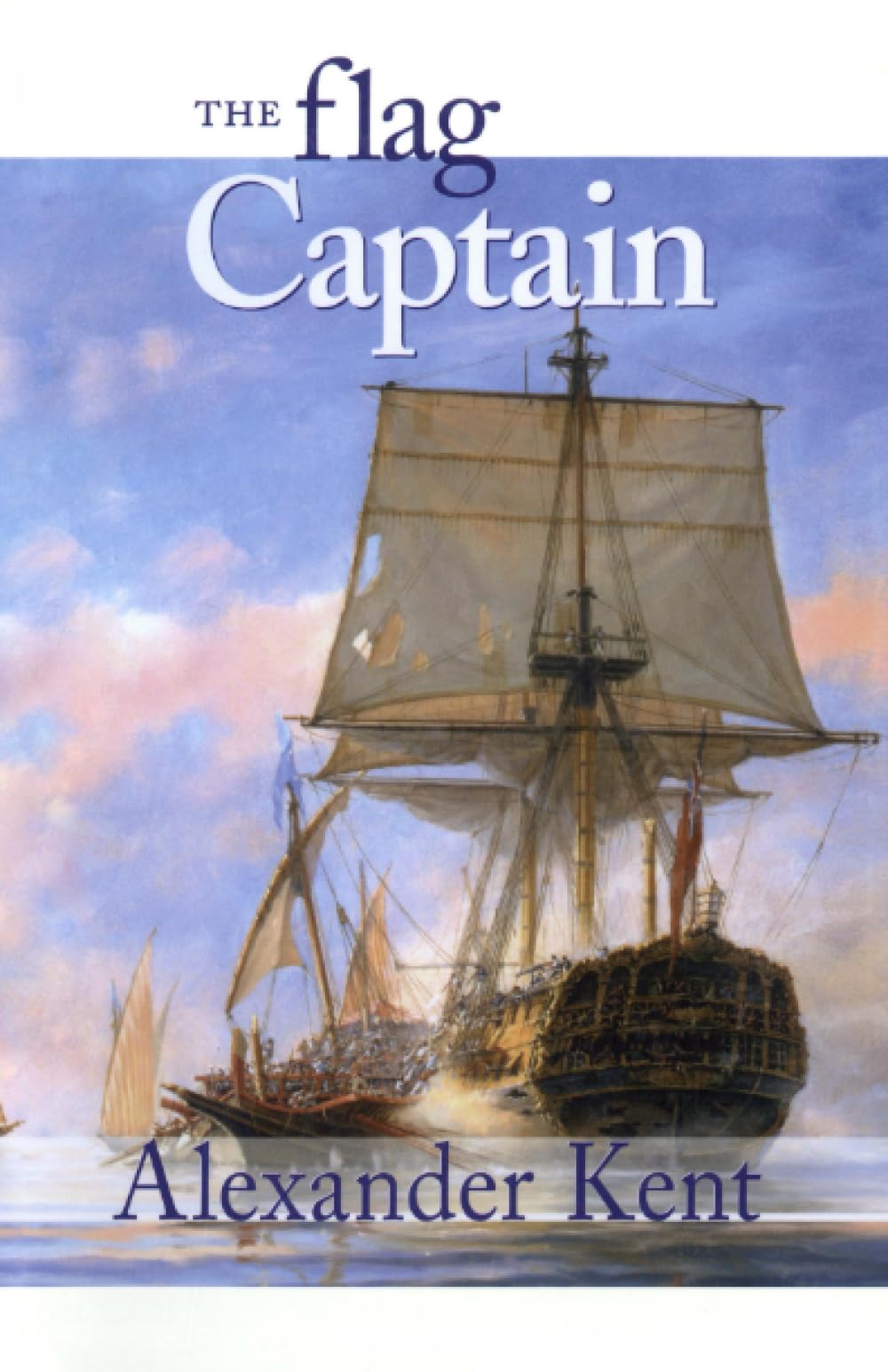



April 1797, Falmouth Bay. As France continues her bitter struggle for supremacy on land and sea, the Royal Navy receives a crippling blow at home: the Great Mutiny. Returning home after eighteen-months' service, Flag Captain Richard Bolitho finds himself at the center of the crisis. "Writing in the dynamic style that first caused him to be compared with C.S. Forester and has since marked him as a writer of superior abilities in his own right, Kent re-creates a vivid picture of the 18th-century English Navy." -- Library Journal Alexander Kent, pen name of Douglas Edward Reeman, joined the British Navy at 16, serving on destroyers and small craft during World War II, and eventually rising to the rank of lieutenant. He has taught navigation to yachtsmen and has served as a script adviser for television and films. His books have been translated into nearly two dozen languages. The Flag Captain The Bolitho Novels: 11 By Alexander Kent McBooks Press, Inc. Copyright © 1971 Alexander Kent All rights reserved. ISBN: 978-0-935526-66-0 CHAPTER 1 LANDFALL As six bells of the morning watch chimed out from the forecastle belfry, Captain Richard Bolitho walked from beneath the poop and paused momentarily beside the compass. A master's mate who was standing close to the great double wheel said quickly, "Nor' west by north, sir," and then dropped his eyes as Bolitho glanced at him. It was as if they could all sense his tension, he thought briefly, and although they might not understand its cause, wanted to break him from it. He strode out on to the broad quarterdeck and crossed to the weather side. Around him, without looking, he could see his officers watching him, gauging his mood, waiting to begin this new day. But the ship had been in continuous commission for eighteen months, and most of her company, excluding those killed by combat or injury at sea, were the same men who had sailed with him from Plymouth on an October morning in 1795. It was more than enough time for them to realise that he needed to be left alone for these first precious moments of each successive day. The wet sea mist which had dogged them for most of the night while they had edged slowly up the Channel was still with them, thicker than ever. It swirled around the black criss-cross of shrouds and rigging and seemed to cling to the hull like dew. Beyond the nettings with their neatly stowed hammocks the sea was heaving in a deep offshore swell, but was quite unbroken in the low breeze. It was dull. The colour of lead. Bolitho shivered slightly and clasped his hands behind him beneath his coat-tails and looked up, beyond the great braced yards to where a rear-admiral's flag flapped wetly from the mizzen masthead. It was hard to believe that up there somewhere the sky would be bright blue, warm and comforting, and on this May morning the sun should already be touching the approaching land. His land. Cornwall. He turned and saw Keverne, the first lieutenant, watching him, waiting for the right moment. Bolitho forced a smile. "Good morning, Mr Keverne. Not much of a welcome, it appears." Keverne relaxed slightly. "Good morning, sir. The wind remains sou' west, but there is little of it." He fidgeted with his coat buttons and added, "The master thinks we might anchor awhile. The mist should clear shortly." Bolitho glanced towards the short, rotund shape of the ship's sailing master. His worn, heavy coat was buttoned up to his several chins, so that in the strange light he looked like a round blue ball. He was prematurely grey, even white haired, and had it tied at the nape of his neck in an old fashioned queue, giving it the appearance of a quaint powdered wig of a country squire. "Well, Mr Partridge." Bolitho tried again to put some warmth into his tone. "It is not like you to show such reluctance for the shore?" Partridge shuffled his feet. "Never sailed into Falmouth afore, Cap'n. Not in a three-decker, that is." Bolitho shifted his gaze to the master's mate. "Go forrard and see there are two good leadsmen in the chains. Make sure the leads are well armed with tallow. I want no false reports from them." The man hurried away without a word. Bolitho knew that like the others he would know what to do without being told, just as he was aware he was only giving himself more time to think and consider his motives. Why should he not take the master's advice and anchor? Was it recklessness or conceit which made him continue closer and closer towards the invisible shore? Mournfully a leadsman's voice echoed from forward. "By th' mark seven!" Above the deck the sails stirred restlessly and shone in the mist like oiled silk. Like everything else they were dripping with moisture, and hardly moved by the sluggish breeze from across the larboard quarter. Falmouth. Perhaps that was the answer to his uncertainty and apprehension. For eighteen months they had been employed on blockade and later the watch over the southern approaches of Ireland. A Fre