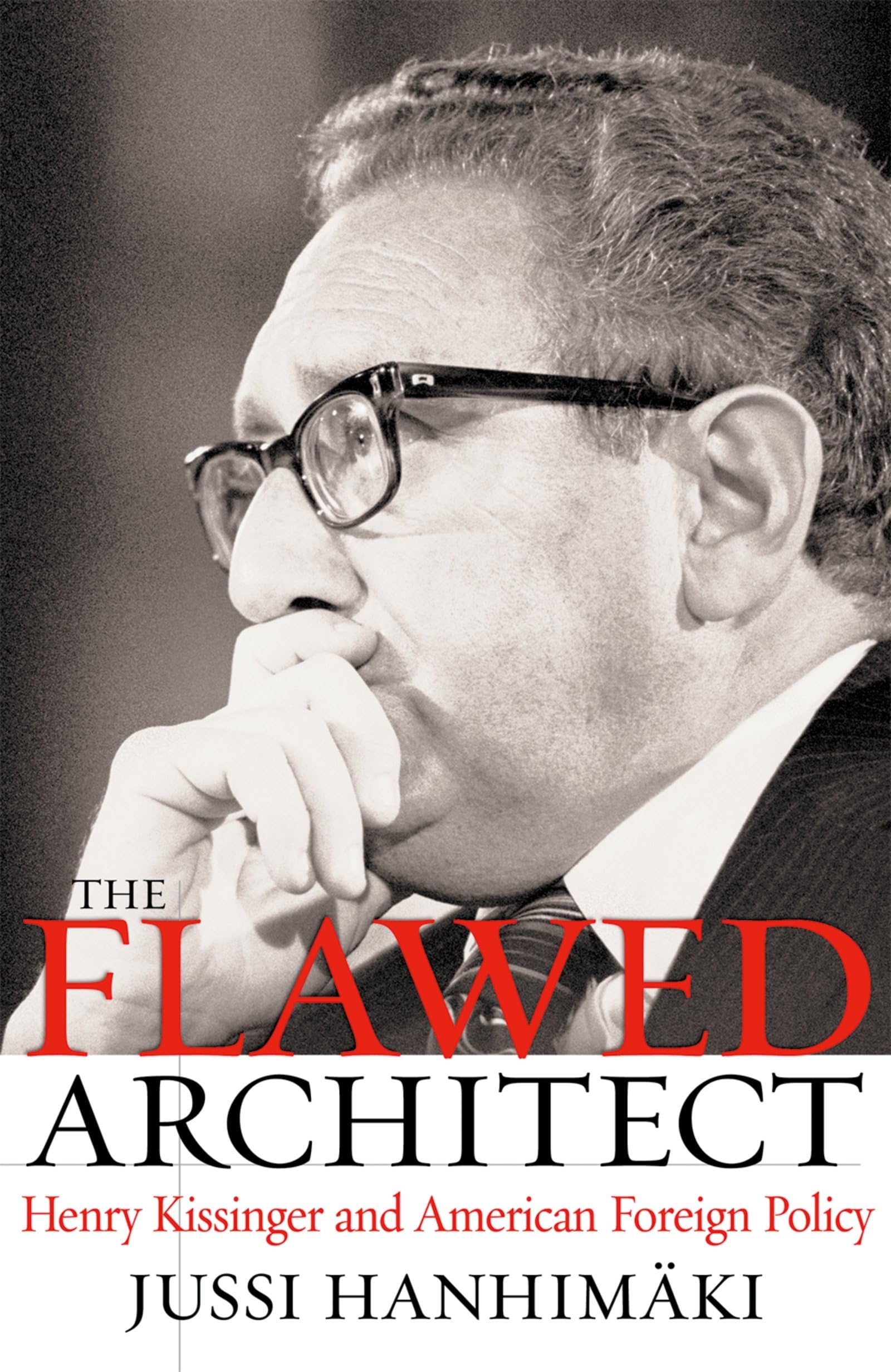
The Flawed Architect: Henry Kissinger and American Foreign Policy
$28.13
by Jussi M. Hanhimaki



Henry Kissinger dominated American foreign relations like no other figure in recent history. He negotiated an end to American involvement in the Vietnam War, opened relations with Communist China, and orchestrated détente with the Soviet Union. Yet he is also the man behind the secret bombing of Cambodia and policies leading to the overthrow of Chile's President Salvador Allende. Which is more accurate, the picture of Kissinger the skilled diplomat or Kissinger the war criminal? In The Flawed Architect , the first major reassessment of Kissinger in over a decade, historian Jussi Hanhimaki paints a subtle, carefully composed portrait of America's most famous and infamous statesman. Drawing on extensive research from newly declassified files, the author follows Kissinger from his beginnings in the Nixon administration up to the current controversy fed by Christopher Hitchens over whether Kissinger is a war criminal. Hanhimaki guides the reader through White House power struggles and debates behind the Cambodia and Laos invasions, the search for a strategy in Vietnam, the breakthrough with China, and the unfolding of Soviet-American detente. Here, too, are many other international crises of the period--the Indo-Pakistani War, the Yom Kippur War, the Angolan civil war--all set against the backdrop of Watergate. Along the way, Hanhimaki sheds light on Kissinger's personal flaws--he was obsessed with secrecy and bureaucratic infighting in an administration that self-destructed in its abuse of power--as well as his great strengths as a diplomat. We see Kissinger negotiating, threatening and joking with virtually all of the key foreign leaders of the 1970s, from Mao to Brezhnev and Anwar Sadat to Golda Meir. This well researched account brings to life the complex nature of American foreign policymaking during the Kissinger years. It will be the standard work on Kissinger for years to come. "A striking indictment. Hanhimäki is one of the most persuasive of the many detractors of Henry Kissinger."-- Publishers Weekly (starred review) "Absorbing and rich.... Hanhimäki provides breaking news by revealing Kissinger's efforts throughout the early 1970s to engineer a way of extracting US forces from Vietnam 'without immediate embarrassment,' meaning he was willing to betray South Vietnam."-- Kirkus Reviews "The tone is critical, it is not at all polemical. Hanhimaki gives Kissinger due credit for his very real accomplishments while not concealing unpleasant facts, placing this work midway between Seymour Hersh's Price of Power and Marvin and Bernard Kalb's more admiring Kissinger ."-- Library Journal "No one can read The Flawed Architect without being impressed by the scope and complexity of the issues that ended up on Kissinger's desk. He was--as every secretary of state should be--a superb juggler. However, he displayed disdain for democracy and impatience with a free press and an active Congress. He sought refuge in secrecy, back channels and outright lies. He approved the wiretapping of his own staff. Many have considered these failings peccadilloes compared to his brilliance as a diplomat. By showing us precisely how Kissinger's globalist vision blinkered him to regional realities and how this undermined the effectiveness of his diplomacy, Hanhimaki makes us think again."-- Raleigh News & Observer "Was Kissinger a war criminal or a calculating realist? Was he the creative architect of a new world order or a traditional cold warrior? Was he an imaginative diplomat or a secretive opportunist bent on maximizing his personal power? Using a broad array of new archival materials and brilliantly assessing Kissinger's policies in the Third World, Hanhimaki persuasively argues that 'Super-K' was a superb tactician and flawed strategist. This book is essential reading for an understanding of the evolution of the Cold War." --Melvyn P. Leffler, Stettinius Professor of American History, University of Virginia "Hanhimaki's study of Kissinger in power is first-rate scholarship. The author has mined rich veins of previously unavailable government documents to explain in detail a controversial set of foreign policies. Crisp prose and a sure command of materials make this important book a pleasure to read. In short: a splendid contribution to the literature of post-1945 U.S. diplomatic history." --David Mayers, Boston University "A fine and illuminating reappraisal of one of the most lastingly controversial figures in the history of U.S. foreign policymaking. Rooted in a slew of recently declassified documentation on Kissingers tenure, The Flawed Architect gives us the good (détente, the opening to China, the Arab-Israeli shuttles), the bad (the secret bombing of Cambodia, the protracted agony of Vietnam, the coup in Chile), and the ugly (a tangled web of secrecy and deception all too redolent of Nixon's White House). As the United States struggles anew to find the right balance between American interests and America