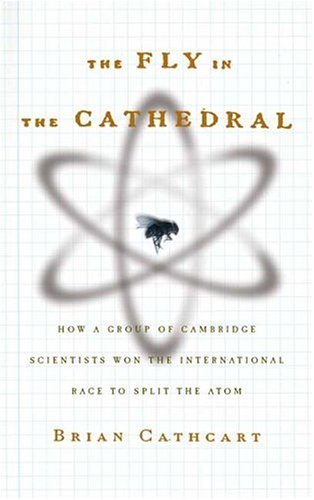
The Fly in the Cathedral: How a Group of Cambridge Scientists Won the International Race to Split the Atom
$16.99
by Brian Cathcart



"Cathcart tells this exhilarating story with both verve and precision" -- The Sunday Telegraph Re-creating the frustrations, excitements, and obsessions of 1932, the "miracle year" of British physics, Brian Cathcart reveals in rich detail the astonishing story behind the splitting of the atom. The most celebrated scientific experiment of its time, it would lead to one of mankind's most devastating inventions--the atomic bomb. All matter is made mostly of empty space. Each of the billions of atoms that comprise it is hollow, its true mass concentrated in a tiny nucleus that, if the atom were a cathedral, would be no bigger than a fly. Discovering its existence three quarters of a century ago was Lord Rutherford's greatest scientific achievement, but even he caught only a glimpse. Almost at the point of despair, John Cockcroft and Ernest Walton, two young researchers in a grubby basement room at the famous Cavendish Laboratory in Cambridge, grappled with the challenge. Racing against their American and German counterparts-a colorful cast of Nobel Prize winners--they would change everything. With paper-and-pencil calculations, a handmade apparatus, the odd lump of plasticine, and some revolutionary physics, Cockroft and Walton raised the curtain on the atomic age. The Fly in the Cathedral is a riveting and erudite narrative inspired by the dreams that lead the last true gentlemen scientists to the very essence of the universe: the heart of matter. If you want to understand how something works, you can dismantle it and study its pieces. But what if the thing you're curious about is too small to see, even with the most powerful microscope? Brian Cathcart's The Fly in the Cathedral tells the intriguing story of how scientists were able to take atoms apart to reveal the secrets of their structures. To keep the story gripping, Cathcart focuses on a time (1932, the annus mirabilis of British physics), a place (Cambridge's Cavendish Laboratory), and a few main characters (Ernest Rutherford, the "father of nuclear physics," and his protégés, John Cockcroft and Ernest Walton). Rutherford and his team knew that the long-accepted atomic model was held together by nothing more than trumped-up math and hope. They hoped to find out what held oppositely charged protons and electrons together, and what strange particles shared the nucleus with protons. In a series of remarkable experiments done on homemade apparatus, these Cambridge scientists moved atomic science to within an inch of its ultimate goal. Finally, Cockcroft and Walton--competing furiously with their American and German peers--put together the machine that would forever change history by splitting an atom. The Fly in the Cathedral combines all the right elements for a great science history: historical context, gritty detail, wrenching failure, and of course, glorious victory. Although the miracles that occurred at Cambridge in 1932 were to result in the fearful, looming threat of atomic warfare, Cathcart allows readers to find unfiltered joy in the accomplishments of a few brilliant, ingenious scientists. --Therese Littleton *Starred Review* A stereotypical scenario has the theorists of twentieth-century physics sporting wild hair and leading wild lives; their exuberance is tamed by the experimentalists, with their trimmed coifs, staid lives, and engineering exactitude. Cathcart's marvelous history of a portentous achievement, the first artificially induced disintegration of an atomic nucleus, in 1932, demonstrates this comparison in compulsively readable fashion. For the role of flamboyant theorist Cathcart introduces George Gamow, the brilliant Russian emigre physicist whose pranks are lore in the field; the feet-on-the-ground experimentalists were John Cockcroft and Ernest Walton. Proteges of Ernest Rutherford at Cambridge University, they received the assignment to prove one of Gamow's quantum-mechanical brainstorms: that it was possible to drive an alpha particle (the nucleus of helium) into a larger nucleus, splitting it. Cockcroft thought that a lighter proton could also do the trick and, better yet, was easier to accelerate with the available technology. Cathcart's narrative then expands into the apparatus Cockcroft and Walton devised, branching into the differing contraptions of rivals and the competition for a Nobel. The fluent Cathcart applies just the right intensity in illuminating both the science and the scientists. Gilbert Taylor Copyright © American Library Association. All rights reserved A former reporter for Reuters and the Independent, Brian Cathcart i s the author of: Test of Greatness: Britain's Struggle for the Atom Bomb, among other books. He lives in North London. Excerpt from The Fly in the Cathedral: How A Small Group of Cambridge Scientists Won The Race to Split the Atom by Brian Cathcart. Copyright © 2005 by Brian Cathcart. To be published in January, 2005 by Farrar, Straus and Giroux, LLC. All rights res