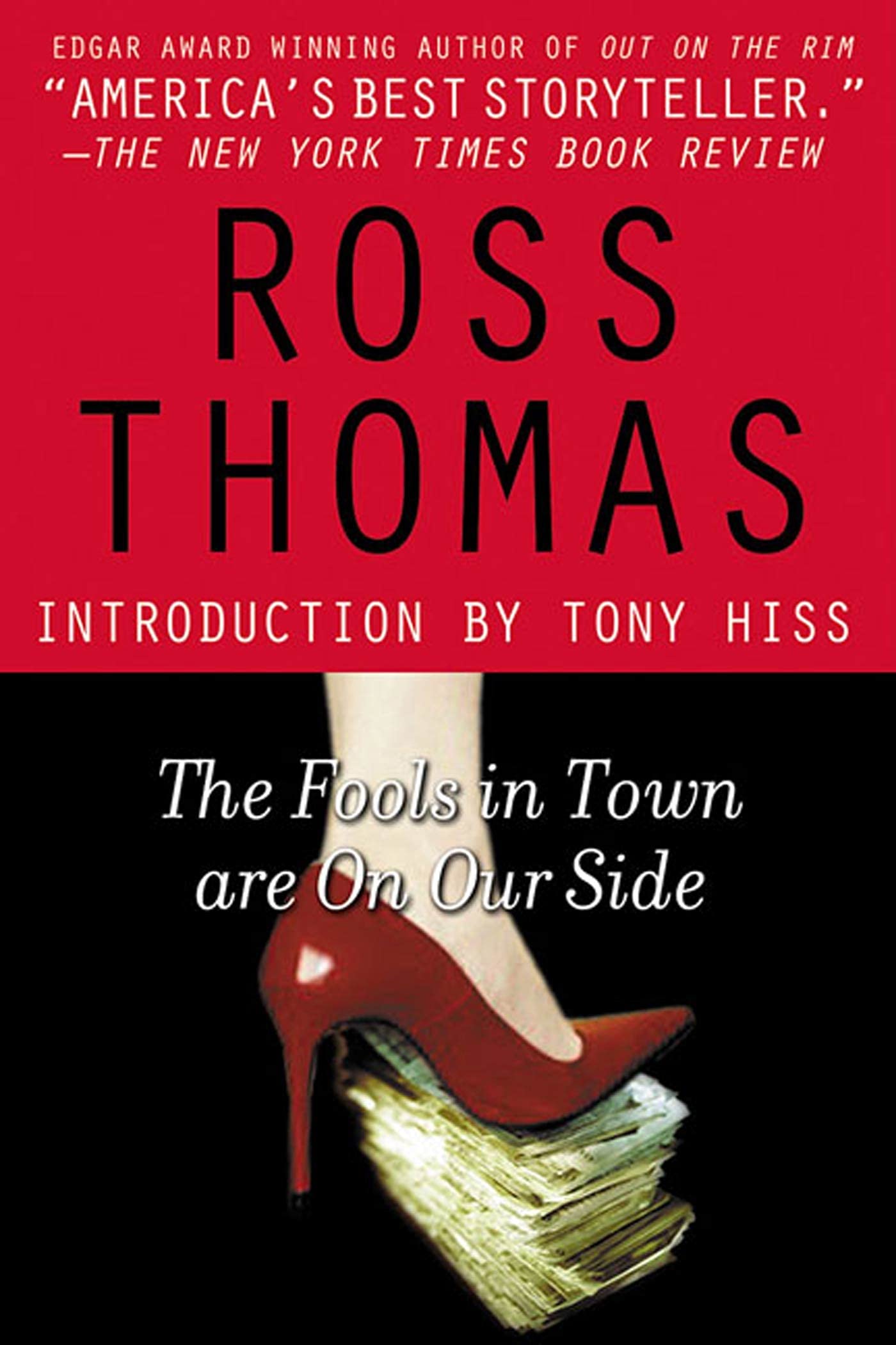



"Hain't we got all the fools in town on our side? And ain't that a big enough majority in any town?" -- Mark Twain When Lucifer Dye is released from three months in a Hong Kong prison, debriefed, handed a false passport, a new wardrobe and a $20,000 check, his haughty control makes it clear that Dye's career with his country has been permanently terminated. But a good agent is always in demand, and just a few hours later Dye is being interviewed for a highly ingenious position. Victor Orcutt, although a not very good imitation of a British pre-war gent, has creative talents of his own. He has his sights a small southern city, with the ordinary run-of-the-mill corruption one would expect in such a place. The canny Orcott knows there's no profit in that. His creed is "To get better, it must be much worse." He and his two associates have looked up Dye's history, and he now offers the ex-spy a mission: for two and a half times the government's bounty, Dye is to thoroughly corrupt the town. And the sly Dye takes the offer. “America's Best Storyteller.” ― New York Times Book Review ROSS THOMAS is the author of over twenty-five critically acclaimed novels. His debut, The Cold War Swap , was written in under six weeks and won an Edgar Award for Best First Novel, and Briarpatch won an Edgar Award for Best Novel. He's also written under the name Oliver Bleeck. Thomas died in 1995 at the age of 69 in Santa Monica, California. The Fools in Town are on Our Side By Ross Thomas St. Martin's Press Copyright © 1970 Ross E. Thomas All rights reserved. ISBN: 978-0-312-31582-5 CHAPTER 1 The debriefing took ten days in a sealed-off suite in the old section of the Army's Letterman General Hospital on the Presidio in San Francisco and when it was finished, so was my career — if it could be called that. They were polite enough throughout, perhaps even a bit embarrassed, providing that they felt anything at all, which I doubted, and the embarrassment may have prompted their unusual generosity when it came to the matter of severance pay. It amounted to twenty thousand dollars and, as Carmingler kept saying, it was all tax-free so that really ran it up to the equivalent of twenty-eight or even thirty thousand. It was Carmingler himself who handed me the new passport along with the certified check drawn on something called the Brookhaven Corporation. He did it quickly, without comment, much in the same manner as he would shoot a crippled horse — a favorite perhaps, and when it was done, that last official act, he even unbent enough to pick up the phone and call a cab. I was almost sure it was the first time he had ever called a cab for anyone other than himself. "It shouldn't take long," he said. "I'll wait outside." "No need for that." "I think there is." Carmingler produced his dubious look. He managed that by sticking out his lower lip and frowning at the same time. He would use the same expression even if someone were to tell him it had stopped raining. "There's really no reason to —" I interrupted. "We're through, aren't we? The loose ends are neatly tied off. The crumbs are all brushed away. It's over." I liked to mix metaphors around Carmingler. It bothered him. He nodded slowly, produced his pipe, and began to stuff it with that special mixture of his which he got from some tobacco shop in New York. I could never remember the shop's name although he had mentioned it often enough. He kept on nodding while he filled his pipe. "Well, I wouldn't put it quite that way." "No," I said, "you wouldn't. But I would and that's why I'll wait outside." Carmingler, who loved horses if he loved anything, which again was doubtful, rose and walked around his desk to where I stood. He must have been forty or even forty-two then, all elbows and knee joints and what I had long felt was a carefully practiced, coltish kind of awkwardness. The flaming hair that stopped just short of being true madder scarlet half-framed his long narrow face, which I think he secretly wanted to resemble a horse. It looked more like a mule. A stubborn one. He held out his hand. "Good luck to you." Sweet Christ, I thought, the firm handshake of sad parting. "By God, I appreciate that, Carmingler," I said, giving his hand a brief, hard grasp. "You don't know how much I appreciate it." "No need for sarcasm," he said stiffly. "No call for that at all." "Not for that or for anything else," I said. "I mean it," he said. "Good luck." "Sure," I said and picked up the new plastic suitcase that failed utterly in its attempt to resemble cordovan. I turned, went through a door, down a hall, and out onto the semicircular drive where a pair of chained-down mortars that had been made in 1859 by some Boston firm called C.A. & Co. guarded the flagpole and the entrance to Letterman General Hospital, established 1898, just in time for the war with Spain. In the distance, there was Russian Hill to look at. The cab arrived ten minutes later and I placed the bag