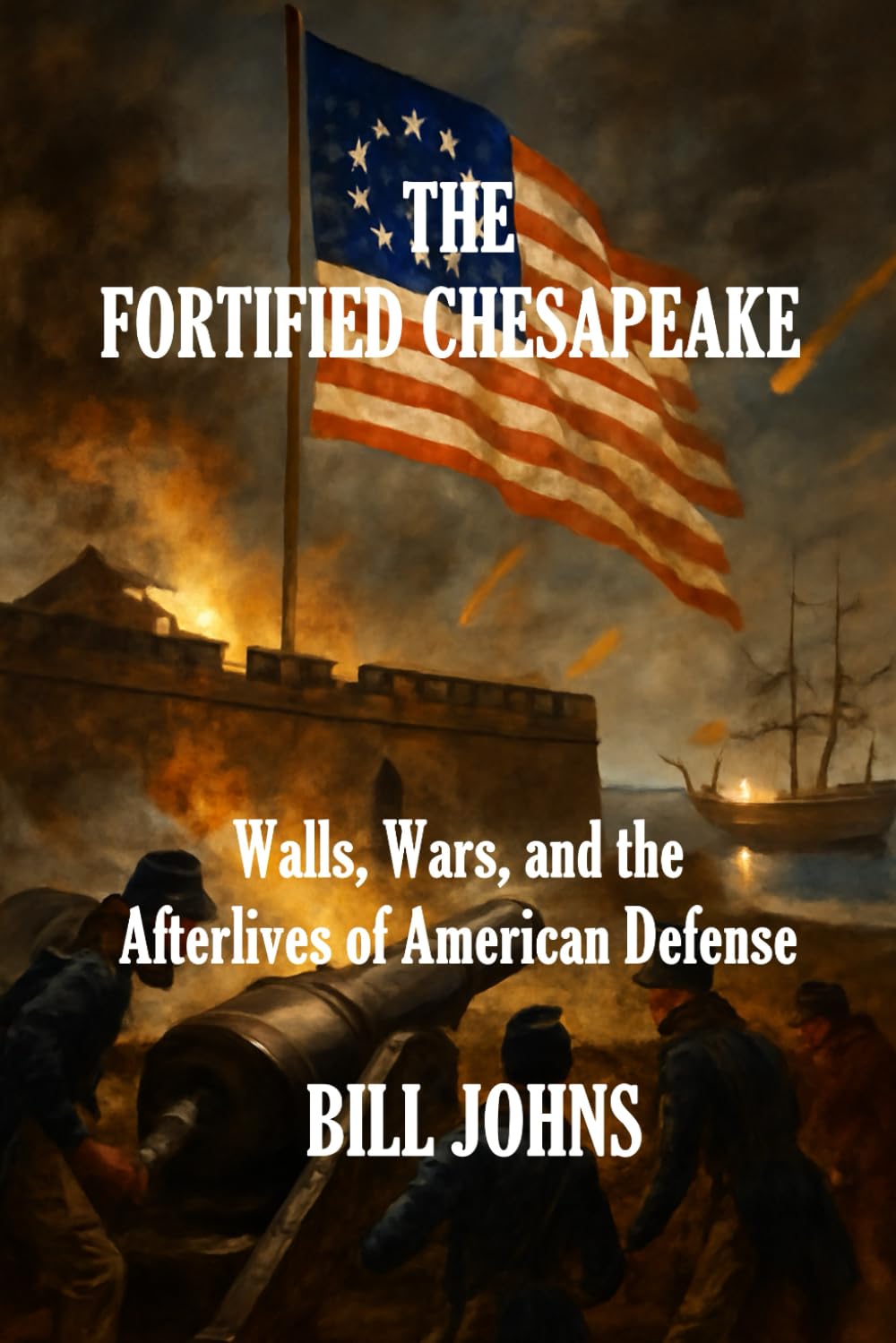
The Fortified Chesapeake: Walls, Wars, and the Afterlives of American Defense (Chesapeake Unwritten)
$19.99
by Bill Johns



The Chesapeake Bay is lined with forgotten forts—stone fragments, crumbling walls, and ghostly names that still appear on maps long after the structures themselves have vanished. The Fortified Chesapeake: Walls, Wars, and the Afterlives of American Defense is a sweeping, evocative cultural history of these remnants, exploring how military architecture once sought to stabilize a restless shoreline, and how its ruins now expose deeper truths about power, vulnerability, and American memory. From Fort McHenry to Fort Wool, from Cold War proving grounds to colonial batteries lost beneath the tide, this book traces the rise and fall of coastal fortification as both physical and ideological project. Built across centuries to defend ports and assert sovereignty over contested terrain, the Chesapeake’s forts have outlived their martial purpose. But their presence—visible or submerged—continues to shape the cultural imagination of the region. In their stones, we read the ambitions of empires. In their erosion, we confront the limits of those ambitions. Author Bill Johns brings a layered, urgent clarity to this narrative. Raised on the Bay, Johns walks the vanished and vanishing shoreline with precision and care. He moves between history and geography, between archival record and tidal ruin, between the language of state defense and the unofficial stories whispered by locals who live among the remnants. This is not a catalog of battles, nor a nostalgic meditation on ruins. It is a reckoning with what the American state has chosen to preserve, what it has let decay, and what it prefers to forget. Across its chapters, The Fortified Chesapeake explores forts as instruments of exclusion and authority—structures built not only to repel enemies but to control labor, enforce racial boundaries, and domesticate dissent. The narrative moves from colonial outposts that displaced Indigenous communities, to nineteenth-century bastions that fortified slavery while guarding rivers, to twentieth-century proving grounds where the language of national security disguised environmental destruction and social control. Forts that never saw battle still altered the geography of citizenship. Walls that never fired a shot still shaped lives, mapped fear, and projected federal presence into uncertain terrain. Yet this is also a book about absence: the seawalls that no longer hold, the foundations that sink beneath the tide, the names on charts that mark nothing solid. Forts that once defined the boundary between inside and outside now crumble without ceremony, their meanings adrift. Some are repurposed as parks, their histories softened for public display. Others remain inaccessible, overgrown and unmapped. And some, like Fort Carroll in Baltimore Harbor, sit unclaimed—visible only to those who know where to look. These afterlives matter. They reveal the quiet politics of heritage: what gets remembered, and what is allowed to disappear. Written in clear, unsentimental prose, Johns’s work resonates with readers of narrative nonfiction who value grounded storytelling, deep research, and ethical inquiry. He is not interested in spectacle. He is interested in patterns—of erosion, abandonment, renaming, and erasure. His lens is local, but his questions are national: What do our ruins say about the fantasies we once held? Who inherits the silence left behind? And what happens to memory when the state stops tending its monuments? With its richly layered narrative, The Fortified Chesapeake offers not just a history of walls, but a meditation on the boundaries we still draw today. To read this book is to walk the edge of the Bay with new eyes, to hear what the waves echo back, and to recognize that even in ruin, the walls continue to speak. Step into a story where geography is never stable, memory is never neutral, and every vanished fort still casts a shadow. The Bay remembers. Will we