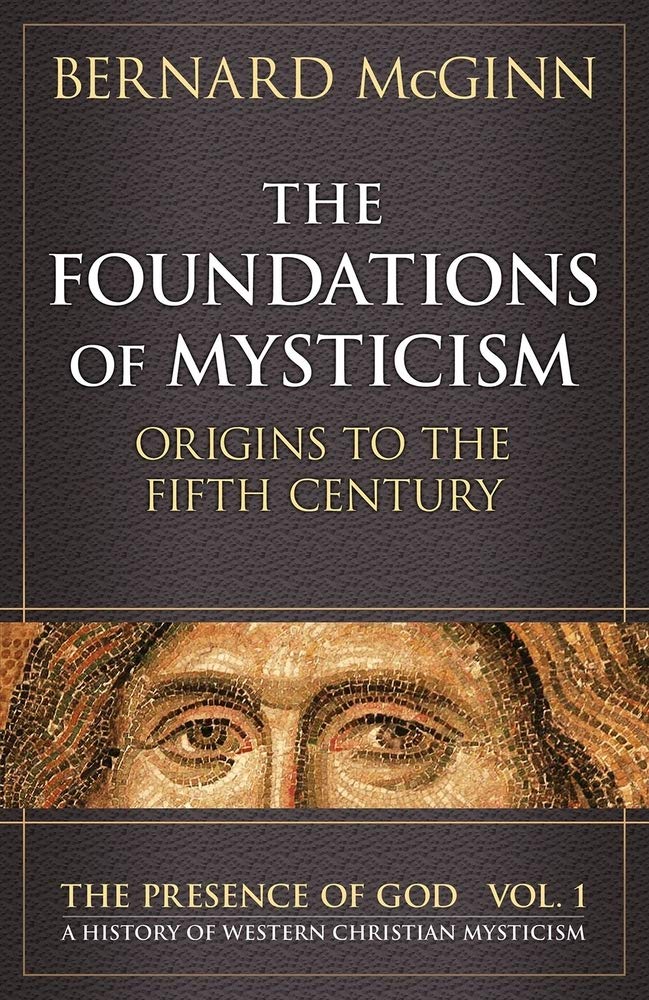
The Foundations of Mysticism: Origins to the Fifth Century (The Presence of God: A History of Western Christian Mysticism, Vol. 1)
$49.95
by Bernard McGinn



In this first volume of the highly-acclaimed Presence of God series, Bernard McGinn explores the origins of Christian mysticism, from early Jewish apocalyptic writings to pre-Christian Greek contemplative thought; the New Testament witnesses; early Greek Patristic thought; and the contribution of early monastic practice. In Part 2, McGinn discusses Western Christian mysticism proper, with special attention to Augustine of Hippo. Of special interest is the now-influential appendix, which reviews various theoretical approaches to mysticism. "A truly magnificent book." -- The Way "Bernard McGinn has enriched the knowledge of our spiritual tradition as no other work in recent memory has done." -- The Thomist "No one will be able to write on Christian mysticism without taking this extraordinary book into account." -- Theological Studies Bernard McGinn is the Naomi Shenstone Donnelley Professor in the Divinity School of the University of Chicago. He is widely acknowledged as "the world's greatest interpreter of Western mysticism" (Choice). In addition to his comprehensive series "The Presence of God," he is best known for his perceptive work on the writings of Meister Eckhart and the Beguines, and has been at the forefront of rediscovering the distinctly Christian elements in Eckhart's view of the God beyond God. It is important to remember that mysticism is always a process or a way of life. Although the essential note-or, better, goal-of mysticism may be conceived of as a particular kind of encounter between God and the human, between Infinite Spirit and the finite human spirit, everything that leads up to and prepares for this encounter, as well as all that flows from or is supposed to flow from it for the life of the individual in the belief community, is also mystical, even if in a secondary sense. Isolation of the goal from the process and the effect has led to much misunderstanding of the nature of mysticism and its role as an element of concrete religions. This goal, essential characteristic, or defining note has most often been seen as an experience of some form of union with God, particularly a union of absorption or identity in which the individual personality is lost. If we define mysticism in this sense, there are actually so few mystics in the history of Christianity that one wonders why Christians ever used the qualifier "mystical" so often (from the late second century on) and eventually created the term "mysticism" (first in French, "la mystique") in the seventeenth century. This suggests that at the very least, it is necessary to expand the notion of union, recognizing that there were several, perhaps even many, understandings of union with God held by Christians over the centuries. But it may also be argued that union with God is not the most central category for understanding mysticism. Inspired in part by the seminar work of Joseph Maréchal, but especially by my reading of the texts that have been accepted as mystical classics in the history of Christianity, both East and West, I have come to find the term "presence" a more central and more useful category for grasping the unifying note in the varieties of Christian mysticism. Thus we can say that the mystical element in Christianity is that part of its belief and practices that concerns the preparation for, the consciousness of, and the reaction to what can be described as the immediate or direct presence of God. Used Book in Good Condition