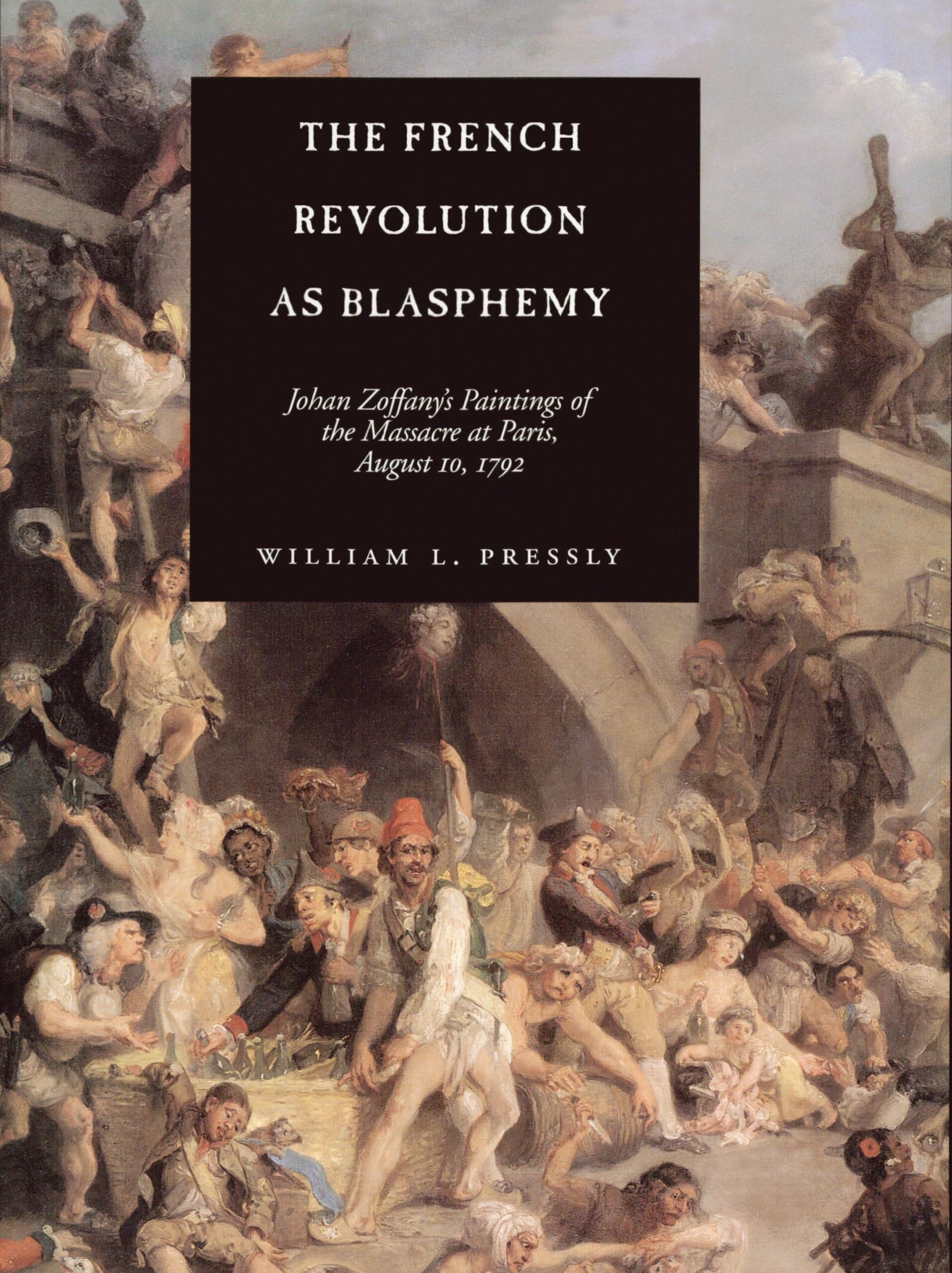
The French Revolution as Blasphemy: Johan Zoffany's Paintings of the Massacre at Paris, August 10, 1792 (Volume 6) (The Discovery Series)
$48.76
by William L. Pressly



William Pressly presents for the first time a close analysis of two important, neglected paintings, arguing that they are among the most extraordinary works of art devoted to the French Revolution. Johan Zoffany's Plundering the King's Cellar at Paris, August 10, 1792 , and Celebrating over the Bodies of the Swiss Soldiers , both painted in about 1794, represent events that helped turn the English against the Revolution. Pressly places both paintings in their historical context―a time of heightened anti-French hysteria―and relates them to pictorial conventions: contemporary history painting, the depiction of urban mobs in satiric and festival imagery, and Hogarth's humorous presentation of modern moral subjects, all of which Zoffany adopted and reinvented for his own purposes. Pressly relates the paintings to Zoffany's status as a German-born Catholic living in Protestant England and to Zoffany's vision of revolutionary justice and the role played by the sansculottes, women, and blacks. He also examines the religious dimension in Zoffany's paintings, showing how they broke new ground by conveying Christian themes in a radically new format. Art historians will find Pressly's book of immense value, as will cultural historians interested in religion, gender, and race. William L. Pressly is Professor and Chair of the Department of Art History and Archaeology at the University of Maryland, College Park, and the author of The Life and Art of James Barry (1981). The French Revolution as Blasphemy: Johan Zoffany's Paintings of the Massacre at Paris, August 10, 1792 By William L. Pressly University of California Press Copyright 1999 William L. Pressly All right reserved. ISBN: 0520211960 Introduction During the eighteenth century, Great Britain and France, locked in global competition, fought one another in several major conflicts. Yet France's declaration of war on February 1, 1793, was more than just another round in this continuing rivalry: the nature of the conflict had changed drastically. In a letter of September 18, 1793, to his friend Hannah More, the aging Horace Walpole, long a perceptive observer of current affairs, conveyed a new sense of urgency: "This is not a war of nation and nation: it is the cause of everything dear and sacred to civilized men, against the unbounded licentiousness of assassins."1 The war was over ideology, over which worldview would predominate, and many in Britain saw it as a struggle for nothing less than civilization itself. Not surprisingly, in light of the magnitude of the events unfolding in revolutionary France, British writers churned out reams of material arguing over its meaning. In the visual arts, the popular genre of the political caricature also commented on the Revolution and its impact on British life. But in the realm of high art, there is remarkably little direct representation of these cataclysmic events. Using painting as a barometer, the casual observer would be hard-pressed to detect that a political and social upheaval of unprecedented proportions was occurring across the Channel. Once Great Britain was at war with France, those prominent artists who were sympathetic to republicanism, such as James Barry and George Romney, chose not to espouse unpopular, some would even argue treasonous, sentiments directly. Instead they refer obliquely to the contemporary situation, choosing, for example, to depict Satan from Milton's Paradise Lost as the heroic spirit of revolt. William Blake, who did not enjoy the same stature as his colleagues, was more direct in championing the revolutionary cause, yet he too subsequently found it prudent to veil his allusions.2 Even Benjamin West, the president of the Royal Academy, may have intended that his sketch Death on the Pale Horse from the Book of Revelation, exhibited in 1796, link biblical prophecy with current affairs, holding out the millenarian promise of a new order. That West made his sketch as a study for a painting commissioned by the king for a proposed Chapel of Revealed Religion at Windsor Castle makes any contemporary political allusions even more relevant and daring.3 Although artists who might have been sympathetic to the French Revolution wisely avoided direct representations of its unfolding drama, artists who supported the British government's anti-French policies were free to depict revolutionary subjects without circumspection. Unlike their prorepublican colleagues, however, these painters generally came from the minor echelons of their profession. In addition, uncomfortable with scenes depicting the triumph of the masses, they focused primarily on the tribulations of members of the royal family, manufacturing sentimental melodramas of their unfortunate fate.4 Johan Zoffany, a royalist sympathizer, stands apart from his collea