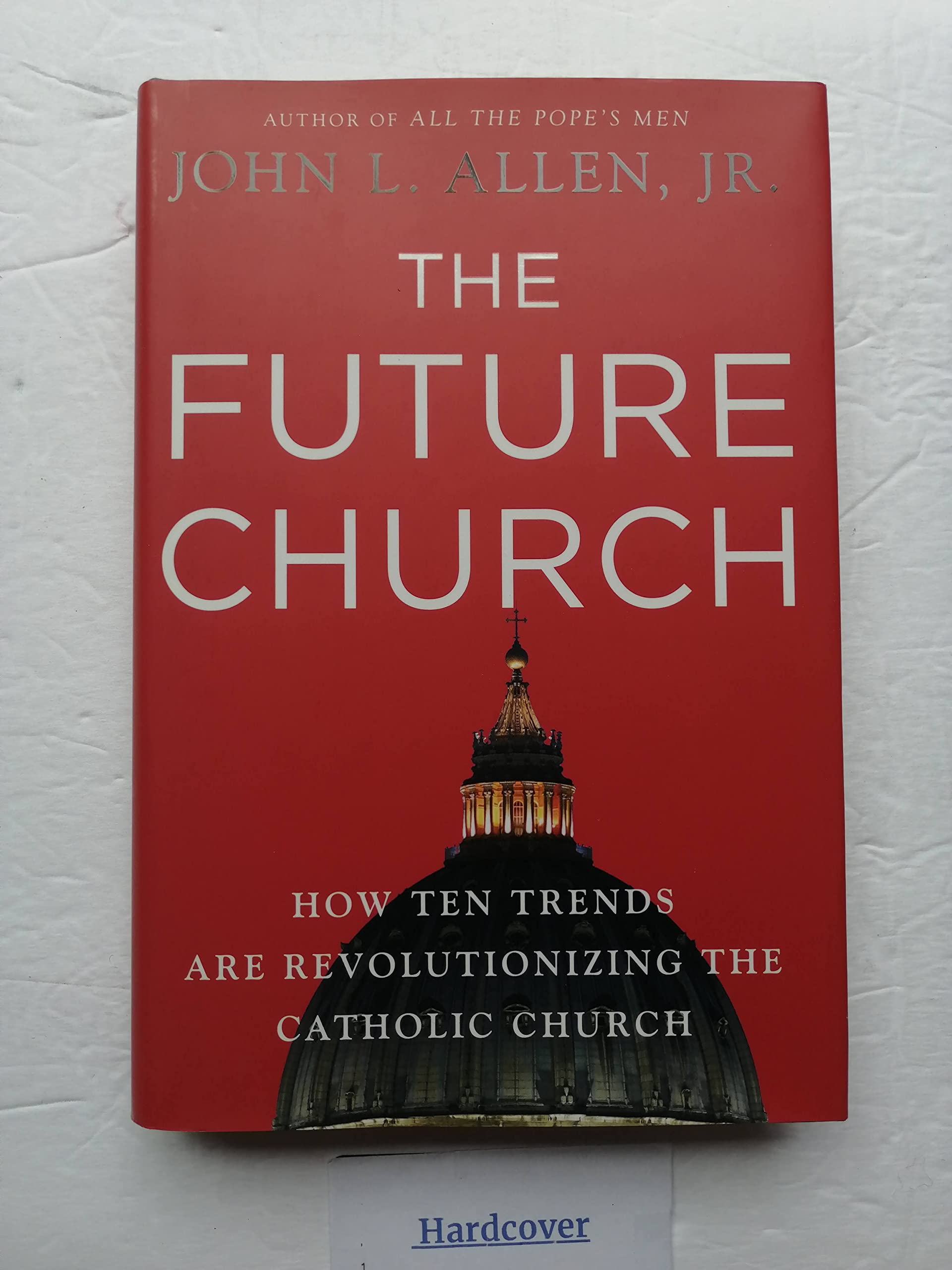
The Future Church: How Ten Trends are Revolutionizing the Catholic Church by John L. Allen Jr. (2009-11-10)
$27.98
by John L. Allen Jr



One of the world’s foremost religion journalists offers an unexpected and provocative look at where the Catholic Church is headed—and what the changes will mean for all of us. What will the Catholic Church be like in 100 years? There hasn’t been much revolutionizing in the Catholic Church since Vatican II. In fact, recent years have witnessed a semi-resurgence of conservative movements both within and outside the confines of the church hierarchy. Veteran Vatican analyst and journalist Allen, however, outlines a set of trends he believes will truly transform the church as we know it. Individual chapters that are devoted to examining these trends in detail include a world church, Evangelical Catholicism, Islam, the new demography, expanding lay roles, the biotech revolution, globalization, ecology, multipolarism, and Pentecostalism. Separately, these trends have little impact; together, they point to the possibility of a radically different future for the Catholic Church. Allen provides reasonable food for thought in this intriguing must-read for all church watchers. --Margaret Flanagan JOHN L. ALLEN, Jr., is the Vatican correspondent for the National Catholic Reporter and a Vatican analyst for CNBN and National Public Radio. He is the author of Conclave , All the Pope’s Men , and Opus Dei, and writes the weekly Internet column, “The Word from Rome.” He lives in New York City and Rome. In Thomas Friedman’s enormously popular book about globalization, he summarized the essential message in four words: the world is flat. Globalization is knocking down one barrier to opportunity after another, creating a world in which smart, hungry go- getters in India, China, or Brazil can compete not just for the low- wage jobs Americans don’t want, but for the hightech, high- pay jobs they definitely do want. For that reason, Friedman’s book came with a warning: Americans need to hustle in this century or they’ll find themselves run over by this phenomenon. This too is a book about globalization. Its subject is the oldest globalized institution on earth, the Roman Catholic Church. Its bottom line can also be expressed in a few words: the church is upside down. By that, I don’t mean that the Church is topsy- turvy or out of whack. I mean that the issues, party lines, and ways of doing business that have dominated Catholicism in the forty- plus years since the close of the Second Vatican Council in 1965, that watershed moment in modern Catholic life, are being turned on their head by a series of new forces reshaping the global Church. This book comes with a warning too: Catholics in the twenty- first century won’t just need hustle (though they certainly will need that), but above all they’ll need imagination. They’ll need the capacity to reconsider how they think about the Church, and what they do with their faith, because otherwise Catholicism won’t rise to the occasion of these new challenges— it’ll be steamrolled by them. Consider the following ways in which the Catholic Church is upside down in the twenty- first century: • A Church dominated in the twentieth century by the global North, meaning Europe and North America, today finds two thirds of its members living in Africa, Asia, and Latin America. Catholic leadership will come from all over the world in this century to a degree never before experienced. • A Church whose watchword after the Second Vatican Council (1962– 65) was aggiornamento, meaning “opening up to the modern world,” is today officially cutting in the opposite direction, reaffirming everything that makes Catholicism different from modernity. This politics of identity is in part a reaction against runaway secularization. • A Church whose primary interreligious relationship for the last forty years has been with Judaism now finds itself struggling to come to terms with a newly assertive Islam, not just in the Middle East, Africa, and Asia, but in its own European backyard. • A Church that has historically invested a large share of its pastoral energy in the young now has to cope, beginning in the North, with the most rapidly aging population in human history. • A Church that has long relied on its clergy to deliver pastoral care and to provide leadership now has lay people doing both in record numbers and in a staggering variety of ways. • A Church used to debating bioethical issues that have been around for millennia— abortion, birth control, and homosexuality— finds itself in a brave new world of cloning, ge ne tic enhancements, and trans- species chimeras. Its moral teaching is struggling desperately to keep pace with scientific advances. • A Church whose social teaching took shape in the early stages of the Industrial Revolution now faces a twenty- first- century globalized world, populated by strange entities such as multinational corporations (MNCs) and intergovernmental organizations (IGOs) that didn’t exist when it crafted its vision of the just society. • A Church whose social concern focu