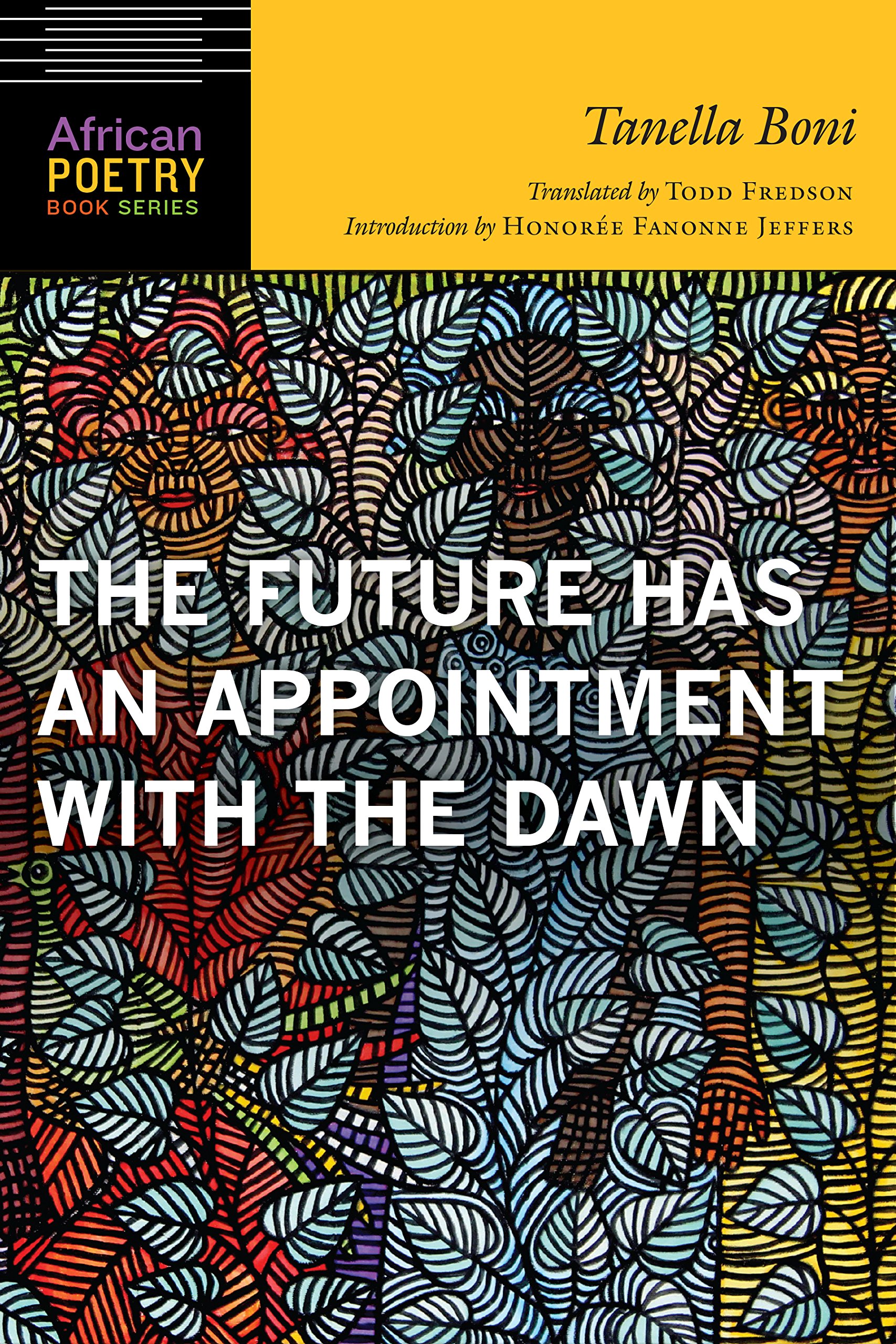



Tanella Boni is a major African poet, and this book, The Future Has an Appointment with the Dawn , is her first full collection to be translated into English. These poems wrestle with the ethnic violence and civil war that dominated life in West Africa’s Ivory Coast in the first decade of the new millennium. Boni maps these events onto a mythic topography where people live among their ancestors and are subject to the whims of the powerful, who are at once magical and all too petty. The elements—the sun, the wind, the water—are animated as independent forces, beyond simile or metaphor. Words, too, are elemental, and the poet is present in the landscape—“during these times / I searched for the letters / for the perfect word.” Boni affirms her desire for hope in the face of ethno‑cultural and state violence although she acknowledges that desiring to hope and hoping are not the same. "Todd Fredson ably captures the images, structure, and tone of Boni's poetic landscape in a project supported in part by the National Endowment for the Arts. No doubt Fredson's extended visits to the Ivory Coast (first, as a Peace Corps volunteer, and then as a Fulbright Fellow), as well as the fact that he is a prizewinning poet in his own right, have informed this exciting translation."—Nancy Naomi Carlson, World Literature Today “‘The dawn counted its nomadic steps / to the border.’ Tanella Boni’s translucent, extraordinary poems transform usually ineffable explorations of war, violence, and the ever-tangled exit out of these realities, into meticulous experiences that––while rendered elegantly––nevertheless leave the reader face to face with the horror of our own humanity. Boni not only expands poetry’s possibilities (‘ordinary life / between routine and rupture’), but in searing, unique, meticulous language, her work challenges the limit of writing itself.”—Robin Coste Lewis, author of Voyage of the Sable Venus , winner of the National Book Award Published On: 2018-03-05 Tanella Boni is an Ivorian poet, novelist, and professor of philosophy at the University Félix Houphouët-Boigny, formerly the University of Abidjan (Cocody). She has published numerous critical and literary works in French and won many literary awards, including the 2009 Antonio Viccaro International Poetry Prize from UNESCO for her body of work. Todd Fredson is the author of the poetry collections The Crucifix-Blocks and Century Worm and has translated two poetry collections by Josué Guébo, including Think of Lampedusa (Nebraska, 2017). Honorée Fanonne Jeffers is a professor of English at the University of Oklahoma and the author of The Gospel of Barbecue . The Future Has an Appointment with the Dawn By Tanella Boni, Todd Fredson UNIVERSITY OF NEBRASKA PRESS Copyright © 2018 Board of Regents of the University of Nebraska All rights reserved. ISBN: 978-1-4962-1185-9 Contents Introduction, by Honorée Fanonne Jeffers, Translator's Note, Land of Hope, A Murdered Life, Acknowledgments, Notes, INTRODUCTION Honorée Fanonne Jeffers Parce que je me dis que je prends cette langue que je vais utiliser et puis, je vais essayer peut-etre de la transformer, de dire en francais ce que moi, J'ai envie de dire. [Because I tell myself that I'll take this language that I'm going to use and perhaps I'll try to transform it, to say in French what it is that I want to say.] — Tanella Boni This collection of verse, The Future Has an Appointment with the Dawn by Tanella Boni, is extraordinary, combining historical knowledge with skilled craft. But if it hadn't been translated from the French, you never would have read it, even though Boni is a renowned West African writer who has published widely. This is where we start, because any Western reader will ask why when offered the work of a non-Western writer. Most American readers only consume literature published in English. This is especially true when it comes to African literature. African novelist and critic Ngugi Wa Thiong'o has been averse to writing in the European colonizer's language, and this remains an appropriate concern. The emphasis on English shields the lives of non-Anglophone Africans from American readers, but the practical issue is that many American readers are not fluent in other languages. (I am not, though I took those required two years of foreign language back in college.) Translation is important, but history and cultural connections are too. For example, the Black Arts Movement ended more than forty years ago, and we are more than eighty years past the Harlem Renaissance. Writers of both eras were prolific, producing work that traversed waters to connect with others of African descent around the globe, and in this twenty-first-century moment, we bear witness to a (re)new(ed) literary era that privileges the lives, history, and political possibilities of black people. Here we are again, despite some critics' premature arguments agains