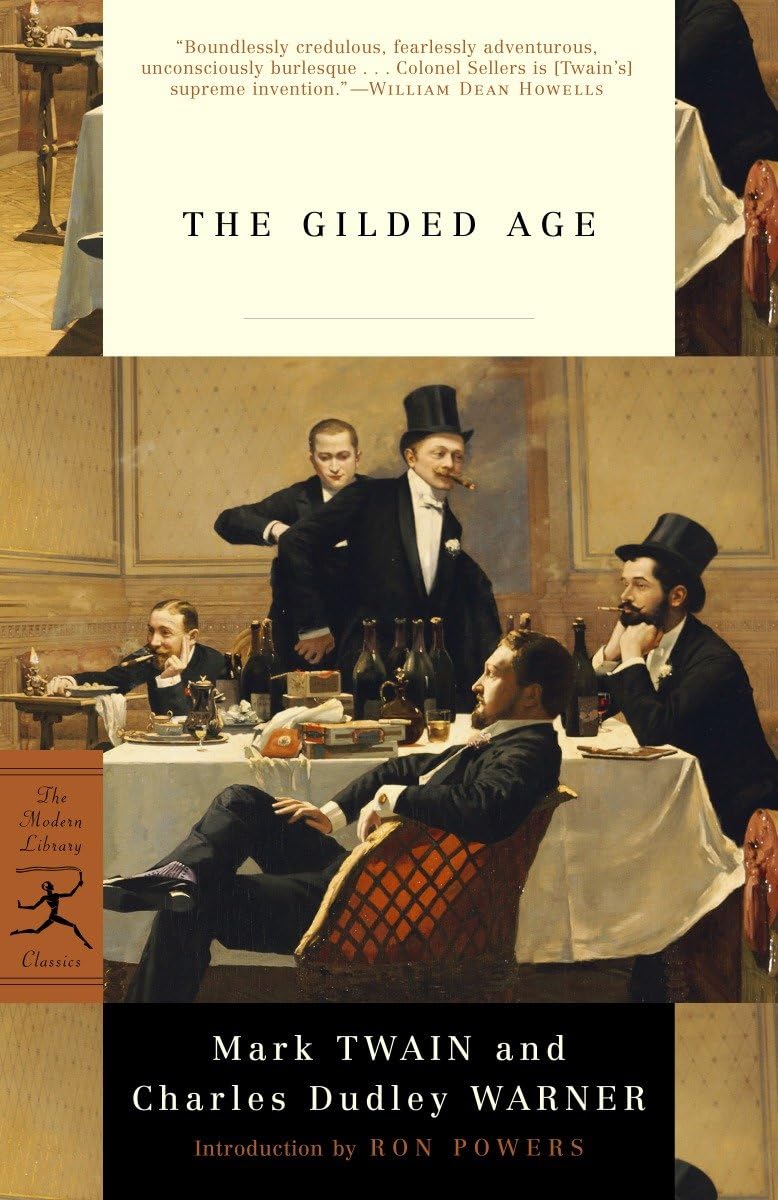



Introduction by Ron Powers Includes Newly Commissioned Endnotes Arguably the first major American novel to satirize the political milieu of Washington, D.C. and the wild speculation schemes that exploded across the nation in the years that followed the Civil War, The Gilded Age gave this remarkable era its name. Co-written by Mark Twain and Charles Dudley Warner, this rollicking novel is rife with unscrupulous politicians, colorful plutocrats, and blindly optimistic speculators caught up in a frenzy of romance, murder, and surefire deals gone bust. First published in 1873 and filled with unforgettable characters such as the vainglorious Colonel Sellers and the ruthless Senator Dilsworthy, The Gilded Age is a hilarious and instructive lesson in American history. Ron Powers is a Pulitzer Prize—winning journalist. His books include Tom and Huck Don’t Live Here Anymore: Childhood and Murder in the Heart of America and Mark Twain: A Life. He co-wrote, with James Bradley, the #1 New York Times bestseller Flags of Our Fathers: Heroes of Iwo Jima. Chapter 1 Nibiwa win o-dibendan aki.1 Eng. A gallant tract Of land it is! Meercraft. ’Twill yield a pound an acre: We must let cheap ever at first. But, sir, This looks too large for you, I see. June, 18—. Squire Hawkins sat upon the pyramid of large blocks, called the “stile,” in front of his house, contemplating the morning. The locality was Obedstown, East Tennessee. You would not know that Obedstown stood on the top of a mountain, for there was nothing about the landscape to indicate it—but it did: a mountain that stretched abroad over whole counties, and rose very gradually. The district was called the “Knobs of East Tennessee,” and had a reputation like Nazareth,2 as far as turning out any good thing was concerned. The Squire’s house was a double log cabin, in a state of decay; two or three gaunt hounds lay asleep about the threshold, and lifted their heads sadly whenever Mrs. Hawkins or the children stepped in and out over their bodies. Rubbish was scattered about the grassless yard; a bench stood near the door with a tin wash basin on it and a pail of water and a gourd; a cat had begun to drink from the pail, but the exertion was overtaxing her energies, and she had stopped to rest. There was an ash-hopper by the fence, and an iron pot, for soft-soap-boiling, near it. This dwelling constituted one-fifteenth of Obedstown; the other fourteen houses were scattered about among the tall pine trees and among the corn-fields in such a way that a man might stand in the midst of the city and not know but that he was in the country if he only depended on his eyes for information. “Squire” Hawkins got his title from being postmaster of Obedstown—not that the title properly belonged to the office, but because in those regions the chief citizens always must have titles of some sort, and so the usual courtesy had been extended to Hawkins. The mail was monthly, and sometimes amounted to as much as three or four letters at a single delivery. Even a rush like this did not fill up the postmaster’s whole month, though, and therefore he “kept store” in the intervals. The Squire was contemplating the morning. It was balmy and tranquil, the vagrant breezes were laden with the odor of flowers, the murmur of bees was in the air, there was everywhere that suggestion of repose that summer woodlands bring to the senses, and the vague, pleasurable melancholy that such a time and such surroundings inspire. Presently the United States mail arrived, on horseback. There was but one letter, and it was for the postmaster. The long-legged youth who carried the mail tarried an hour to talk, for there was no hurry; and in a little while the male population of the village had assembled to help. As a general thing, they were dressed in homespun “jeans,” blue or yellow—there were no other varieties of it; all wore one suspender and sometimes two—yarn ones knitted at home,—some wore vests, but few wore coats. Such coats and vests as did appear, however, were rather picturesque than otherwise, for they were made of tolerably fanciful patterns of calico—a fashion which prevails there to this day among those of the community who have tastes above the common level and are able to afford style. Every individual arrived with his hands in his pockets; a hand came out occasionally for a purpose, but it always went back again after service; and if it was the head that was served, just the cant that the dilapidated straw hat got by being uplifted and rooted under, was retained until the next call altered the inclination; many hats were present, but none were erect and no two were canted just alike. We are speaking impartially of men, youths and boys. And we are also speaking of these three estates when we say that every individual was either chewing natural leaf tobacco prepared on his own premises, or smoking the same in a corn-cob pipe. Few of the men wore whiskers; none wore moustaches;