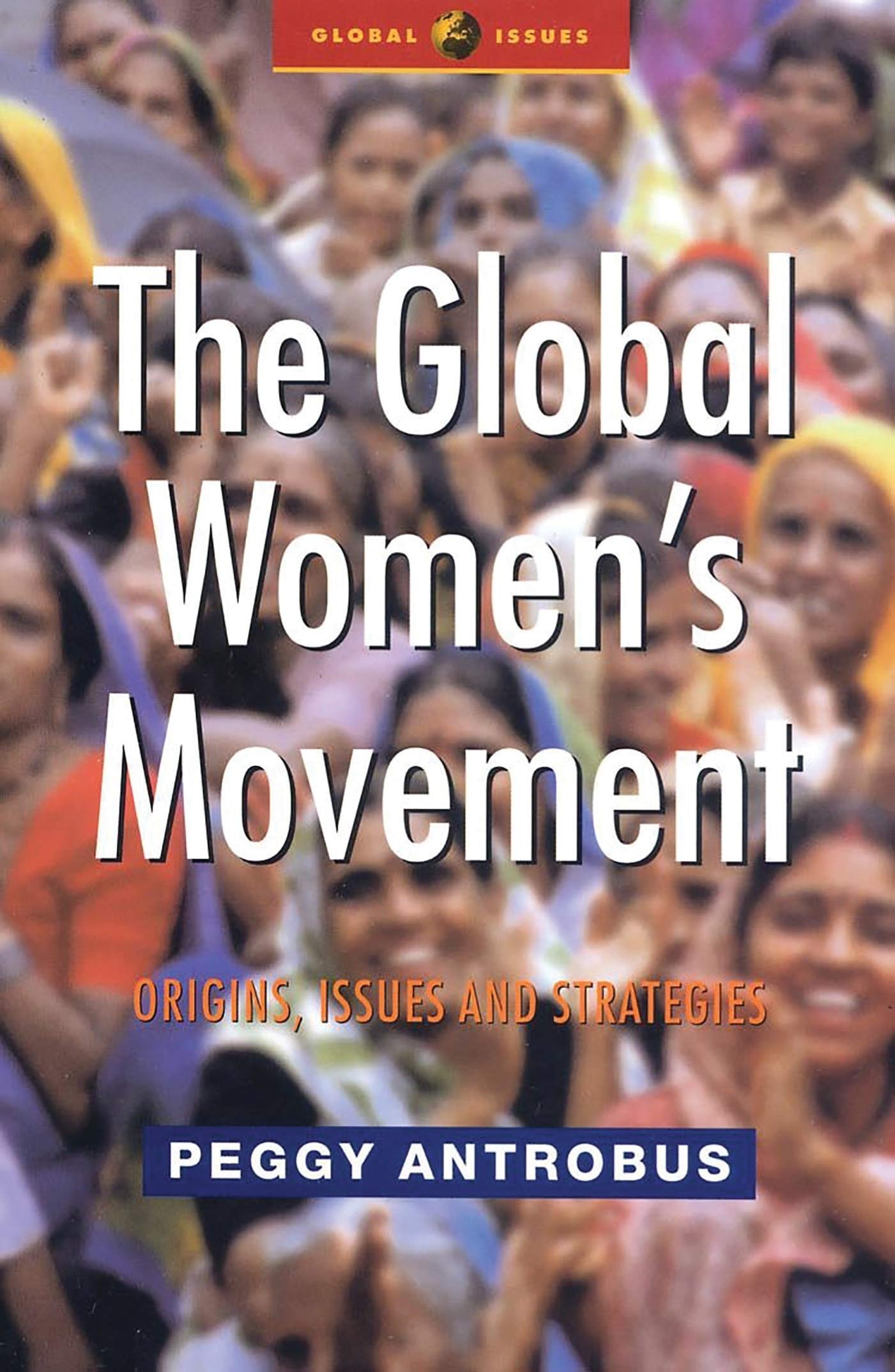
The Global Women's Movement: Origins, Issues and Strategies (Global Issues)
$43.86
by Peggy Antrobus



The spread and consolidation of the women's movement in North and South over the past thirty years looks set to shape the course of social progress over the next generation. Peggy Antrobus draws on her long experience of feminist activism to set women's movements in their changing national and global context. “This is a breath-taking attempt at documenting the challenges and triumphs of the Global Women's Movement over the past 30 years, and there are few women in this movement more qualified than Peggy Antrobus to take this on.” ― Bisi Adeleye-Fayemi, Women's Rights in Development “A fascinating book where the researcher and the activist come together to tell the history of a revolutionary movement that changed the way we think about gender and sexuality, social justice and human rights, the political economy and power.” ― Carmen Barroso, Western Hemisphere Region “This is a must read for all activists, policy makers and scholars who care about the future of equity and justice in the world.” ― Charlotte Bunch, Rutgers University “A reflection on the international women's movement by one of its most important leaders is both timely and stimulating.” ― Noeleen Heyzer, UNIFEM Nalini Visvanathan is an independent researcher living in the Washington, DC area. A native of India, her research and publications cover women's health in the population context, education and the empowerment of adolescent girls, women's movements and community-based participatory research. Her doctorate is in interdisciplinary communication with an emphasis on development studies. Lynn Duggan, Professor of Labor Studies since 1997 and PhD economist, teaches at Indiana University Bloomington. She has written articles and book chapters on free trade and social policy, feminist comparative economic systems, family policy in East and West Germany, and reproductive rights in the Philippines. Laurie Nisonoff, Professor of Economics, has taught economics, economic history and women's studies at Hampshire College in Amherst, Massachusetts, USA, since 1974. She is an editor of the Review of Radical Political Economics, and served as the co-ordinator of the RRPE 6th Special Issue on Women, 'Women in the International Economy'. She has published alone and with Marilyn Dalsimer on women in China, and on the labour process. Nan Wiegersma is Professor of Economics, Emeritus, at Fitchburg State College, Massachusetts. She has published numerous articles on land tenure, gender and development. Her article “Peasant Patriarchy and the Subversion of the Collective in Vietnam” was reprinted in the research anthology Gender and Development: Theoretical, Empirical and Practical Approaches, Volume I, Lourdes Beneria Ed. She is author of Vietnam: Peasant Land, Peasant Revolution and is coauthor (with Joseph Medley) of US Development Policies toward the Pacific Rim. She was the Women and Development Expert for the United Nations on a World Food Programme mission to Vietnam. She was also a coeditor of the first edition of The Women Gender and Development Reader. Nan was a Fulbright Fellow in Nicaragua, studying women's work in export processing zones. The research from this study was published in Women in the Age of Economic Transformation, Aslanbegui et al. Eds. (1994) and Women in Globalization, Aguilar and Lacsamana Eds. (2004). The Global Women's Movement Origins, Issues and Strategies By Peggy Antrobus Fernwood Publishing and Zed Books Ltd Copyright © 2004 Peggy Antrobus All rights reserved. ISBN: 978-1-84277-017-7 Contents Abbreviations and acronyms, ix, Acknowledgements and biographical note, x, Preface, xiii, 1 Introduction, 1, 2 The global women's movement: definitions and local origins, 9, 3 Global contexts for an emerging movement: the UN Development Decades, 1960s–1970s, 28, 4 A Decade for Women: UN conferences, 1975–85, 37, 5 The Lost Decade – the 1980s, 67, 6 It's about justice: feminist leadership making a difference on the world stage, 80, 7 Political strategies and dynamics of women's organizing and feminist activism, 109, 8 The new context: challenges and dilemmas for the future, 137, 9 Leadership for moving forward, 164, 10 Epilogue: is another world possible?, 181, Bibliography, 187, Selected women's networks and websites, 189, Appendices:, 1 The World Needs the Love of a Free Woman, 191, 2 The Global Women's Strike, 193, 3 The Sisterhood is Global Institute, 195, Index, 197, CHAPTER 1 Introduction A book about a global women's movement is, inevitably, controversial. The adjective 'global' itself appears to minimize cultural and contextual differences that are valued by women's movements in different cultures and contexts, and indeed to disregard profound differences among women even within national boundaries. Realities of class, race, nationality, ethnicity, geographical location, age, sexual orientation, physical capacity, religion and political affiliation often lead to sharp d