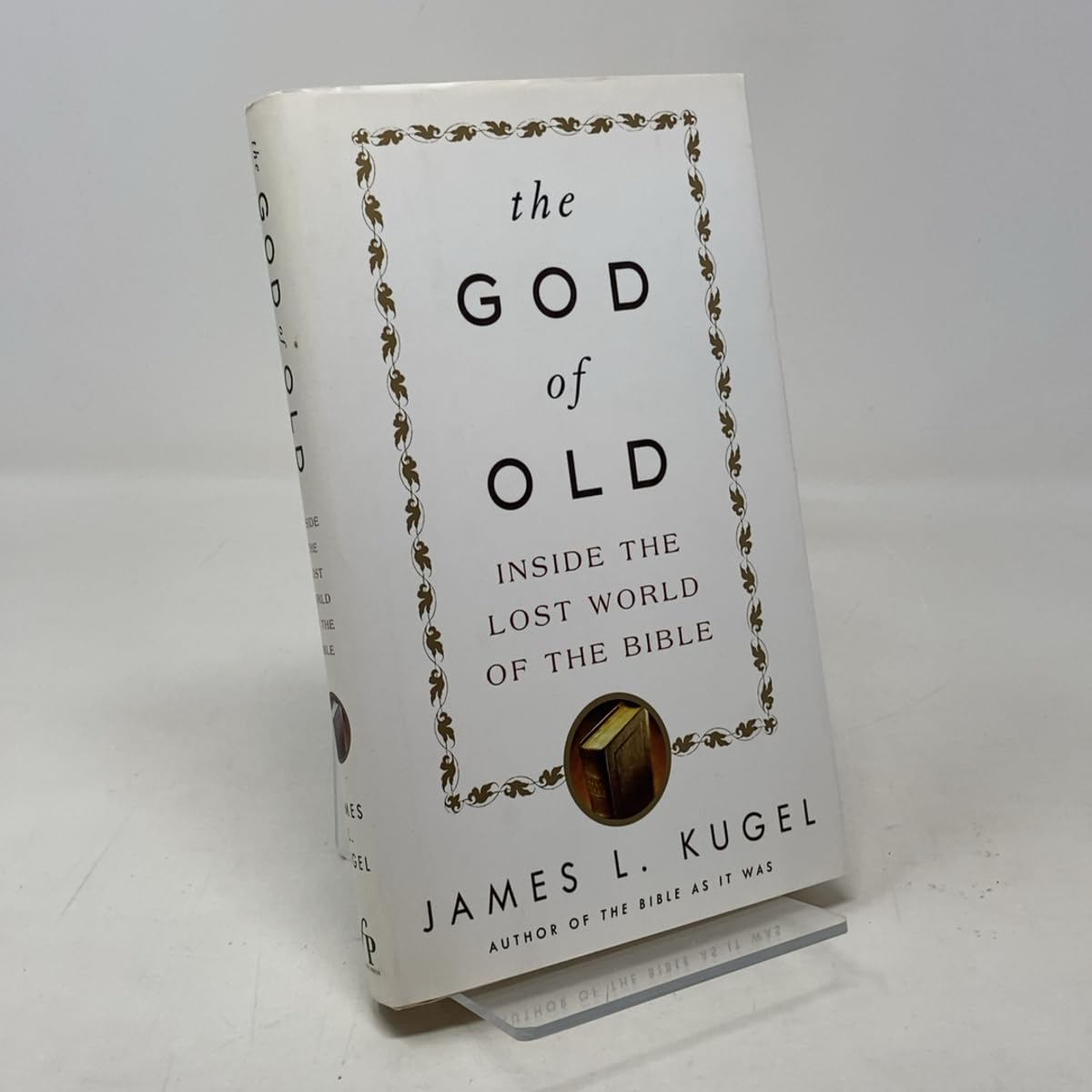



The God of the modern world -- all-powerful, all-knowing, invisible, and omnipresent -- has been a staple of Western civilization. Yet in this remarkable book, James Kugel shows that this God is not the same as the God of most of the Hebrew Bible, the God who appeared to Abraham, Moses, and other biblical heroes. That God, the "God of Old," was actually perceived in a very different way -- a way that has much to teach modern believers. James Kugel is renowned for his investigations into the history of the biblical era, a time beginning more than three thousand years ago, when the Bible's earliest parts first took shape. Now he goes even deeper, attempting to enter the spiritual world of ancient Israelites and see through their eyes God as they encountered him. The God of Old appeared to people unexpectedly; He was not sought out. Often He was not even recognized, at first mistaken for an ordinary human being. The realm of the divine was not as it is today -- a spiritual dimension set off from the material world. The spiritual and the material overlapped, and the realm of the dead was a real domain just beyond the world of the living. Ordinary reality was in constant danger of sliding into something else, something stark but oddly familiar. God was always standing just behind the curtain of the everyday world. Kugel suggests that this alternative spirituality is not simply an archaic relic, replaced by a "better" understanding. Kugel's picture of the God of Old has much to tell us about God's very nature, and about the encounter between Him and human beings in today's world. This is a book to treasure side by side with the Bible, and for years to come. Kugel, a professor of Hebrew Literature at Harvard, delves into the Bible to find the answer to this question: Why is the God of the ancient texts, who walked and talked with the patriarch, so different from the more distant God of today? When did the change take place and why? Kugel suggests that there was a time when Israelites perceived God as near and dear, but that, during the Babylonian exile, he took on a more omniscient role. Named angels such as Gabriel and Michael then came to the fore, preserving a holy personification. Less clear is Kugel's effort to explain his passion for understanding the ancient worship of God in terms of something he calls "the Project," which he defines as a commitment to getting to the bottom of a particular experience, "to see how far it goes." Unlike many biblical scholars, Kugel has an engaging writing style, and although he tends to meander a bit through the centuries, his enthusiasm and insight will attract anyone interested in Old Testament studies. Ilene Cooper Copyright © American Library Association. All rights reserved Peter J. Gomes Harvard University, author of The Good Book Once again my colleague James Kugel presents us with an irresistible book about the Bible. The lost world of the Bible has been made accessible to us by an expert, and again we stand in the debt of a gifted scholar and gregarious guide to the land and look of God. -- Review James L. Kugel is Starr Professor of Hebrew Literature at Harvard University, and Professor of Bible Studies at Bar-Ilan University in Israel. He is the author of a number of books of biblical scholarship, including The Great Poems of the Bible (1999) and The Bible As It Was (1997). In 2001, Kugel was awarded the prestigious Gawemeyer Prize in Religion. He lives in Jerusalem, Israel, and in Cambridge, Massachusetts. James L. Kugel is Starr Professor of Hebrew Literature at Harvard University and Visiting Professor of Bible Studies at Bar-Ilan University in Israel. Chapter One: The Project My field is the study of ancient texts. I have spent the better part of my life working on them, mostly texts from the Hebrew Bible, the Dead Sea Scrolls, and other writings of the ancient Near East, but also Hebrew texts from the middle ages. One thing I have learned through my years of studying is that authors, although they are writing on some specific topic and for some definite purpose, often end up telling more than they set out to. Especially if a text is of any length or substance, it can open a window onto the inner world of the person who wrote it, revealing something crucial about how that person saw and understood things in general. Such information is often far more valuable than whatever it was the author had consciously set out to write about. The reason is that the author himself, and all the things he thought were obvious or took for granted, are by now long gone. The text is the only thing we have that will allow us to enter that lost world and, with some effort, restore its way of understanding, of seeing. The trick, of course, is to know how to allow a text to tell everything it knows about its author and his world. This afternoon, I was in the library studying a poem written by a Hebrew poet of the middle ages. It is a poem about the soul, and reading