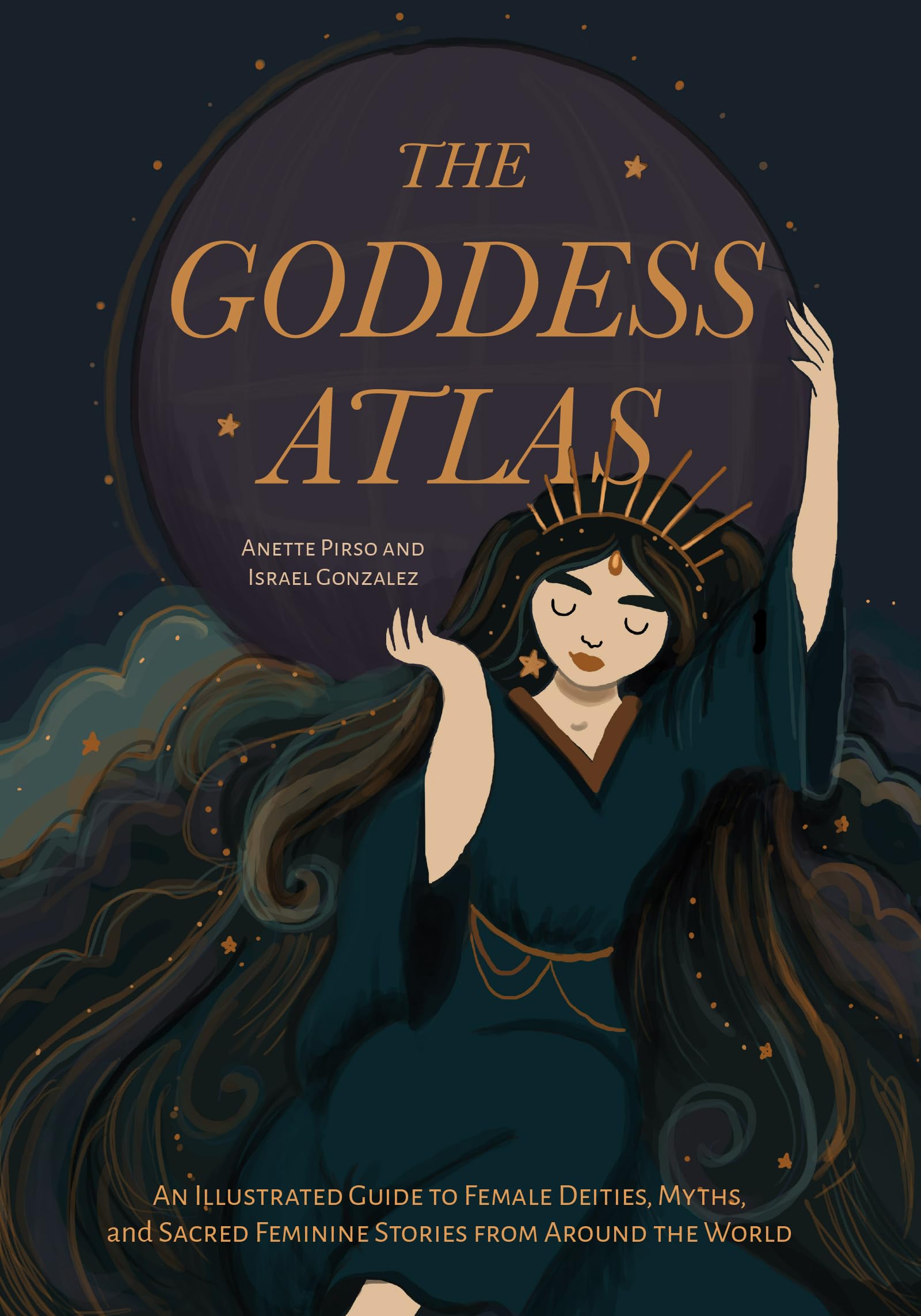
The Goddess Atlas: An Illustrated Guide to Female Deities, Myths, and Sacred Feminine Stories from Around the World (Goddess Mythology, Divine
$49.99
by Anette Pirso



Explore the Sacred Feminine Worldwide Step into a world where goddesses reign. In The Goddess Atlas , illustrator and storyteller Anette Pirso brings to life 90 female deities from myths, legends, and spiritual traditions around the globe. #1 New Release in Mythology & Folklore Encyclopedias, New Age Goddesses, and Folklore & Mythology Studies From the Olympians of ancient Greece to powerful figures from Indigenous, African, Asian, Slavic, and lesser-known cultures, each illustrated profile offers both beauty and depth. Learn each goddess’s original cultural, historical, and mythological context, pronunciation guidance, and quotes from ancient sources. Designed for readers of goddess mythology books , divine feminine books , and anyone drawn to spiritual history, The Goddess Atlas is both an inspiring art object and an inclusive reference. Move beyond the typical Western lens and celebrate a diverse, global tapestry of sacred feminine wisdom. Inside, you’ll find: Stunning full-color portraits of 90 goddesses from around the world - Rich mythological and cultural context for each figure - A celebration of the sacred feminine in global history and spirituality If you liked Goddesses in Everywoman , The Divine Feminine Oracle , or Seeds from the Sacred Feminine , you’ll love The Goddess Atlas . Anette Pirso is a self-taught illustrator and storyteller. Her work focuses on visual storytelling, cultural preservation, and the female religious symbol. She has illustrated for books, companies, and private clients, and held a lecture and exhibited at Castlefest (NL). With a focus on myth and the sacred feminine, she has previously authored The Divine Feminine and the Femme Folk Oracle Deck . The Goddess Atlas showcases her illustrated exploration of global goddess myths and spiritual traditions. Her online platform includes over 160,000 followers on Instagram (@Anetteprs), where she shares original illustrations and narratives. Her work has been featured in feminist, historical, and metaphysical art circles. She lives in Tallinn, Estonia. Israel Gonzalez is a writer of poetry and prose, often weaving intricate mythological themes with unrequited romance and highly structured rhyming patterns. His work is heavily influenced by his deep appreciation for classic literature, Pre-Raphaelite artwork, and alliteration. Although currently based in Rhode Island, Israel draws inspiration from his Mexican American heritage with the aim of making mythology both accessible and enjoyable for everyone. Israel has collaborated on several successful projects with illustrator Anette Pirso, where they join their love of mythology and the divine through art and writing, resulting in beautifully balanced endeavors. Aphrodite “...tell me the deeds of golden Aphrodite Kypria, who stirs up sweet passion in the gods and subdues the tribes of mortal men...” —Homeric Hymn to Aphrodite (Hymn V) According to the classical narrative of her origins within Hesiod’s Theogony, Aphrodite (af-ruh-dahy-tee) famously emerged from seafoam following the death of the sky god Uranus. As the Greek goddess of sex, love, and beauty, she was said to be completely irresistible to any who laid eyes upon her, be it a god or mortal. Although she was adopted into the Greek pantheon, historians trace her worship under various names throughout ancient Mesopotamia and Phoenicia before the rise of the Greek Empire. The allure of Aphrodite was so captivating that in order to avert perpetual war between the gods over her favor, Zeus dictated that she must marry Hephaestus, the god of blacksmiths. Despite the marriage, the goddess remained resolute in the belief that she could take a lover as she pleased. The most notable figure amongst her conquests was Ares, the god of war, with whom she would bear at least eight children, including Eros (Cupid). Aphrodite also played a role in the instigation of conflict in other narratives. The promise of Helen’s love to Paris, a key event in Homer’s Iliad, ignited the fabled Trojan War. Although predominantly recognized for her dominion over infatuation and attraction, Aphrodite was also acknowledged as a protector of ancient seafarers. Due to her association with Venus, the planet that shines the brightest in the night sky and the name of her Roman equivalent, she was considered to be an invaluable point of reference for those voyaging across the oceans. Artists and sculptors frequently looked to Aphrodite for inspiration, and she became a common fixture amongst temples in the form of statues, paintings, and other assorted mediums. She was most often depicted nude, either standing in the company of birds and marine life or laying on her side within large clam shells adorned with flowing fabrics. Artio “...revolving forever as constellations around the Pole Star, axis mundi of the heavenly vault.” —Historical Atlas of World Mythology, Joseph Campbell, 1988 Artio (ahr-tee-oh), the “She-Bear,” is the illusive Celtic