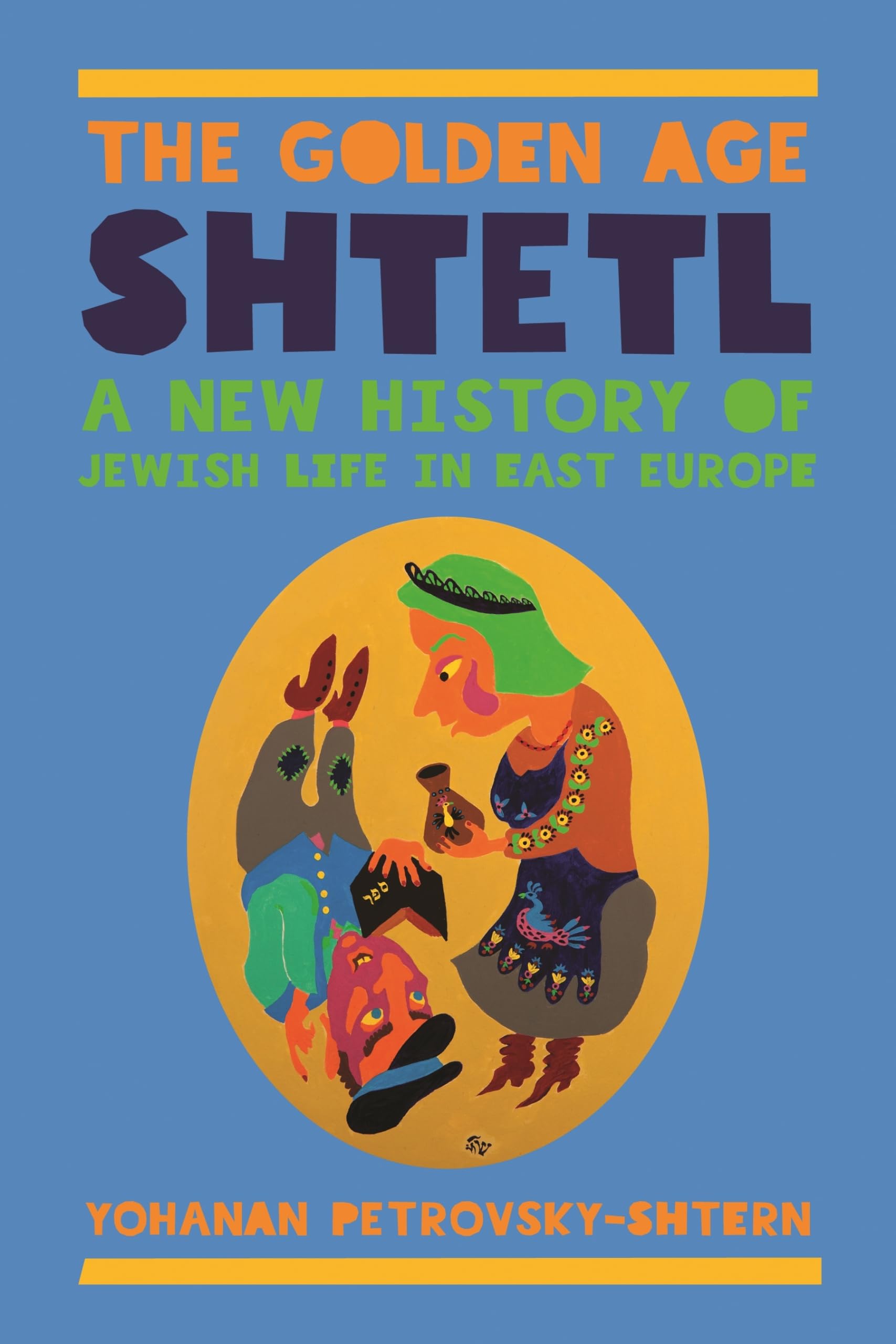
The Golden Age Shtetl: A New History of Jewish Life in East Europe
$20.00
by Yohanan Petrovsky-Shtern



A major history of the shtetl's golden age The shtetl was home to two-thirds of East Europe's Jews in the eighteenth and nineteenth centuries, yet it has long been one of the most neglected and misunderstood chapters of the Jewish experience. This book provides the first grassroots social, economic, and cultural history of the shtetl. Challenging popular misconceptions of the shtetl as an isolated, ramshackle Jewish village stricken by poverty and pogroms, Yohanan Petrovsky-Shtern argues that, in its heyday from the 1790s to the 1840s, the shtetl was a thriving Jewish community as vibrant as any in Europe. Petrovsky-Shtern brings this golden age to life, looking at dozens of shtetls and drawing on a wealth of never-before-used archival material. Illustrated throughout with rare archival photographs and artwork, this nuanced history casts the shtetl in an altogether new light, revealing how its golden age continues to shape the collective memory of the Jewish people today. "Winner of the 2014 National Jewish Book Award in History (Gerrard and Ella Berman Memorial Award), Jewish Book Council" "Honorable Mention for the 2015 PROSE Award in European & World History, Association of American Publishers" "One of Choice's Outstanding Academic Titles for 2015" "Petrovsky-Shtern . . . succeeds in vividly evoking a Jewish world that survived not merely in spite of its neighbors but in complex collaboration with them. . . . [A] moving feat of cultural reclamation and even, in its way, an act of quiet heroism." ---Jonathan Rosen, New York Times Book Review "[ The Golden Age Shtetl ] is a colorful, exhaustively researched study of a period when Jews were fully at home in shtetl life." ― Publishers Weekly "Petrovsky-Shtern turns some of the received knowledge about Jewish history on its head as he delves into rich, formerly classified primary sources delineating the evidence of Jewish economic power during the transition between the partitions of Poland by Russia (1772-1775) and the advent of the Russian military age, beginning in the 1840s, which brought xenophobia and nationalism. . . . Petrovsky-Shtern's book is lively and entertaining. A welcome study that is by turns picturesque and scholarly, startling and accessible." ― Kirkus "Yohanan Petrovsky-Shtern . . . has written a work that should be required reading for all those interested in, perplexed by or driven to madness by this subject. The produce of prodigious archival research, primary source materials and mastery of numerous languages, The Golden Age Shtetl tells a history that has rarely been transmitted in scholarly books, around the dinner table or even in Yiddish literature." ---Jonathan Brent, Moment Magazine "[T]he author's 15 years of research, 355 pages of lively writing and archival photos more than achieve his goal of recreating 'a three-dimensional, colorful and picturesque shtetl.'" ---Neal Gendler, American Jewish World "If earlier accounts of the shtetl, such as Zborowski's Life Is With People , described it as 'not a place but a state of mind,' then Petrovsky-Shtern's work restores a physicality or material reality to the shtetl. Here are a series of locations with a real history, as opposed to a 'timeless existence.' And, along with other modern historians, Petrovsky-Shtern gives us a context to understand the places where many of our grandparents and great-grandparents came from." ---Aaron Howard, Jewish Herald Voice "The vibrancy of shtetl life in the days before it was destroyed by the Russian state comes through vividly. This book should appeal to anyone interested in Jewish or Eastern European history." ---Frederic Krome, Library Journal "In The Golden Age Shtetl , Petrovsky-Shtern draws on thousands of previously classified archival sources from six countries, in seven languages, to provide a vivid account of life in the villages and towns that came to be called shtetls . . . . The author makes a compelling case that between 1790 and 1840, the shtetl was a far different place from its late-19th-century successor, which is now universally associated with poverty and pogroms." ---Glenn C. Altschuler, Jerusalem Post "[T]he amount of detail Petrovsky-Shtern uncovered is amazing. . . . The book's combination of history and anthropology worked extremely well. . . . Petrovsky-Shtern has produced something new and original. Anyone interested in the history of Eastern European Jews would do well to pick up a copy." ---Rabbi Rachel Esserman, Reporter "[H]ighly readable and rich with observed detail. . . . Petrovsky-Shtern gives us something even more precious--a glimpse of the shtetl at its moment of greatest glory." ---Jonathan Kirsch, Jewish Journal "Using a wide variety of archival sources, Perovsky-Shtern not only stakes his claim to what the shtetl is (at least during the historical period he calls the 'golden age of the shtetl,' roughly the first half of the 19th century), but also brings it to glorious