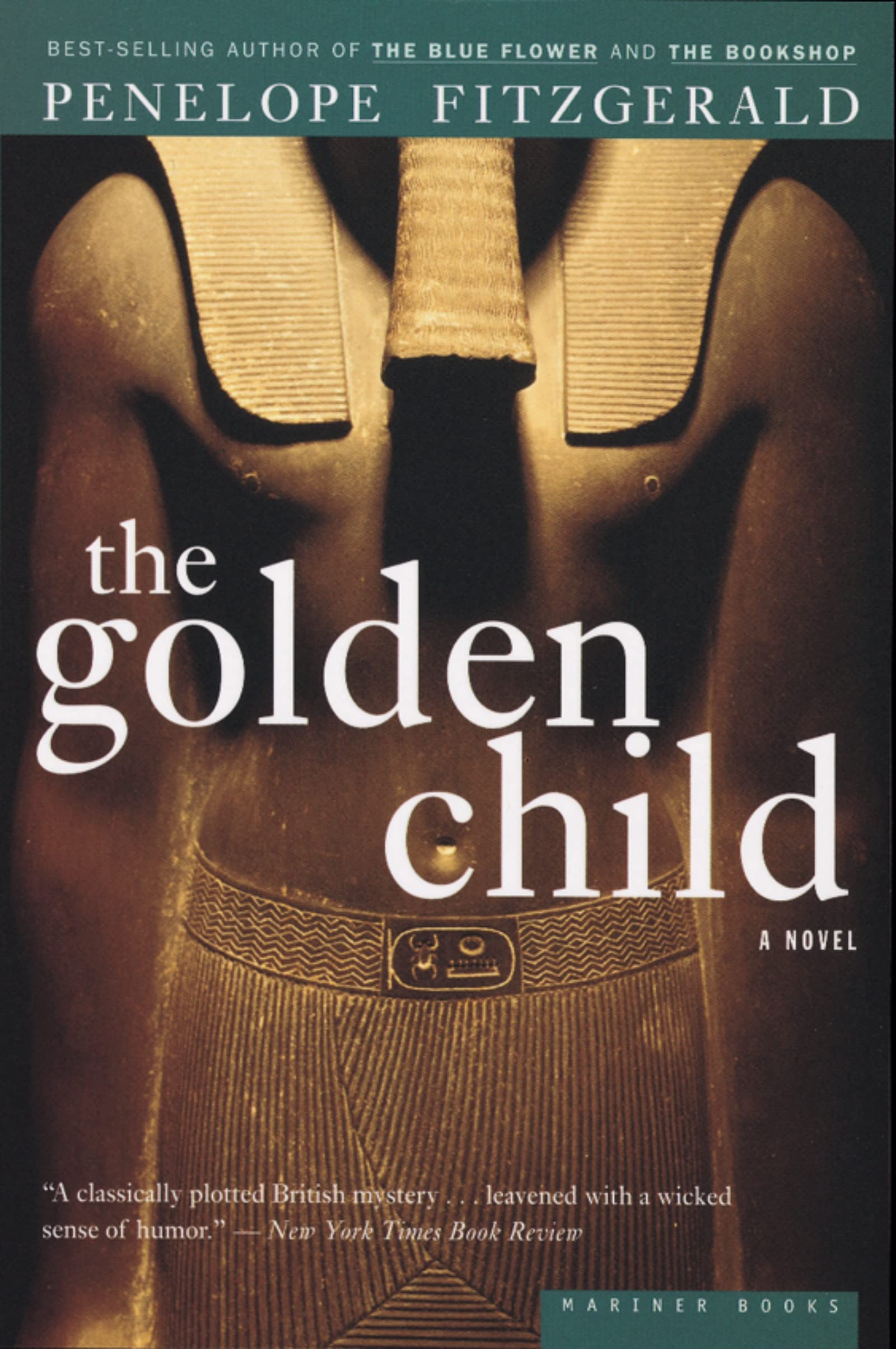
The Golden Child: A Deft Comedy of Manners Meets Classic Literary Mystery – Terrifically Witty Read
$10.06
by Penelope Fitzgerald



Penelope Fitzgerald's novel, The Golden Child , combines a deft comedy of manners with a classic mystery set in London's most refined institution—the museum. When the glittering treasure of ancient Garamantia, the golden child, is delivered to the museum, a web of intrigue tightens around its personnel, especially the hapless museum officer Waring Smith. While prowling the halls one night, Waring is nearly strangled. Two suspicious deaths ensue, and only the cryptic hieroglyphics of the Garamantes can bring an end to the mayhem. Fitzgerald has an unerring eye for human nature, and this satirical look at the art world delivers a terrifically witty read. Penelope Fitzgerald's first novel is packed with institutional follies and fiercely territorial old trouts. Set in a London museum whose officers only appear august, The Golden Child literally proves that authorities are clowns and clowns authorities. As the book opens, all England is queuing up to see the golden treasure of the Garamantes--the remains of a young king who was interred complete with a trove of toys and goodies. Only the man who unearthed the kinglet back in 1913 refuses to go anywhere near the exhibit, despite his constant proximity: "Sir William, in extreme but clear-headed old age, and after a lifetime of fieldwork, had come to roost in the Museum itself." Meanwhile, everyone--from nations to corporations--wants a piece of the Golden Child. (The exhibit is even underwritten by a company that hopes its puff, "Silence is Golden," will give its cigarettes more positive associations.) What, then, if the relics are cursed--or fake? As both possibilities grow increasingly likely, and the Museum risks ridicule, its director deputizes Waring Smith to transport the mummy's doll to an incorruptible expert. Too bad if Professor Semyonov is in Russia: this junior officer will simply have to smuggle the toy in! Suffice it to say that Waring's covert odyssey to Moscow is but one of The Golden Child 's many witty--and enigmatic--episodes. Near the Kremlin, he comes upon a line that makes him think he's back at work. The citizens, though, have assembled for another mummy altogether: The park statues were covered with shrouds of straw to protect them against the cold, but the human beings stood there, wiping the frozen drops from noses and eyelashes, waiting with immemorial patience to see what they had been told was worth seeing. In an hour and a half they would be filing past the embalmed head and hands, and the ghastly evening dress suit, of Lenin. On the surface, Fitzgerald's 1977 novel is a bona fide mystery, complete with a body in the library and a spot of garroting. But adepts of this author will prize it for its pixilated cast of characters and for its gentle, perfect assaults on pretension--whether academic, journalistic, or even gustatory. As ever, Fitzgerald is drawn to explore the power--and sheer inconvenience--of the emotions. No wonder The Golden Child 's mysteries go so far beyond those of its genre. --Kerry Fried "A classically plotted British mystery . . . leavened with a wicked sense of humor. Nobody is safe: pompous art critics with their gobbledygook, precious aesthetes, heads of departments, the public, the cops . . . Miss Fitzgerald has been around - the plot flops all over the place, including a trip to Russia. Somehow Miss Fitzgerald, thanks to her lovely writing style and eye for the absurd, makes everything hang together." -- Newdigate Callendar The New York Times "Reading "The Blue Flower," Fitzgerald's 1995 novel about the German romantic poet Novalis, whichwon the National Book Critics Circle Award, gave me a shock of pleasure in her originaland uncommonly forceful literary presence. (That book, by the way, should be requiredreading for all writers and devotees of historical novels.) With the re-issue of "The GoldenChild" and "At Freddie's," all nine of Fitzgerald's novels are now available in Americanpaperback editions. Her dryly smiling wit, more reminiscent of French aphorists than British novelists, was fully evident in her first book, "The Golden Child." It's plotted as a classically dotty English murder mystery, featuring eccentric but deadly ambitious art curators." -- reviewed by Brigitte Frase Newsday PENELOPE FITZGERALD wrote many books small in size but enormous in popular and critical acclaim over the past two decades. Over 300,000 copies of her novels are in print, and profiles of her life appeared in both The New Yorker and The New York Times Magazine . In 1979, her novel Offshore won Britain's Booker Prize, and in 1998 she won the National Book Critics Circle Prize for The Blue Flower . Though Fitzgerald embarked on her literary career when she was in her 60's, her career was praised as "the best argument ... for a publishing debut made late in life" ( New York Times Book Review ). She told the New York Times Magazine, "In all that time, I could have written books and I didn’t. I think you can