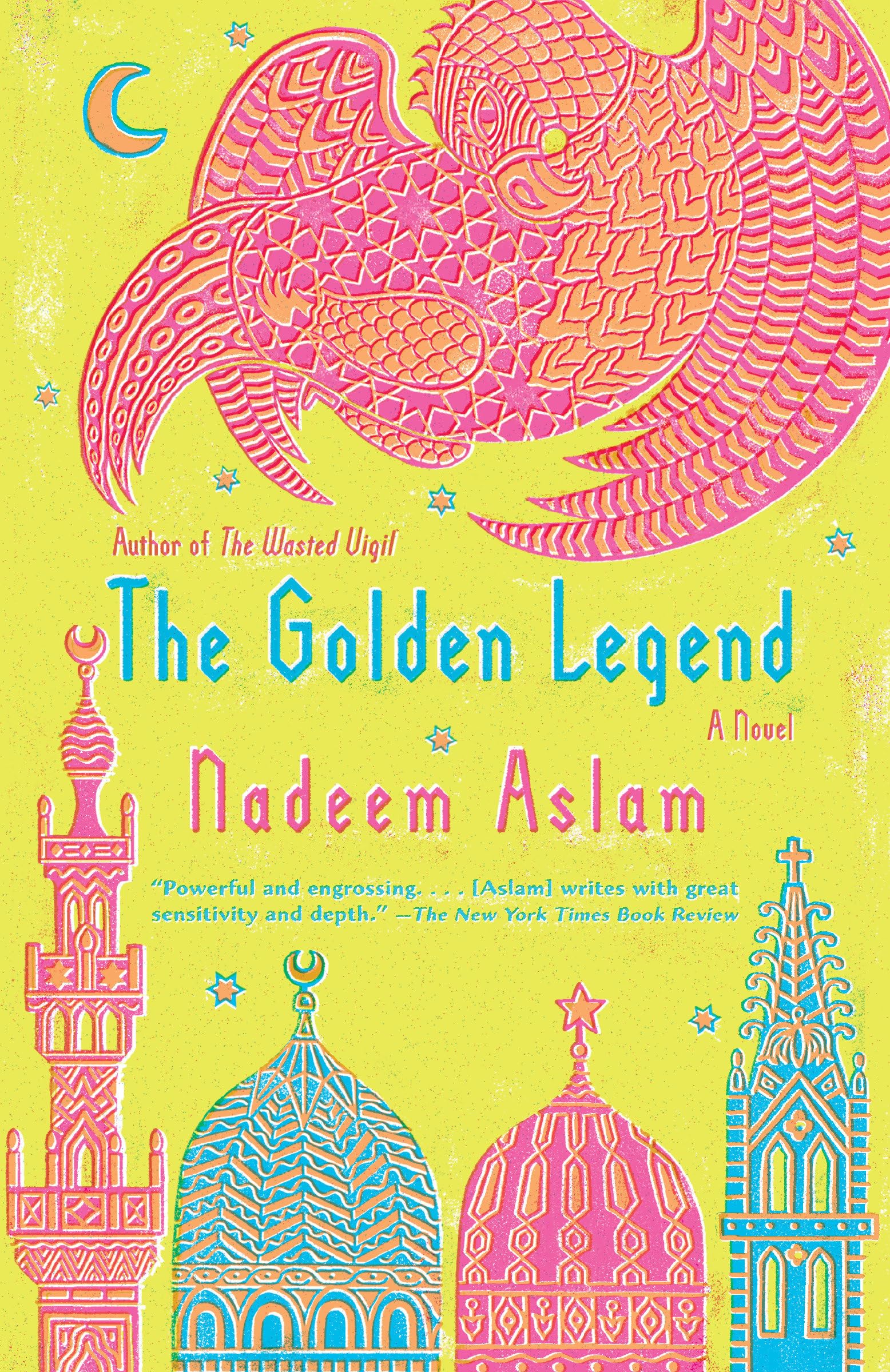



When shots ring out on the Grand Trunk Road in the fictional Pakistani city of Zamara, Nargis’s life begins to crumble around her. Soon her husband—and fellow architect—is dead and, under threat from a powerful military intelligence officer, she fears that a long-hidden truth about her past will be exposed. For weeks someone has been broadcasting people’s secrets from the minaret of the local mosque, and, in a country where even the accusation of blasphemy is a currency to be bartered, the mysterious broadcasts have struck fear in Christians and Muslims alike. A revelatory portrait of the human spirit, in The Golden Legend , Nadeem Aslam gives us a novel of Pakistan’s past and present—a story of corruption and resilience, of love and terror, and of the disguises that are sometimes necessary for survival. One of the Best Books of the Year: The Christian Science Monitor , The Economist , and LitHub “Powerful and engrossing. . . . [Aslam] writes with great sensitivity and depth.” — The New York Times Book Review “Stunning. . . . [ The Golden Legend is] masterful and compelling fiction, intricately layering symbols and parallels, unspooling its plot in dramatic twists until the very last sentence.” — The Boston Globe “A powerful and timely comment on the precarious state of religious minorities in Pakistan and an honest mirror to the Pakistani state and society.” — The Washington Post “Beautifully imagined.” — The Wall Street Journal “Remarkable. . . . The Golden Legend is extravagant with imagery and elaborate with metaphor.” — The Economist “A heart-pounding and timely novel about kinship and resilience.” — O, The Oprah Magazine “A magical book. . . . Aslam’s writing is lyrical and expansive. . . . He’s a brilliant novelist, one of two or three truly great writers in the world today. His work reminds me of Orhan Pamuk at an earlier stage of his career. And, yes, like Pamuk, Nadeem Aslam ought to be awarded the Nobel Prize for Literature.” —Charles R. Larson, Counterpunch “At once a coming-of-age love story, a study of loss, and a lucid portrait of the conflicts pervading contemporary Pakistan. . . . Aslam’s crystalline prose and emotionally nuanced characters give his novel a wide resonance. . . . Though unsparing in its depiction of the brutal exercise of power, this is also a paean to human resilience.” — Financial Times “Aslam has quietly built up a body of work quite unlike that of any other novelist, detailing the worst that humans can do in prose that suggests the redemptive possibilities of art. Horror and beauty are held in precarious balance in The Golden Legend .” —Peter Parker, The Spectator “Mesmerizing . . . other-worldly astonishing. Superlatives feel downright insufficient.” — The Christian Science Monitor Nadeem Aslam was born in Pakistan and now lives in England. He is the author of four previous novels, most recently The Blind Man’s Garden . His work has been long-listed for the Man Booker Prize, short-listed for the International IMPAC Dublin Literary Award and the DSC Prize for South Asian Literature, and has won the Kiriyama Pacific Rim Book Prize, the Encore Award, the Windham-Campbell Prize, and the Lannan Literary Fellowship for Fiction. He is a fellow of the Royal Society of Literature. Prologue It was a large room. There were many shelves of books, a metal helmet for a stallion from the times of the Crusades, and there were the vertebrae of a whale from a bay in Antarctica. In one alcove was the earliest known photograph of a snowflake. The child entered the silence and stillness of the vast interior through the far door. She came past the fishing canoe resting on a long low table under the window. She was seven years old and her name was Helen. Two buildings stood next to each other at the centre of the room. Each was taller than the girl, was perhaps four times her height. During that early morning hour, the light still only half awake, she stood looking at them. They appeared to be mosques, and they were beautiful—with their families of domes, semi-domes, and minarets. She thought of them as two elaborate hats or headdresses, possibly meant for djinns or a pair of giants from a fairytale. She considered taking a few additional steps and peering through one of their windows. The colours and features were so precise and assorted—the muted shine on the walls and the arcs of the domes. She reached out and touched the detail of a painted leaf. Buildings situated within a room! Normally it was a room that existed within a building, was contained by it. She described a circle around them now. She went past the cupboard where stood the vase of dried branches brought back from Russia. They were from the apple trees that Count Tolstoy had planted with his own hands. Four of them were still alive in his orchard. The girl stopped when one of the buildings produced a creak, as though it were experiencing a mild earthquake. It stirr