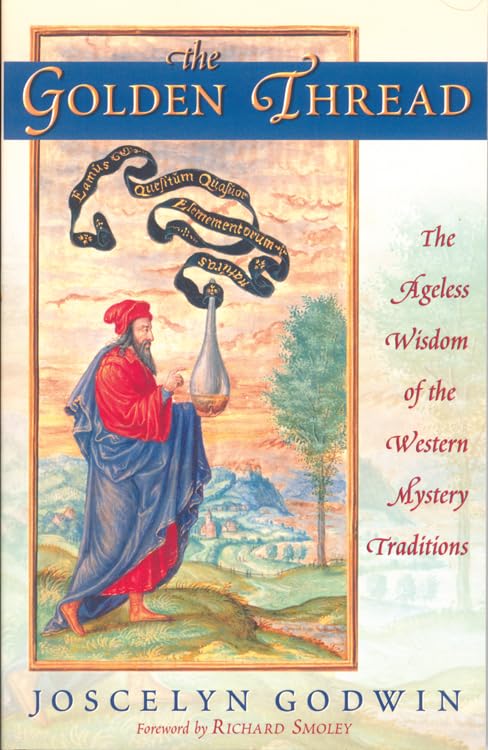
The Golden Thread: The Ageless Wisdom of the Western Mystery Traditions
$18.95
by Joscelyn Godwin



The Golden Thread traces the interconnectedness of esoteric wisdom in the Western world, from classical antiquity to contemporary Europe and America. Joscelyn Godwin lends personal perspective to an arrangement of text that is historical and wisdom that is timeless, creating a source of inspiration that calls us to action in our everyday spiritual practice. Every chapter, therefore, makes reference to some aspect of contemporary life and issues of immediate concern. Elegantly written and not without irony and humor, readers will appreciate the non-threatening tone of Godwin's writing, which is not meant to preach or convert but rather inform the public on an often baffling field. Educated readers who are curious about the esoteric and mystery traditions and interested in finding surprising, new approaches to subjects that veer away from the trends of current thought will be particularly drawn to this book. Joscelyn Godwin is a composer, musicologist and translator, known for his work on ancient music, paganism and music in the occult. He is the author of the first complete English language translation (1999) of one of the first illustrated printed texts, the incunabulum Hypnerotomachia Poliphili (1499). He teaches at Colgate University. The Golden Thread The Ageless Wisdom of the Western Mystery Traditions By Joscelyn Godwin Theosophical Publishing House Copyright © 2007 Joscelyn Godwin All rights reserved. ISBN: 978-0-8356-0860-2 Contents FOREWORD BY RICHARD SMOLEY, PREFACE, CHAPTER 1: The Prisca Theologia, CHAPTER 2: The Hermetic Tradition, CHAPTER 3: The Orphic Mysteries, CHAPTER 4: Pythagoras and His School, CHAPTER 5: Plato's Cave, CHAPTER 6: The Power of the Egregore, CHAPTER 7: The Meddling God, CHAPTER 8: The Negative Theology, CHAPTER 9: Cathedrals of Light, CHAPTER 11: The Pagan Renaissance, CHAPTER 12: The Philosopher's Dilemma, CHAPTER 13: Inner Alchemy, CHAPTER 14: The Religion of Art, CHAPTER 15: Wise Men from the East, CHAPTER 16: The End of the Thread?, NOTES, CHAPTER 1 The Prisca Theologia When the Christian humanists of the Italian Renaissance studied the newly-discovered writings of the ancient philosophers, a new era opened in the self-image of Western civilization. It had long been taken for granted that, as the Bible relates, humanity toiled in ignorance and wickedness until the true God chose to reveal himself: to Noah, Abraham, Moses, and the Hebrew prophets, and finally in person as Jesus Christ. But these philosophers of antiquity, for all that they were pagans and polytheists, turned out to display a profound wisdom and a high spirituality. Some of them surely knew more than reason alone could explain: things that could only have come to them through divine revelation. The only reasonable conclusion was that God had not left his heathen children in total ignorance, but had revealed himself through their prophets (Zoroaster, Orpheus), priest-kings (Hermes Trismegistus), and inspired philosophers (Pythagoras, Plato, Plotinus, Porphyry). The bearer of this good news was an enigmatic character: Georgios Gemistos Plethon (c.1356–1450). A high official of the Byzantine Empire (or what was left of it), he lived in Mistra in the Peloponnese, the last holdout of Christian Byzantium in the Greek peninsula. His public mission was to attend the Council of Florence and Ferrara, convened in 1438–39 in the hope of reconciling the Greek (Orthodox) and the Roman (Catholic) churches. More privately, Gemistos met with the Florentine humanists, to whom he explained his vision of a "primordial theology" ( prisca theologia ) periodically revealed to the pagan world. His lineage of the ancient illuminates began in Chaldea or Persia with Zoroaster, then moved to Thrace with Orpheus, whose disciple Aglaophemus was the link to Pythagoras and Plato. It was in honor of the latter that Gemistos had adopted the surname Plethon. The aged envoy made a powerful impression on his Italian hosts, and not least on Cosimo de' Medici, father of the famous dynasty. After his departure, Cosimo founded a Platonic Academy in his villa at Careggi, near Florence, and placed the scholarpriest Marsilio Ficino at its head. This became the center for the celebration, study, translation, and propagation of the "perennial philosophy" ( philosophia perennis ), the wisdom common to Jews, Christians, and pagans. Gemistos could produce canonical scriptures for nearly all of his ancient theologians. To Zoroaster he ascribed the Chaldean Oracles ; to Orpheus, the Orphic Hymns ; to Pythagoras, the Golden Verses , and to Plato the Republic, Laws , and other works. To these the Florentine Platonists would add the Corpus Hermeticum and its author, who was confidently assumed to be the Egyptian philosopher-king Hermes Trismegistus (see chapter 2 ). In every case but Plato's, these attributions were mistaken. The Chaldean Oracles, Orphic Hymns, Golden Verses , and Corpus Herme