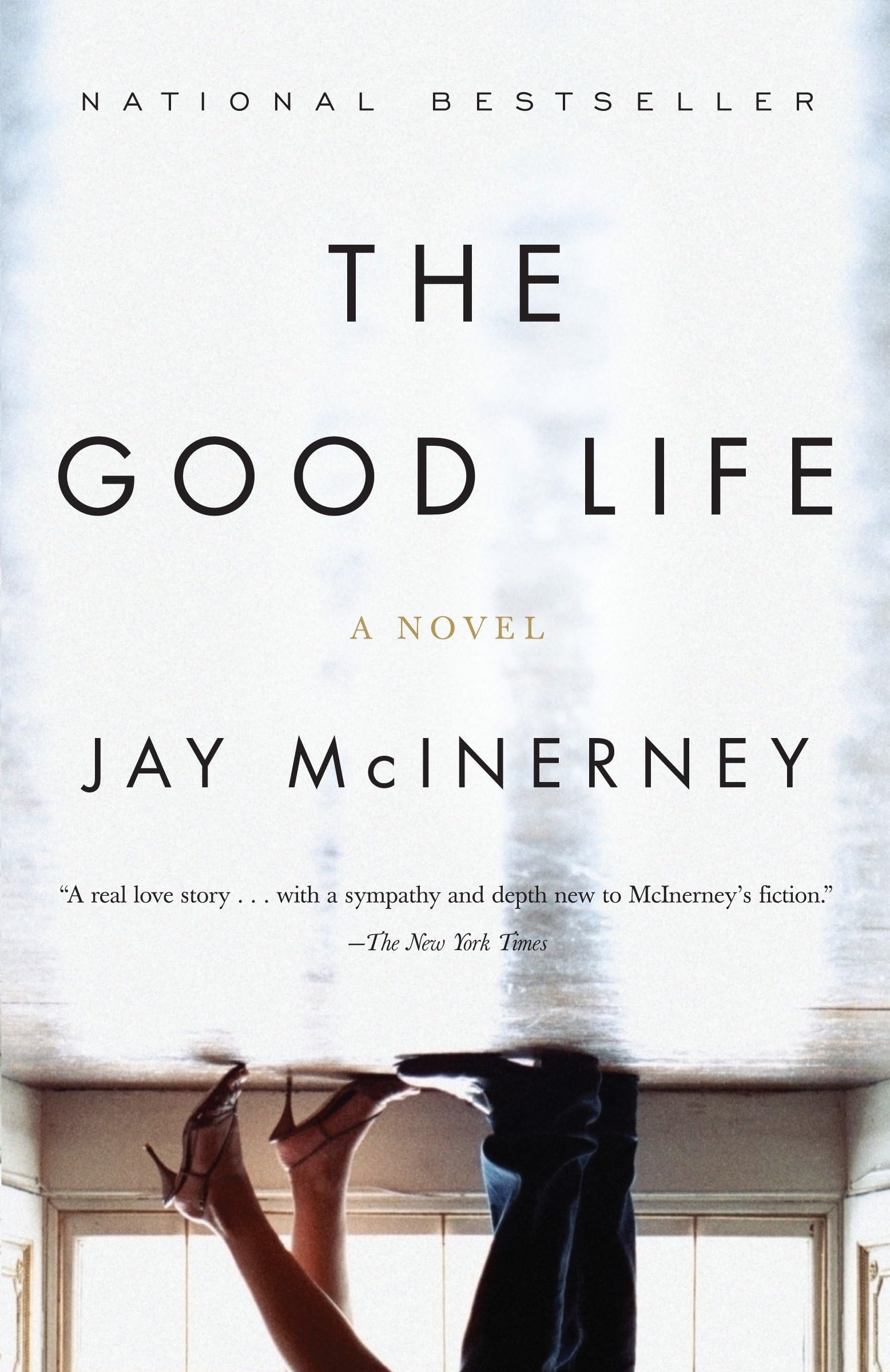



In this bestselling novel, the author of Bright Lights, Big City unveils a story of love, family, conflicting desires, and catastrophic loss in a powerfully searing work of fiction. Clinging to a semiprecarious existence in TriBeCa, Corrine and Russell Calloway have survived a separation and are wonderstruck by young twins whose provenance is nothing less than miraculous. Several miles uptown and perched near the top of the Upper East Side’s social register, Luke McGavock has postponed his accumulation of wealth in an attempt to recover the sense of purpose now lacking in a life that often gives him pause. But on a September morning, brightness falls horribly from the sky, and people worlds apart suddenly find themselves working side by side at the devastated site. Wise, surprising, and, ultimately, heart-stoppingly redemptive, The Good Life captures lives that allow us to see–through personal, social, and moral complexity–more clearly into the heart of things. “A real love story . . . with a sympathy and depth new to McInerney’s fiction.” — The New York Times “The Good Life is McInerney’s most fully imagined novel as it is his most ambitious and elegiac.” — The New York Review of Books “A triumph.”— The Village Voice “McInerney at his narrative best.”— Chicago Sun-Times Jay McInerney is the author of eight novels, a collection of short stories and three collections of essays on wine. He lives in New York City and Bridgehampton, New York. Summer used to be as endless as the ocean when she was a girl and her family rented the gray shingled cottage on Nantucket. Now, she found it hard to believe she was already back in Manhattan and the kids were in school and she was already racing home, late again, feeling guilty that she'd lingered over a drink with Casey Reynes. The kids had been home for hours after their first day in first grade, and she had yet to hear about it.Women blamed themselves; men blamed anything but.This was Corrine's interpretation of the guilt nipping at her high heels as she cantered up Hudson Street from the subway, passing the hand-lettered sign in the window of their Chinese takeout: FRESHLY GROUNDED COFFEE. Guilt about leaving the kids for so long, about not helping Russell with dinner, about attempting to restart her long-dormant professional life. Oh, to be grounded herself. Seven-fifteen by her watch. Still attuned to the languorous rhythm of the summer—they'd just closed up the house in Sagaponack four days ago—she'd barely had time to kiss the kids good-bye this morning and now the guests would be arriving at any minute, Russell frenzied with cooking and child care.Bad mother, bad wife, bad hostess. Bad .When she had yearned to be a mother, imagining what it would be like to be a parent, it had been easy to conjure the joy . . . the scenes of tenderness, the Pieta moments. What you don't picture are the guilt and the fear that take up residence at the front of your brain, like evil twins you didn't bargain for. Fear because you're always worried about what might go wrong, especially if your kids were born, as hers were, three months early. You can never forget the sight of them those first few days, intubated under glass, veined eggshell skulls and pink writhing limbs—the image stays with you even as they grow, reminding you of just how fragile these creatures are, how flimsy your own defenses. And guilt because you can never possibly do enough. There's never enough time. No matter how much love and attention you lavish on them, you're always afraid that it will never be enough.Corrine had become a connoisseur of guilt; not for her the stabbing thrust of regret for an ill-conceived act—but, rather, the dull and steady throb of chronic guilt, even as she'd done her best to rearrange her life around her kids, quitting her job to take care of them and, over the past two years, working highly flexible hours on a screenplay and on a project that was the obverse of a busman's holiday—a start-up venture called Momtomtom.com, which had been on the verge of a big launch this past spring, when the Internet bubble started to deflate and the venture capital dried up. This afternoon, she'd spent four hours making a presentation to a possible backer, hustling for seed money for the Web site. As these prospects dimmed, she'd been trying to set up meetings on the screenplay, an adaptation of Graham Greene's The Heart of the Matter . And here were the theoretical bookends of her existence, the maternal and the romantic—the latter submerged and almost extinct. In fact, that had been her secret intention in writing this script: to try to rekindle the romance and fan it back to life.Corrine hadn't wanted to be one of those mothers who paid someone else to raise her kids; for the first five years, to the astonishment of her friends and former colleagues, she'd stayed at home. Manhattan was an existential town, in which identity was a function of professional accomplishment; only the