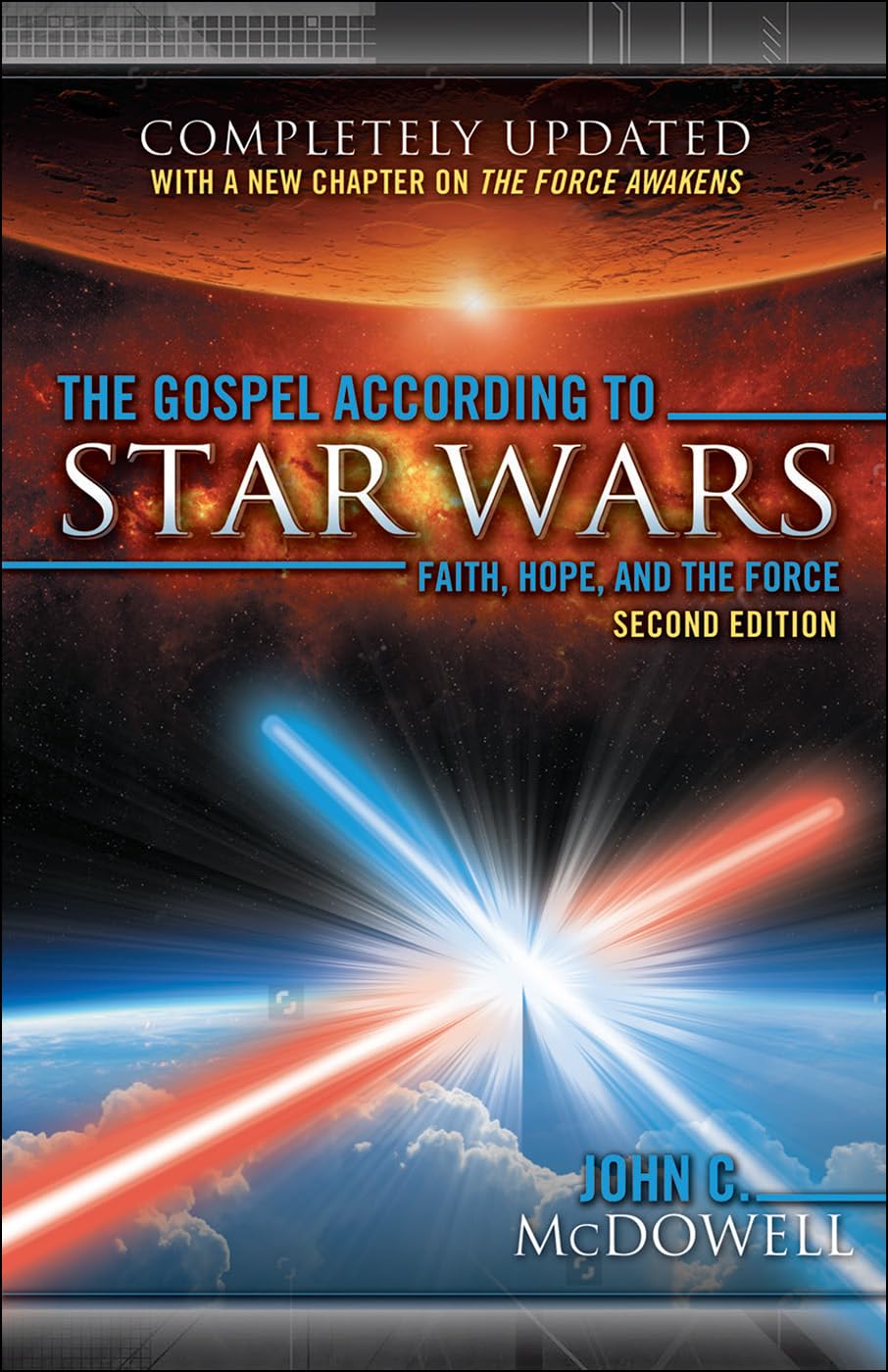
The Gospel according to Star Wars, Second Edition: Faith, Hope, and the Force
$13.69
by John C. McDowell



In a new and updated version of this best-selling book, John McDowell explores the many spiritual themes that weave throughout the Star Wars films. From the Force to the dark side, the issues discussed in the films have a moral and spiritual complexity that, if paid attention to, can help us better understand our place in the world and our relation to others and to God. George Lucas, the creator of Star Wars, did not intend for his films to be mere entertainment, McDowell argues. Rather, he hoped his films would be used as a vehicle for moral education. This new version has been thoroughly revised to include discussion of The Force Awakens and other new developments in the Star Wars universe. John C. McDowell is Professor of Theology and Director of Research at the University of Divinity, Melbourne, Australia. He is the author of numerous works on the ideologies of Star Wars. The Gospel according to Star Wars Faith, Hope, and the Force By John C. McDowell Westminster John Knox Press Copyright © 2017 John C. McDowell All rights reserved. ISBN: 978-0-664-26283-9 Contents Acknowledgments, ix, Abbreviations, xiii, Introduction, xv, 1. A New Myth: The Truthfulness of Star Wars, 1, 2. The Force of the Divine: God and the Good, 20, 3. Evil Strikes Back, 39, 4. Beware the Dark Side Within: The Tragedy of Anakin Skywalker, 58, 5. The Politics of Evil, 78, 6. Rebelling against Evil: The Violence of Star Wars, 98, 7. Feeling the Force: The Ethics of the Good Life, 117, 8. A New Hope: Redemption in Star Wars, 135, 9. Whose Force Awakens? J. J. Abram's Star Wars's Return to Violence, 146, Afterword, 176, Notes, 183, Select Bibliography, 209, Index, 215, CHAPTER 1 A New Myth The Truthfulness of Star Wars What you get out of it is what you bring to the cinema, and you read into the thing the things you want to read into it. — Gary Kurtz, cited in John Baxter, George Lucas: A Biography (London: Harper Collins, 1999), 166. One of the many reasons for watching SW is the way it relates to and reveals currents in contemporary culture (from 1977 to the present), reflecting that culture's understanding of itself and its inherent value system. Conversely the saga's success reflects a deep cultural resonance with its story that is manifested in a zealous fan base and has further enabled several of the characters to take on a life of their own (Darth Vader advertises a throat lozenge and Mark Hamill plays himself acting the Luke Skywalker character in an episode of The Simpsons, for instance). However, not only does the saga distill something of the ethos of popular culture; it is also significantly culturally generative. Put another way, it can shape and reshape the ways in which many think and feel about themselves and their world. Because of its massive appeal worldwide — particularly at a time characterized by fragmented and professionalized knowledge — SW is enviably well positioned for mass communication. It is well placed to appeal to, generate, and reinforce a certain collective consciousness with a shared stock of images, narratives, and categories. As Orson Scott Card observes, "Hardly anybody can answer the easy Bible questions on Jeopardy anymore, but almost everybody can tell you about Obi-Wan Kenobi, Darth Vader, Yoda, and The Force." James Ford suggests it even carries "more influence among young adults than the traditional religious myths of our culture." In this way the saga seems to fit Conrad Kottak and Kathryn Kozaitis's criteria for "myth": expressing "fundamental cultural values," being "widely and recurrently told among, and ... [having] special meaning to, people who grow up in a particular culture," and also "at least partly fictionalized." Yet critics such as John Baxter see Lucas's control over the saga as somewhat subverting this sense of ANH as popular mythology: Although Lucas claimed he had created Star Wars to endow mankind with the mythology it lacked, his behaviour became less and less philanthropic with the film's success. Over the next decade, he became obsessively proprietorial of his characters and ideas, ruthlessly pursuing anyone using them without permission and payment.... Real mythology, by its very nature, is communal, and open to interpretation by all. But Lucas ... hadn't given us a mythology; we could only rent it. Lucas himself is profoundly aware of the teaching possibilities available through the medium of film. He claims to have been presented with "a very large megaphone" in making his films, and he consciously uses this to provide a kind of instruction in moral matters. "Somebody has to tell young people what we think is a good person.... You need that in a society." It is this supposed mythic quality that makes SW as myth such rich material for theological and moral reflection. Steven Spielberg claims, "George [has] ... created a mythology of characters — he touched something that needed touching in everybody." SW draw