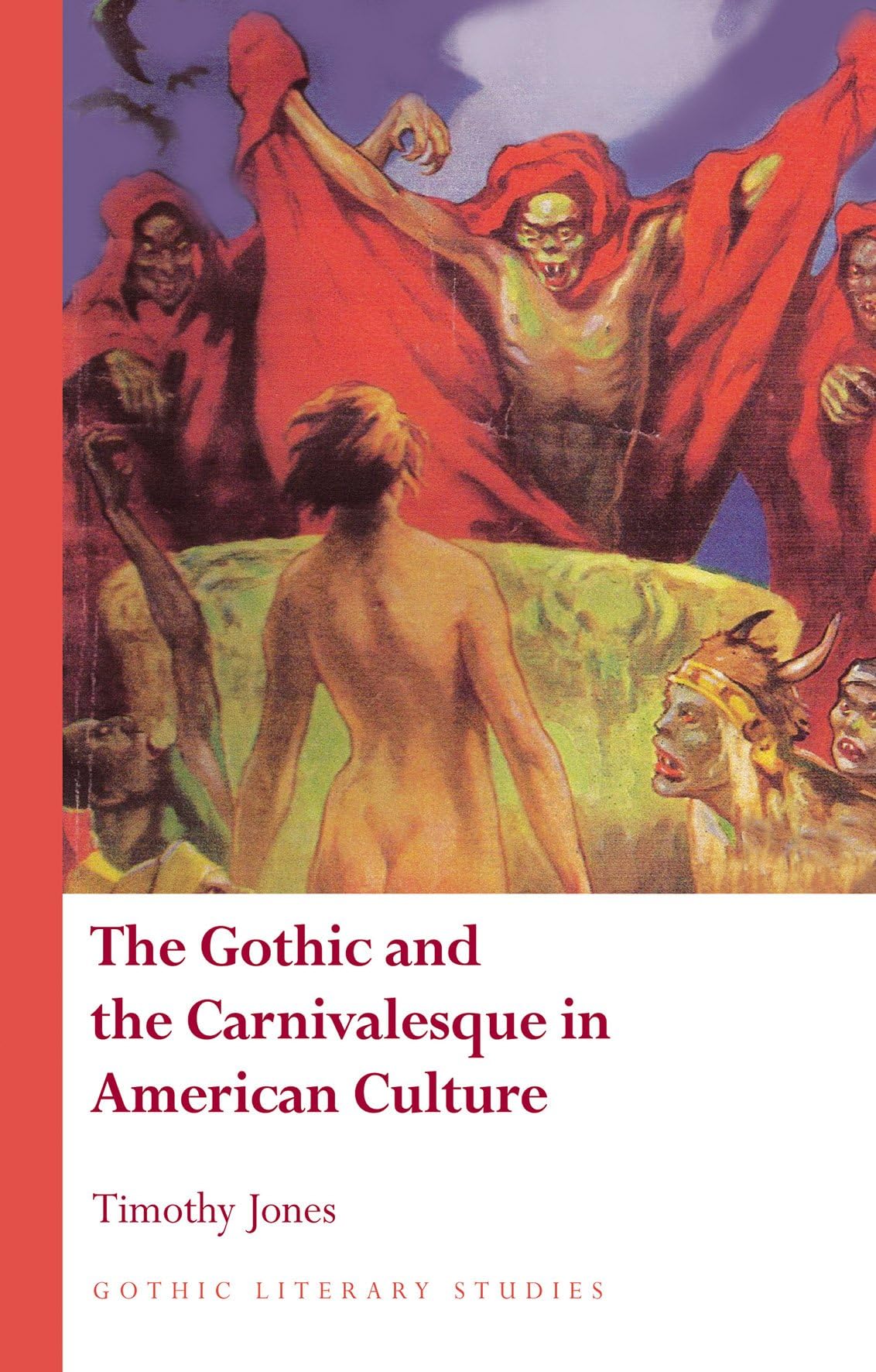
The Gothic and the Carnivalesque in American Culture (Gothic Literary Studies)
$89.52
by Timothy Jones



Writers on gothic literature and art traditionally assume the genre explores genuine historical crises and traumas—yet this does not account for the fact that the gothic is often a source of wicked delight as much as horror, causing audiences to laugh as often as they shriek. The Gothic and Carnivalesque in American Culture offers a different account of the gothic, one that focuses on the carnivalesque in American gothic works from the nineteenth to the twentieth century. Along the way, the author discusses festivals in the works of Poe, Hawthorne and Irving; the celebrations of wickedness on display in the work of Weird Tales and H.P. Lovecraft; and the exhilarating, often exuberant horrors offered up by more recent authors such as Ray Bradbury and Stephen King, and in gothic-inspired television and pop culture, such as Vampirella and American Gothic . “There is a lot of fun to be had in The Gothic and the Carnivalesque in American Culture as its argument bounces convincingly from Poe and Hawthorne to King and Oates. It deftly negotiates comics and horror TV, happily juxtaposing Weird fiction and Bradbury, and enjoying the way Rice, Brite, and Burton play goth. While its playful readings explore the extensive intrageneric reflexiveness of gothic forms, it also provides a serious reexamination of the genre's cultural and critical histories: throwing Bourdieu's habitus into the ring with Bakhtin's carnival , it produces a canny and witty mode of criticism informed by affect and practice.” -- Fred Botting, Kingston University, UK Timothy Jones is a lecturer in English at Victoria University of Wellington in New Zealand. The Gothic and the Carnivalesque in American Culture By Timothy Jones University of Wales Press Copyright © 2015 Timothy Jones All rights reserved. ISBN: 978-1-78316-192-8 Contents Acknowledgements, Introduction: Ballyhoo, 1 Theory, Practice and Gothic Carnival, 2 'The Delight of its Horror' – Edgar Allan Poe's Carnivals and the Nineteenth-Century American Gothic, 3 Weird Tales and Pulp Subjunctivity, 4 Ray Bradbury and the October Aura, 5 'Hello, again, you little monsters!' – Hosted Horrors of the 1950s and 1960s, 6 Stephen King, Affect and the Real Limits of Gothic Practice, 7 Every Day is Halloween – Goth and the Gothic, Conclusion: Waiting for the Great Pumpkin, Notes, Works Cited, CHAPTER 1 Theory, Practice and Gothic Carnival * * * Stephen King's story 'The Raft' first appeared in the pornographic magazine Gallery, before it was republished in his 1985 collection of short fictions, Skeleton Crew. It narrates the story of Randy, Deke, Rachel and LaVerne, four university students who swim out to a raft anchored fifty yards from the shore of the secluded Cascade Lake. Deke and Randy are close friends, Deke an athletics star and Randy in pre-med. We do not learn what Rachel and LaVerne are studying, only that Rachel is a blonde, nervy city girl, and LaVerne is a brunette. In any case, these details are incidental. The narrative is not really interested in representing people but in destroying them; unluckily for the friends, the lake is menaced by an amorphous, hypnotising black blob that devours them, one by one. Rachel dies first. Deke is next, gruesomely pulled between the planks of the raft and consumed. LaVerne and Randy remain, scared and cold as night falls. Huddling for warmth, the pair begin to have sex, but alas, the thing envelops LaVerne's hair, which hangs down in the water, and then consumes her. Randy is left alone and hopeless for a day before he throws himself to the monster. King's narrative is interested in describing unusual mutilations of the human body. Deke virtually explodes as he is sucked through the halfinch gap in the raft's planks: Blood was pouring from Deke's eyes, coming with such force that they had bugged out almost comically with the force of the haemorrhage ... Blood streamed from both of Deke's ears. His face was a hideous purple turnip, swelled shapeless with the hydrostatic pressure of some unbelievable reversal ... As Deke dies, we learn he 'voided a great jet of blood, so thick it was almost solid'. LaVerne is reduced to an abject state as she is covered in the blood that shoots out of Deke. ' "Oooog!" she cried, her face twisted in half-mad revulsion. "Oooog! Blood! Ooooog, blood! Blood!" She rubbed at herself and only succeeded in smearing it around.' Once Rachel is caught in the blob, her arm is reduced to something that 'looked a little like a rolled roast of beef'. How should we interpret a story like this? There have been at least three critical attempts. Tony Magistrale believes one of King's major themes is the betrayal of innocence, and argues this is a useful frame in which to read 'The Raft'. Magistrale's reading makes the blob primarily a metaphor for a youthful fear of adulthood. He believes that: In its ambiguity and destructive hunger, the dark circle (reminiscent of t