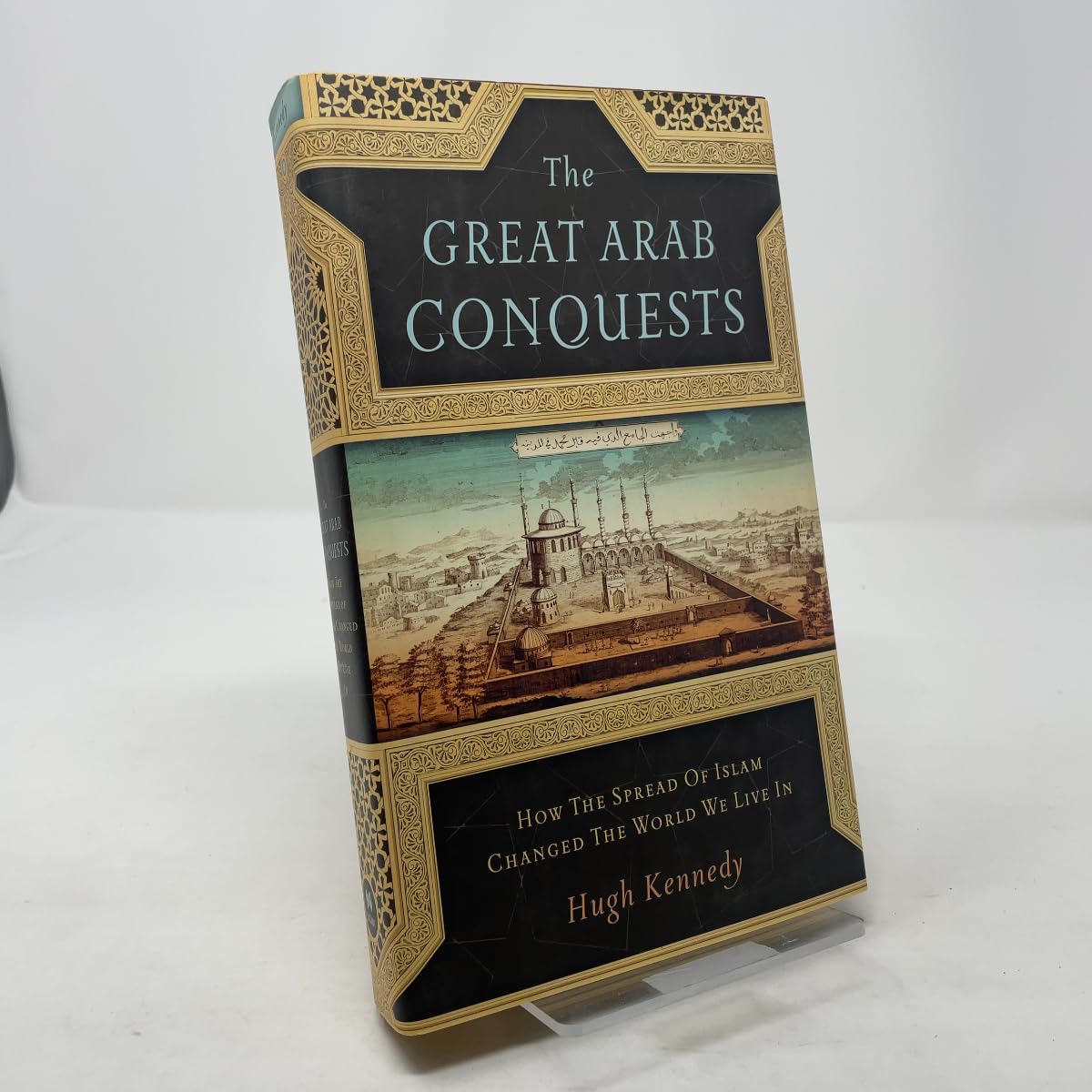
The Great Arab Conquests: How the Spread of Islam Changed the World We Live In
$52.71
by Hugh Kennedy



Today's Arab world was created at breathtaking speed. In just over one hundred years following the death of Mohammed in 632, Arabs had subjugated a territory with an east-west expanse greater than the Roman Empire, and they did it in about one-half the time. By the mid-eighth century, Arab armies had conquered the thousand-year-old Persian Empire, reduced the Byzantine Empire to little more than a city-state based around Constantinople, and destroyed the Visigoth kingdom of Spain. The cultural and linguistic effects of this early Islamic expansion reverberate today. This is the first popular English-language account in many years of this astonishing remaking of the political and religious map of the world. Hugh Kennedy's sweeping narrative reveals how the Arab armies conquered almost everything in their path, and brings to light the unique characteristics of Islamic rule. One of the few academic historians with a genuine talent for story telling, Kennedy offers a compelling mix of larger-than-life characters, fierce battles, and the great clash of civilizations and religions. In forthrightly popular style, Kennedy fascinatingly chronicles the expansion of Islam from the death of the Prophet Mohammed in 632 to the beginning of the Abbasid Caliphate in 750 (the latter the subject of Kennedy's When Baghdad Ruled the Muslim World, 2005). Relating the story, however, requires care since most sources date, as Kennedy cautions, from 150 to 250 years after the conquests they purport to describe. Kennedy's warnings engage interest as he provides the contexts of late antiquity, which lent advantage to the new religion sweeping out of Arabia. Crucially, Near East populations had been devastated by plague and by a war between Islam's political enemies: the Byzantine Empire and the Sasanian Empire of Persia. Kennedy's attention to these factors deepens his interpretations of the Islamic chronicles, which he describes as frustratingly vague on details of battles but strangely attentive to the division of booty. Explaining the élan that propelled Islam so far, so fast, and so permanently, Kennedy vividly introduces the formative establishment of Islam. Taylor, Gilbert Saudi Aramco World “A lively tour d’horizon of the Muslim world circa 750…Each section’s tight geographical focus and ample bibliography make this a helpful guide.” Claremont Review of Books , Fall 2008 “Comprehensive and scholarly…[Kennedy] is a real historian, doing what a historian ought to do…Kennedy has a good eye for a colorful story.” Military History Quarterly , Fall 2008 “Kennedy’s account is a thoughtful reminder of how even the most epochal world-changing events can turn on the unanticipated intersection of a handful of diverse contingencies.” Hugh Kennedy has taught in the Department of Mediaeval History at the University of St. Andrews since 1972. He was elected Fellow of the Royal Society of Edinburgh in 2000. Professor Kennedy lives in St. Andrews, Scotland.