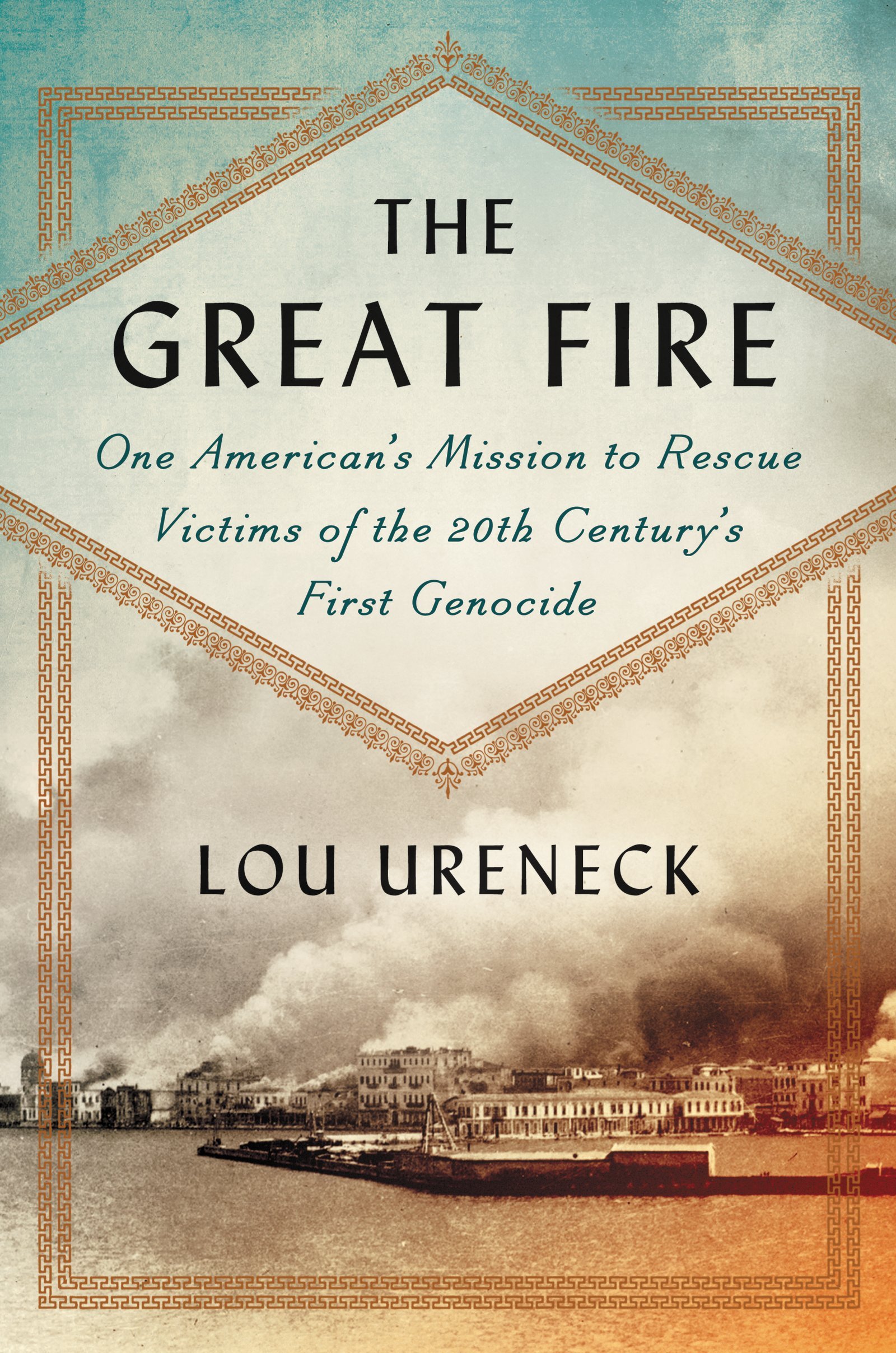
The Great Fire: One American's Mission to Rescue Victims of the 20th Century's First Genocide
$7.98
by Lou Ureneck



The harrowing story of an ordinary American and a principled Naval officer who, horrified by the burning of Smyrna, led an extraordinary rescue effort which saved a quarter of a million refugees from the Armenian Genocide. The year was 1922: World War I had just come to a close, the Ottoman Empire was in decline, and Asa Jennings, a YMCA worker from upstate New York, had just arrived in the quiet coastal city of Smyrna to teach sports to boys. Several hundred miles to the east in Turkey’s interior, tensions between Greeks and Turks had boiled over into deadly violence. Mustapha Kemal, now known as Ataturk, and his Muslim army soon advanced into Smyrna, a Christian city, where a half a million terrified Greek and Armenian refugees had fled in a desperate attempt to escape his troops. Turkish soldiers proceeded to burn the city and rape and kill countless Christian refugees. Unwilling to leave with the other American civilians and determined to get Armenians and Greeks out of the doomed city, Jennings worked tirelessly to feed and transport the thousands of people gathered at the city’s Quay. With the help of the brilliant naval officer and Kentucky gentleman Halsey Powell, and a handful of others, Jennings commandeered a fleet of unoccupied Greek ships and was able to evacuate a quarter million innocent people—an amazing humanitarian act that has been lost to history, until now. Before the horrible events in Turkey were complete, Jennings had helped rescue a million people. By turns harrowing and inspiring, The Great Fire uses eyewitness accounts, documents, and survivor narratives to bring this episode—extraordinary for its brutality as well as its heroism—to life. Praise for Backcast: “This book is a rarity: humble in its beauty, elegant in its reflection.” - Anchorage Daily News “Huckleberry Finn written by Charles Dickens, a story of self-preservation told without bathos. ... There are two adventures here, each in its own wilderness and each with its own measure of indecision, difficulty, discovery and serendipity.” - Keene Sentinel “With its poetic fineness and almost mathematical detail, fly-fishing has a gestural language which links aficionados on a stream, even in silence. It’s that language that Ureneck hoped would help reverse a widening gulf between himself and a teenage son. The hope played out in an eventful fishing trip on Alaska’s lonely Kanektok River in 2000. The father-son link was reknit, if not right away, and not necessarily in the way Ureneck imagined. ... More than a fish story, it’s an autobiography, and at the center are two broken families.” - Boston Globe “Although the fishing-trip memoir verges on literary cliché, this recounting of an Alaskan journey that Ureneck, head of BU’s journalism program, took with his son manages to more than stand out―calling to mind at times that gold standard of fish-and-family portraits, Norman MacLean’s A River Runs Through It. Exploring in equal parts the Alaskan wilderness and his tricky relationship with his son, Ureneck is not content with mere absolution; instead, he hunts for redemption, and along the way nets a fresh start with his boy.” - Boston magazine “[A] thoughtful, engaging memoir...an enjoyable, heartfelt narrative.” - Kirkus Reviews “The unflinching terrain of the Alaskan interior has yielded an unflinching memoir, one of the finest meditations on fathers and sons that I?ve ever read. There’s nothing sentimental or sugarcoated here―it’s of a piece with the landscape where it’s set. But there is quiet redemption.” - Bill McKibben, author of The End of Nature “This is a comprehensive yet intimate work of scholarship, reminding readers of a horrific moment in modern history now largely forgotten.” - Weekly Standard “This is simply a fabulous book, as deep and true as the Alaskan waters that serve as its backdrop. It is an exciting adventure story. It is a profound story of the heart. It is warm and beautiful and so sweetly honest, a father fighting for his son, to know him, to regain him, in a way that will stay and linger long after the final page is turned.” - Buzz Bissinger, author of Friday Night Lights “The Great Fire reads like a fast-paced thriller replete with vivid profiles of heroes, villains and ordinary people caught up in ethnic and religious violence.” - ABC News “The Great Fire reads like a fast-paced thriller replete with vivid profiles of heroes, villains and ordinary people caught up in ethnic and religious violence.” - The Post and Courier “[The Great Fire] is highly readable and paints a portrait of a pivotal period in world history.” - The Register Herald “Ureneck’s narrative is intense and vivid.” - Philadelphia Inquirer “The Great Fire reads like a fast-paced thriller replete with vivid profiles of heroes, villains and ordinary people caught up in ethnic and religious violence.” - Associated Press A bribe, a lie and an empty threat—these were the tools Reverend Asa K. Jennings used