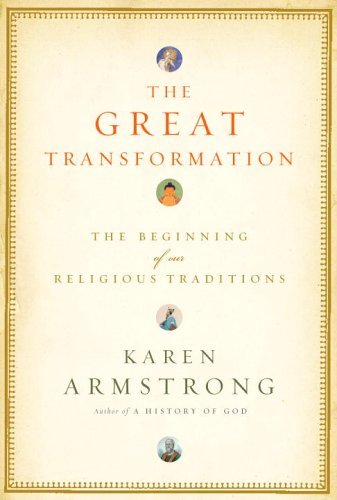
The Great Transformation: The Beginning of Our Religious Traditions
$29.01
by Karen Armstrong



From one of the world’s leading writers on religion and the highly acclaimed author of the bestselling A History of God , The Battle for God and The Spiral Staircase , comes a major new work: a chronicle of one of the most important intellectual revolutions in world history and its relevance to our own time. In one astonishing, short period – the ninth century BCE – the peoples of four distinct regions of the civilized world created the religious and philosophical traditions that have continued to nourish humanity into the present day: Confucianism and Daoism in China; Hinduism and Buddhism in India; monotheism in Israel; and philosophical rationalism in Greece. Historians call this the Axial Age because of its central importance to humanity’s spiritual development. Now, Karen Armstrong traces the rise and development of this transformative moment in history, examining the brilliant contributions to these traditions made by such figures as the Buddha, Socrates, Confucius and Ezekiel. Armstrong makes clear that despite some differences of emphasis, there was remarkable consensus among these religions and philosophies: each insisted on the primacy of compassion over hatred and violence. She illuminates what this “family” resemblance reveals about the religious impulse and quest of humankind. And she goes beyond spiritual archaeology, delving into the ways in which these Axial Age beliefs can present an instructive and thought-provoking challenge to the ways we think about and practice religion today. A revelation of humankind’s early shared imperatives, yearnings and inspired solutions – as salutary as it is fascinating. Excerpt from The Great Transformation : In our global world, we can no longer afford a parochial or exclusive vision. We must learn to live and behave as though people in remote parts of the globe were as important as ourselves. The sages of the Axial Age did not create their compassionate ethic in idyllic circumstances. Each tradition developed in societies like our own that were torn apart by violence and warfare as never before; indeed, the first catalyst of religious change was usually a visceral rejection of the aggression that the sages witnessed all around them. . . . All the great traditions that were created at this time are in agreement about the supreme importance of charity and benevolence, and this tells us something important about our humanity. " The Great Transformation can serve the needs of new readers interested in a popular work that synthesizes scholarship. . . . [U]seful to anyone seeking an integral sense of world religions." — The Globe and Mail Praise for Karen Armstrong : "Karen Armstrong is a genius." —A. N. Wilson, author of Jesus: A Life "Armstrong is a lucid writer with a knack for synthesizing vast quantities of research." — The Globe and Mail "Armstrong’s writing continues to offer a religious mirror and a cultural vision." —Amazon.com "Armstrong has a dazzling ability: she can take a long and complex subject and reduce it to the fundamentals, without oversimplifying." — The Sunday Times Karen Armstrong is the author of numerous books on religious affairs. Her work has been translated into 40 languages and she is the author of 3 television documentaries. Since September 11, 2001, she has been a frequent contributor to conferences, panels, newspapers, periodicals, and other media on both sides of the Atlantic on the subject of Islam. She lives in London. In 1948, the German philosopher Karl Jaspers coined the term "Axial Age" to denote an astonishing era, from roughly 900 B.C. to 200 B.C., in which the foundations of the world's great religions were laid. This was the time of Socrates, Elijah, Siddhartha, Confucius. In her magisterial new exploration of the era, Karen Armstrong argues that all Axial Age traditions emphasized justice and were committed to the practice of "disciplined sympathy" and compassion. The Great Transformation is Armstrong at her best -- translating and distilling complex history into lucid prose that will delight scholars and armchair historians alike, drawing connections between the distant past and our own religious practices, suggesting that the antidotes to some of contemporary religion's excesses lie in the roots of the religious traditions themselves. The Axial Age was anticipated, Armstrong writes, by the prophetic priest Zoroaster. Outraged at the violence of the Aryan warrior culture, Zoroaster conceived of the cosmos as a battle between the forces of good and evil, and he envisioned a great judgment that would eventually culminate in a world of peace and justice. Zoroastrianism is now known to us largely as a historical relic, but his "passionately ethical vision" and his determination to find a spiritual idiom that promoted peace bore fruit in the religious traditions of the Axial Age. Other sages also emerged from the conflicts of the era: In India, the Axial Age coincided with the collapse of the Har