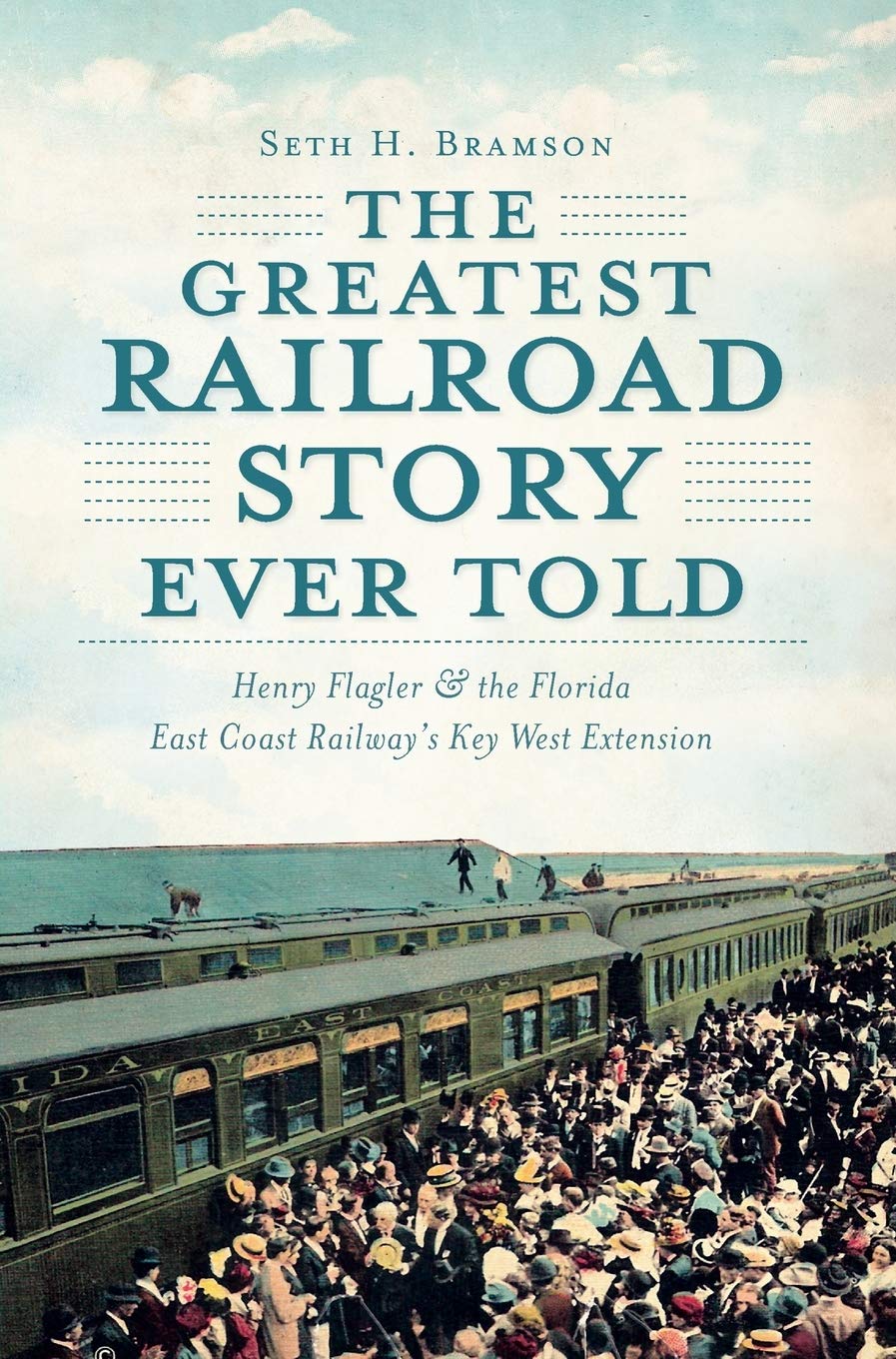
The Greatest Railroad Story Ever Told: Henry Flagler & the Florida East Coast Railway's Key West Extension (Transportation)
$15.00
by Seth H. Bramson



Although several people had considered constructing a railroad to Key West beginning in the early 1800s, it took a bold industrialist with unparalleled vision to make it happen. In 1902, Henry Flagler made the decision to extend the Florida East Coast Railway to "the nearest deepwater American port." In this book, renowned Florida historian Seth H. Bramson reveals how the Key West Extension of the Flagler-owned FEC became the greatest railroad engineering and construction feat in U.S., and possibly world, history, an accomplishment that would cement Flagler's fame and legend for all time. Join Bramson as he recounts the years of operation of this great railroad, what it did for the Florida Keys and what it meant to the resident conchs. Seth Bramson is Miami's foremost local historian. He is America's single most-published Florida history book author, with sixteen of his twenty-two books dealing directly with the villages, towns, cities, counties, people and businesses of the South Florida Gold Coast. Bob Jensen retired in Homestead as a Navy Commander after serving 28 years. He served in Germany, the Philippines, the US Embassy in Cyprus, Iceland, and twice at the National Security Agency and at Naval Security Group Headquarters in Washington D.C. The Greatest Railroad Story Ever Told Henry Flagler & the Florida East Coast Railway's Key West Extension By Seth H. Bramson The History Press Copyright © 2011 Seth H. Bramson All rights reserved. ISBN: 978-1-60949-399-8 Contents Dedication, Acknowledgements, Introduction, 1. In the Beginning, 2. "We Must Have a Railroad", 3. "Gentlemen: The Railroad Will Go to Sea", 4. A Task Like No Other, 5. "I Can Not See the Children but I Can Hear Them Singing!", 6. The Magnificence of the Bridges, 7. Right of Way and Stations, 8. Long Key Fishing Camp, 9. Trumbo Island Terminal, 10. Daily Operations, 11. The Casa Marina, 12. September 2, 1935, Epilogue. "I Can Still Hear the Whistle of Train Number 75 Blowing for the Matecumbe Crossing!", About the Author, CHAPTER 1 In The Beginning While this book is not meant to be a biography of Henry Morrison Flagler, an overview for the purpose of gaining an understanding of who he was and why he did what he did is certainly in order. Hence, a brief retrospective of a man whose legacy is that of the single greatest person in the history of the Sunshine State is, at this juncture, quite apropos. In effect, the story is similar to a biblical parable, for Henry Flagler looked at Florida shortly after his arrival and said, "This is good." And then he said, "Let there be hotels," and lo, there were hotels. And then he said, "Let there be railroads," and lo, there were railroads. And then he said, "Let there be land companies, and cities, and newspapers, and water and gas and electric companies, and paved streets and bridges," and lo, there were all of those things. Henry Flagler looked at what he had done in Florida and said, "This is good," and if one were to encapsulate the work of Mr. Flagler, that is it. But without fleshing out the story, there might be a lack of understanding as to the "why" and the "how," and that is the purpose of this chapter, for, simply put, Henry Flagler never "rested." Instead, he simply moved from great project to great project and, in the course of that work and those projects, became nothing less than a true legend in Florida's history. Regretfully, no small amount of what has been written on and about Flagler is either completely wrong, riddled with errors or sadly and woefully inadequate or misstated. The single best source for information on his life remains the first biography of him ever written, by Sidney Walter Martin, originally published in 1952 by the University of Georgia Press and titled Florida's Flagler. Subsequent biographies offered little new information, likely, to no small extent, because the authors were either unaware of or chose not to avail themselves of the railway company's archives, located in Miami. Those archives contain an immense amount of unpublished material on and about Mr. Flagler and his and the Flagler System's great works. For the first time, in this book, those archives will be fully taken advantage of. That being stated, Dr. Martin's book remains the preeminent source for previously published biographical material on Flagler. Henry Flagler was born on January 2, 1830, in the little village of Hopewell, in upstate New York, to Elizabeth and Isaac Flagler. Both Elizabeth and Isaac had been married twice before, and Henry had a half- sister (his father's daughter from a previous marriage) named Ann-Caroline, or "Carrie," and a half-brother, Dan Harkness (his mother's son from her second marriage, to David Harkness, who died in 1825). The Harkness family was from Ohio, and although Dan lived with his mother and stepfather, he, being eight years older than Henry, left New York in 1837 to return to Ohio to work in the ret