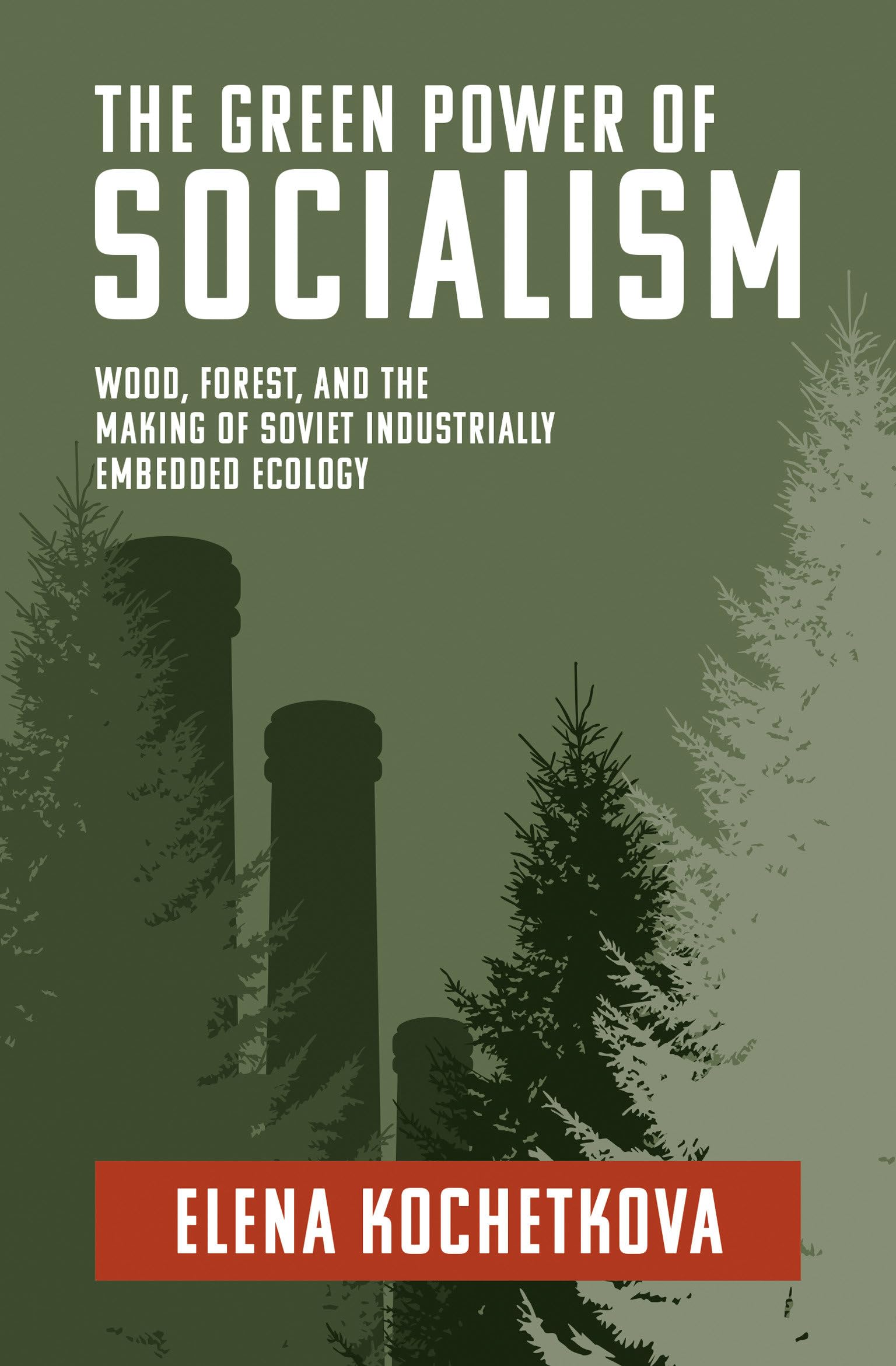
The Green Power of Socialism: Wood, Forest, and the Making of Soviet Industrially Embedded Ecology (History for a Sustainable Future)
$40.00
by Elena Kochetkova



How the Soviet forestry industry developed a unique form of industrial ecology—a commonsense approach toward natural resources for the economy and society. In The Green Power of Socialism, Elena Kochetkova examines the relationship between nature and humans under state socialism by looking at the industrial role of Soviet forests. The book explores evolving Soviet policies of wood consumption, discussing how professionals working in the forestry industry of the Soviet state viewed the present and future of forests by considering them both a natural resource and a trove of industrial material. When faced with the prospect of wood shortages, these specialists came to develop new industry-ecology paradigms. Kochetkova looks at the materiality of Soviet industry through forests and wood to show how, paradoxically, industrial ecology emerged and developed as a by-product of the Soviet industrialization project. The Green Power of Socialism also discusses how post-Soviet industry has abandoned these socialist practices and the idea of nature as a complicated ecosystem that provides a crucial service to society. Emphasizing the technological and environmental impacts of the Cold War, Kochetkova critically reconsiders two explanatory models that have become dominant in the historiography of Soviet approaches to nature over the last decades—ecocide and environmentalism. Within the context of the current environmental crisis, the book invites readers to reevaluate state socialism as a complex phenomenon with sophisticated interactions between nature and industry. In so doing, it contributes a fresh perspective on the activities of socialist experts and their view of nature, shedding light on Soviet state industrial and environmental policy and its continuing legacy in the present day. “Kochetkova’s original, dynamic approach raises the question of how best to understand the real motivations and influence of Soviet environmentalism: the book challenges the idea that solely pure scientists, who have so far attracted most of the attention of historiography, were in the heart of the green movement.” —The Russian Review “A compelling new book about the wood and forestry industry in the Soviet Union and its connection to larger industrial developments... An excellent addition to the literature on this subject.” —Choice “ The Green Power of Socialism is clearly written and lucidly argued, and it has made a fabulous addition to the scholarship on Soviet-era forestry.” —H-Net Reviews “Kochetkova offers interesting insights into the environmental consciousness of one of the central Soviet industries with a focus on the second half of the twentieth century. This provides food for debate about the possibilities and limits of resource use against the backdrop of industrial expansion.” — Ab Imperio “Kochetkova’s nuanced and significant work reveals a distinct set of practices and mentalities in the Soviet Union while powerfully connecting them to global trends that continue to this day.” —Julia Ault, H-Environment Roundtable Reviews “ The Green Power of Socialism offers fresh perspectives on environmentalism.” —Tatiana Kasperski, H-Environment Roundtable Reviews “A compact yet complex work, Elena Kochetkova’s The Green Power of Socialism answers many of its own questions and, as all good books do, raises many more questions for future researchers.” —Péter Szabó, H-Environment Roundtable Reviews “Elena Kochetkova’s The Green Power of Socialism makes an important contribution to the growing literature on Soviet environmental history.” —Katja Doose, H-Environment Roundtable Reviews “Spotlighting the importance of specialists and technocratic expertise, Kochetkova skillfully explores how wood became a crucial “modern material” in Cold War consumption and military production and how the story of ‘green gold’ unveils Soviet approaches to nature and sustainability.” —Nicholas Breyfogle, Associate Professor, The Ohio State University “In addition to giving us an x-ray of the structural problems of the Soviet forest industry, Kochetkova's fine book also shows how costly it is to ignore usable suggestions from our past.” —Douglas Weiner, Professor of History, University of Arizona Elena Kochetkova is Associate Professor in Modern European Economic History at the Department of Archeology, History, Cultural Studies and Religion at the University of Bergen. She served as a Secretary of the European Society of Environmental History from 2019 to 2021.