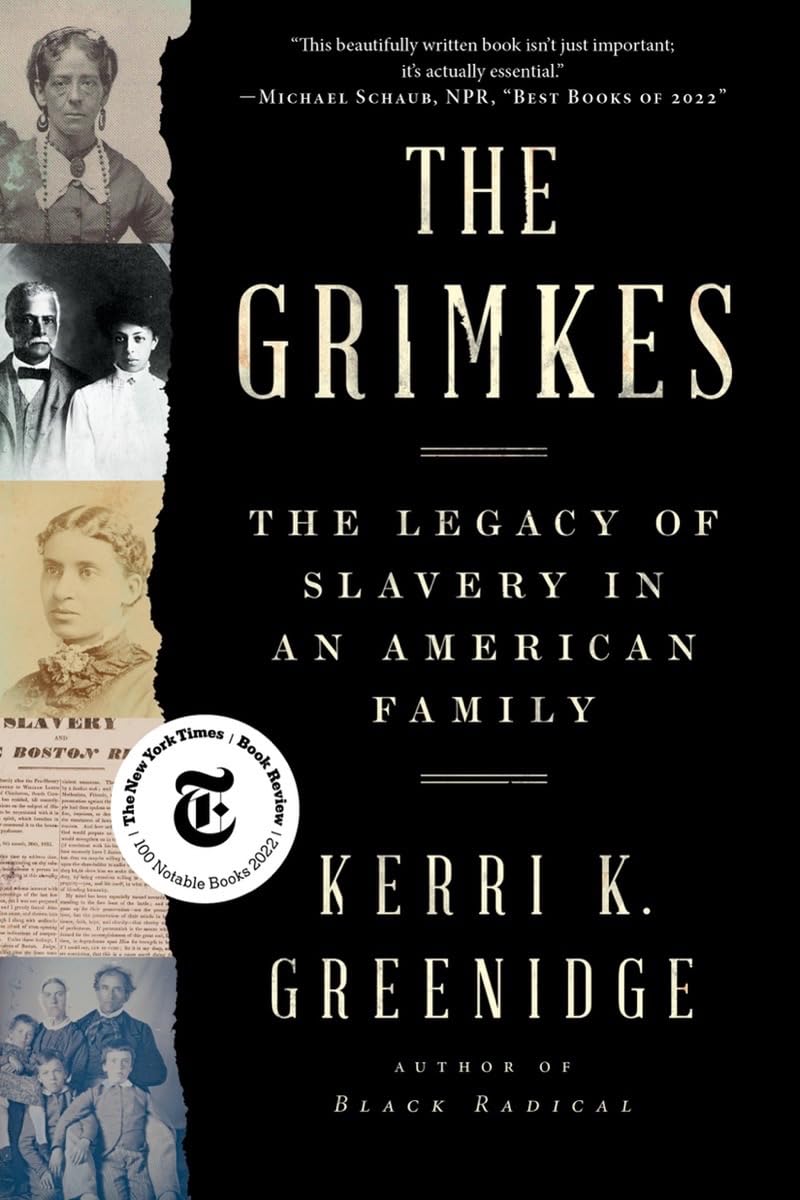



Finalist • National Book Critics Circle Award [Biography] New York Times Book Review • 100 Notable Books of 2022 Winner of the American Historical Association's Joan Kelly Memorial Prize Shortlisted for the Phi Beta Kappa Society's Ralph Waldo Emerson Award Publishers Weekly • 10 Best Books of 2022 Best Books of 2022: NPR, Oprah Daily, Smithsonian, Boston Globe , Chicago Public Library A stunning counternarrative of the legendary abolitionist Grimke sisters that finally reclaims the forgotten Black members of their family. Sarah and Angelina Grimke―the Grimke sisters―are revered figures in American history, famous for rejecting their privileged lives on a plantation in South Carolina to become firebrand activists in the North. Their antislavery pamphlets, among the most influential of the antebellum era, are still read today. Yet retellings of their epic story have long obscured their Black relatives. In The Grimkes , award-winning historian Kerri Greenidge presents a parallel narrative, indeed a long-overdue corrective, shifting the focus from the white abolitionist sisters to the Black Grimkes and deepening our understanding of the long struggle for racial and gender equality. That the Grimke sisters had Black relatives in the first place was a consequence of slavery’s most horrific reality. Sarah and Angelina’s older brother, Henry, was notoriously violent and sadistic, and one of the women he owned, Nancy Weston, bore him three sons: Archibald, Francis, and John. While Greenidge follows the brothers’ trials and exploits in the North, where Archibald and Francis became prominent members of the post–Civil War Black elite, her narrative centers on the Black women of the family, from Weston to Francis’s wife, the brilliant intellectual and reformer Charlotte Forten, to Archibald’s daughter, Angelina Weld Grimke, who channeled the family’s past into pathbreaking modernist literature during the Harlem Renaissance. In a grand saga that spans the eighteenth century to the twentieth and stretches from Charleston to Philadelphia, Boston, and beyond, Greenidge reclaims the Black Grimkes as complex, often conflicted individuals shadowed by their origins. Most strikingly, she indicts the white Grimke sisters for their racial paternalism. They could envision the end of slavery, but they could not imagine Black equality: when their Black nephews did not adhere to the image of the kneeling and eternally grateful slave, they were cruel and relentlessly judgmental―an emblem of the limits of progressive white racial politics. A landmark biography of the most important multiracial American family of the nineteenth century, The Grimkes suggests that just as the Hemingses and Jeffersons personified the racial myths of the founding generation, the Grimkes embodied the legacy―both traumatic and generative―of those myths, which reverberate to this day. 12 black-and-white illustrations "[A] revelatory investigation . . . Like Annette Gordon-Reed’s Pulitzer-winning The Hemingses of Monticello , Greenidge illuminates the dynamic of racial subordination within a slaveholding family . . . brilliant." ― Elizabeth Taylor, National Book Critics Circle "An ambitious book, not only because of its large cast of characters, but because it offers so many insights about racial strife in the United States . . . Greenidge provides a consummate cartography of racial trauma, demonstrating through an adept use of the family’s letters, diaries and other archival materials, how the physical and emotional abuses of slavery traveled through generations long after abolition . . . There is plenty of little-known American history in The Grimkes . . . An intimate and provocative account of a family’s intergenerational struggle to remake itself. [Greenidge] takes the Grimke sisters off their pedestal so that we understand them as pieces of a tapestry that could only be sewn in America. Pain, guilt and yearning lie at the seams, holding the family together and tearing it apart." ― Michael P. Jeffries, New York Times Book Review , cover review "Sisters Sarah and Angelina Grimke were two of America’s most well-known abolitionists, inspired to speak out against slavery by their Quaker faith. But the story of their family goes even deeper – their brother was a cruel sadist who fathered three children with an enslaved woman. Historian Kerri K. Greenidge digs deep into the history of the family, both its white and Black members, and the result is a fascinating examination of the legacy of slavery in America. This beautifully written book isn’t just important; it’s actually essential." ― Michael Schaub, NPR, Best Books of 2022 "[T]he historical record offers occasional glimpses into the tortured dynamics of families ‘Black and white.’ Annette Gordon-Reed’s acclaimed work on Jefferson ranks as one of the most notable of these explorations. But the history of another southern lineage, which Kerri K. Greenidge examines in her new