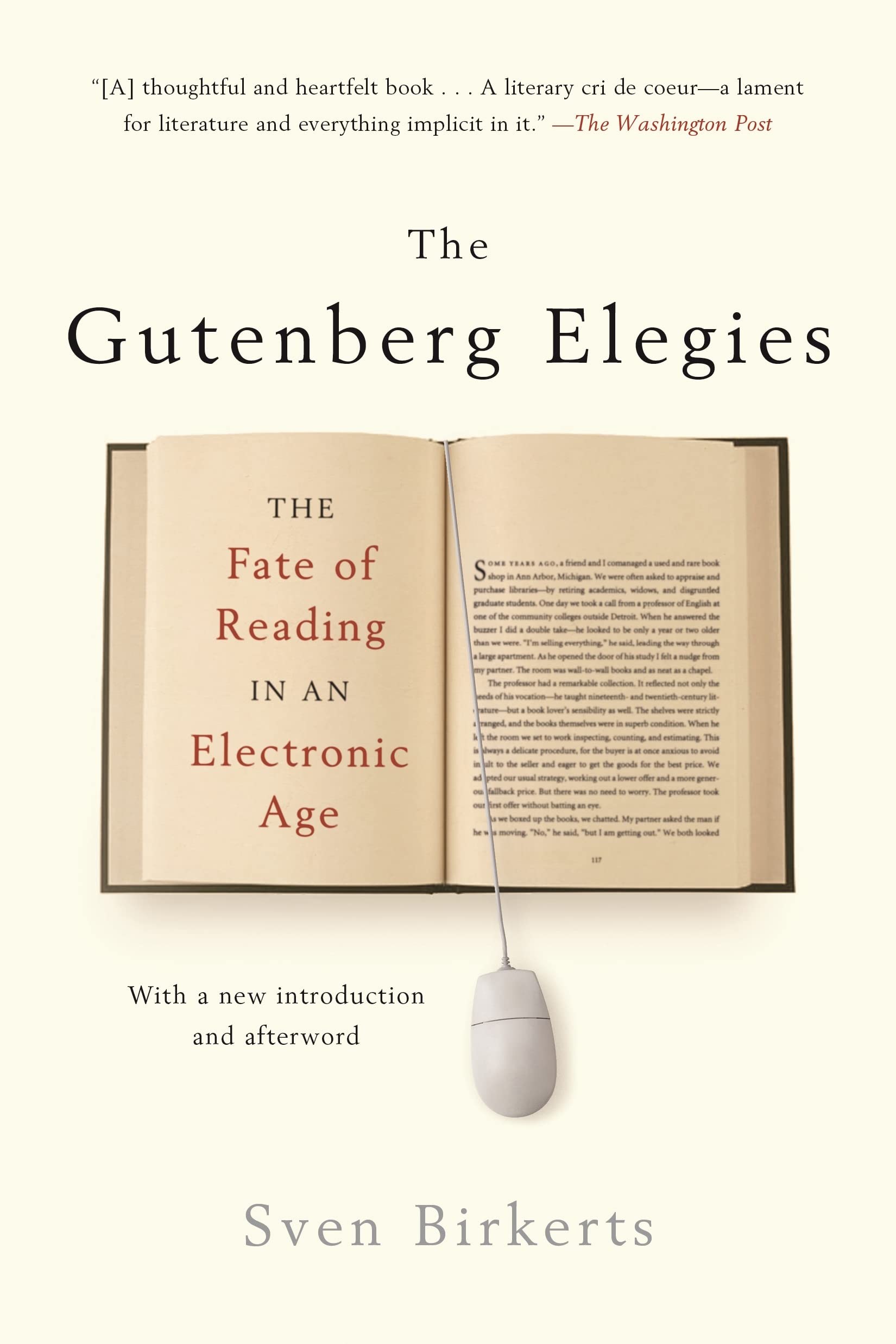



A reissue of the book that first examined the future of reading and literature in the electronic age, now with a new introduction and Afterword In our zeal to embrace the wonders of the electronic age, are we sacrificing our literary culture? Renowned critic Sven Birkerts believes the answer is an alarming yes. In The Gutenberg Elegies , he explores the impact of technology on the experience of reading. Drawing on his own passionate, lifelong love of books, Birkerts examines how literature intimately shapes and nourishes the inner life. What does it mean to "hear" a book on audiotape or decipher its words in electronic form on a laptop screen? Can the world created by Henry James exist in an era defined by the work of Bill Gates? Are books as we know them―volumes printed in ink on paper, with pages to be turned as the reading of each page is completed―dead? At once a celebration of the complex pleasures of reading and a bold challenge to the information technologies of today and tomorrow, The Gutenberg Elegies is an essential volume for anyone who cares about the past and the future of books. “Birkerts on reading fiction is like M.F.K. Fisher on eating or Norman Maclean on fly casting. He makes you want to go do it.” ― The New Yorker "[A] THOUGHTFUL AND HEARTFELT BOOK...A literary cri de coeur--a lament for literature and everything implicit in it." --The Washington Post In our zeal to embrace the wonders of the electronic age, are we sacrificing our literary culture? Renowned critic Sven Birkerts believes the answer is an alarming yes. In The Gutenberg Elegies, he explores the impact of technology on the experience of reading. Drawing on his own passionate, lifelong love of books, Birkerts examines how literature intimately shapes and nourishes the inner life. What does it mean to "hear" a book on audiotape, decipher its words on a screen, or interact with it on CD-ROM? Are books as we know them dead? At once a celebration of the complex pleasures of reading and a boldly original challenge to the new information technologies, The Gutenberg Elegies is an essential volume for anyone who cares about the past and future of books. "[A] wise and humane book....He is telling us, in short, nothing less than what reading means and why it matters." --The Boston Sunday Globe "Warmly elegiac...A candid and engaging autobiographical account sketches his own almost obsessive trajectory through avid childhood reading....This profoundly reflexive process is skillfully described." --The New York Times Book Review "Provocative...Compelling...Powerfully conveys why reading matters, why it is both a delight and a necessity." --The Harvard Review Sven Birkerts is the author of several books, including The Art of Time in Memoir , Reading Life , Readings , and The Gutenberg Elegies . He has taught at Harvard University and currently directs the Bennington Writing Seminars and is the editor of AGNI . He lives in Massachusetts. The Gutenberg Elegies The Fate of Reading in an Electronic Age By Sven Birkerts Faber and Faber, Inc. Copyright © 1994 Sven Birkerts All rights reserved. ISBN: 978-0-86547-957-9 Contents Title Page, Epigraph, Introduction to the 2006 Edition, Introduction: The Reading Wars, PART I - The Reading Self, 1 - MahVuhHuhPuh, 2 - The Paper Chase: An Autobiographical Fragment, 3 - The Owl Has Flown, 4 - The Woman in the Garden, 5 - Paging the Self: Privacies of Reading, 6 - The Shadow Life of Reading, 7 - From the Window of a Train, PART II - The Electronic Millennium, 8 - Into the Electronic Millennium, 9 - Perseus Unbound, 10 - Close Listening, 11 - Hypertext: Of Mouse and Man, PART III - Critical Mass: Three Meditations, 12 - The Western Gulf, 13 - The Death of Literature, 14 - The Narrowing Ledge, Notes, Also by Sven Birkerts, Critical Acclaim for The Gutenberg Elegies, Coda: - The Faustian Pact, Afterword to the 2006 Edition, Cited Material, Copyright Page, CHAPTER 1 MahVuhHuhPuh IT WAS VIRGINIA WOOLF who started me thinking about thinking again, set me to weighing the relative merits of the abstract analytical mode against the attractions of a more oblique and subjective approach. The comparison was ventured for interest alone. Abstract analysis has been closed to me for some time — I find I can no longer chase the isolated hare. Problems and questions seem to come toward me in clusters. They appear inextricably imbedded in circumstance and I cannot pry them loose to think about them. Nor can I help factoring in my own angle of regard. All is relative, relational, Einsteinian. Thinking is now something I partake in, not something I do. It is a complex narrative proposition, and I am as interested in the variables of the process as I am in the outcome. I am an essayist, it seems, and not a philosopher. I have had these various distinctions in mind for some time now, but only as a fidgety scatter of inklings. The magnet that pulled them into