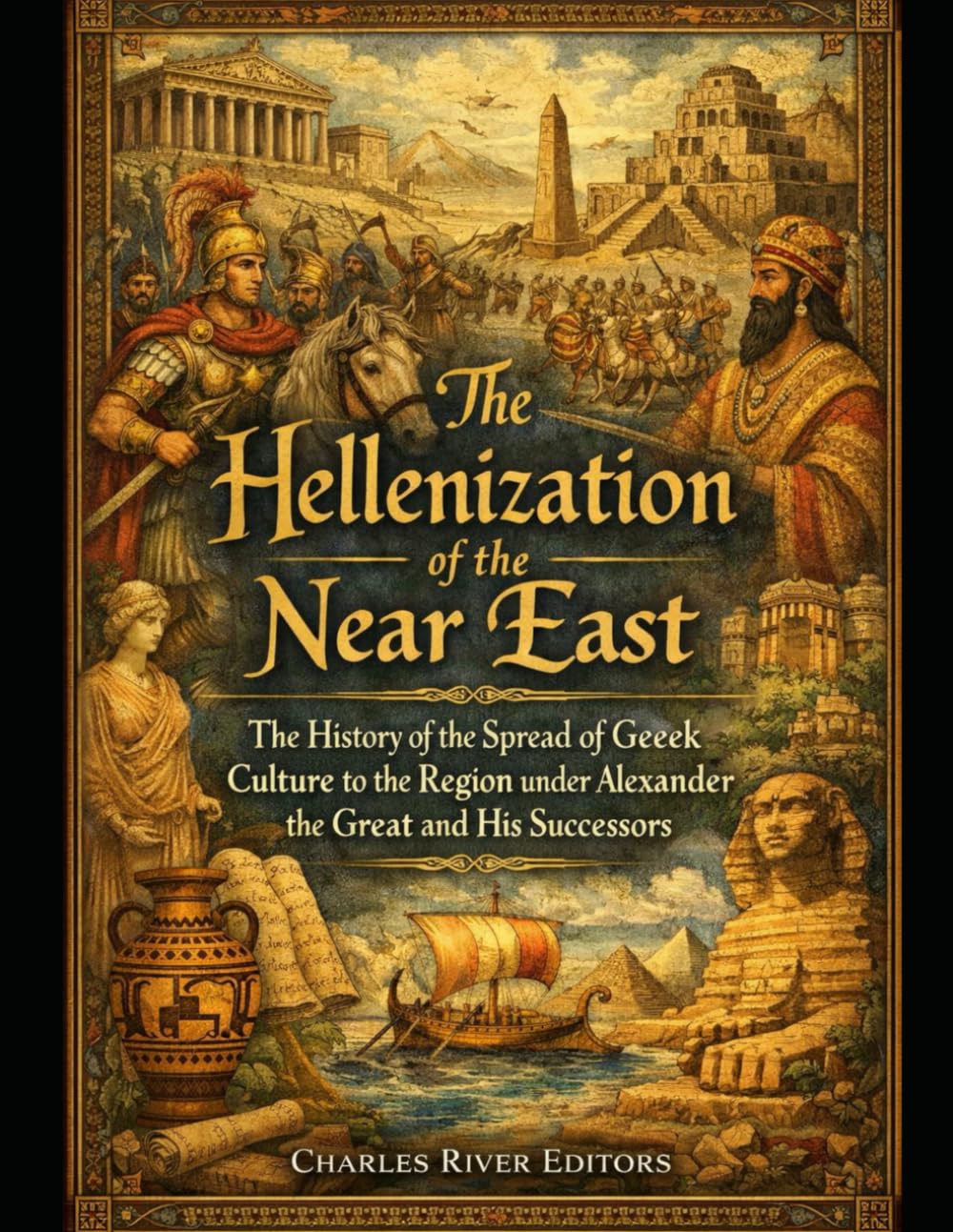
The Hellenization of the Near East: The History of the Spread of Greek Culture to the Region under Alexander the Great and His Successors
$14.99
by Charles River Editors



Over the last 2,000 years, ambitious men have dreamed of forging vast empires and attaining eternal glory in battle, but of all the conquerors who took steps toward such dreams, none were ever as successful as antiquity’s first great conqueror. Leaders of the 20th century hoped to rival Napoleon’s accomplishments, while Napoleon aimed to emulate the accomplishments of Julius Caesar. But Caesar himself found inspiration in Alexander the Great (356-323 BCE), the Macedonian king who managed to stretch an empire from Greece to the Himalayas in Asia by the age of 30. It took less than 15 years for Alexander to conquer much of the known world. The circumstances of Alexander’s death are unclear. Certainly there were plenty of ambitious men, even among his inner circle, who might have wanted him dead, yet all of the main historians for Alexander’s life discount the possibility of foul play, claiming no poison was used, and slow-acting venom capable of prolonging a man’s agony for two weeks seems technologically unviable for the period in question. Perhaps Alexander was simply exhausted: he was a famous binge drinker, like his father, which did little for his health, and he had been on campaign for more than a decade, having sustained at least three serious wounds in the process. Even today scientists and doctors still try to diagnose Alexander based on accounts of his death, naming potential natural causes like malaria, typhoid fever, or meningitis. On his deathbed, some historians claim that when he was pressed to name a successor, Alexander muttered that his empire should go “to the strongest”. Other sources claim that he passed his signet ring to his general Perdiccas, thereby naming him successor, but whatever his choices were or may have been, they were ignored. Alexander’s generals, all of them with the loyalty of their own corps at their backs, would tear each other apart in a vicious internal struggle that lasted almost half a century before four factions emerged victorious: Macedonia, the Seleucid Empire in the east, the Kingdom of Pergamon in Asia Minor, and the Ptolemaic dynasty in Egypt. During the course of these wars, Alexander’s only heir, the posthumously born Alexander IV, was murdered, extinguishing his bloodline forever. Despite its troubles and its sheer size and scope, the Seleucid Empire lasted for several centuries, and it would not truly reach its end until the heyday of the legendary Roman general Pompey the Great in the 1st century BCE. By establishing notable Greek cities like Antioch, the empire tried with partial success to create a sense of cultural harmony among a giant melting pot, which spanned thousands of miles and incorporated a countless number of ethnicities. Certain groups chafed under the Hellenization more than others, and the Seleucid Empire witnessed a lot of infighting, but it managed to leave an indelible mark on the region that has lasted to this day. The Ptolemies gave ancient Egypt an injection of vitality that had not been seen in the Nile Valley for centuries, preserving many aspects of native Egyptian culture while adding their own layer of Hellenic culture. The first few Ptolemaic rulers proved as able as any of their Egyptian predecessors as they worked to make Egypt a first-rate power in the world once again. Unfortunately, these able rulers were followed by a succession of corrupt and greedy kings, more concerned with personal wealth and power than the stability and greatness of their kingdom. Eventually, Ptolemaic Egypt collapsed due to weak rulers, internal social problems, and the rising power of Rome, but before the Ptolemaic Dynasty was extinguished, it proved to be one of the most impressive royal houses in ancient Egyptian history. The end of the Ptolemies also happened to coincide with the most famous period of Roman history.