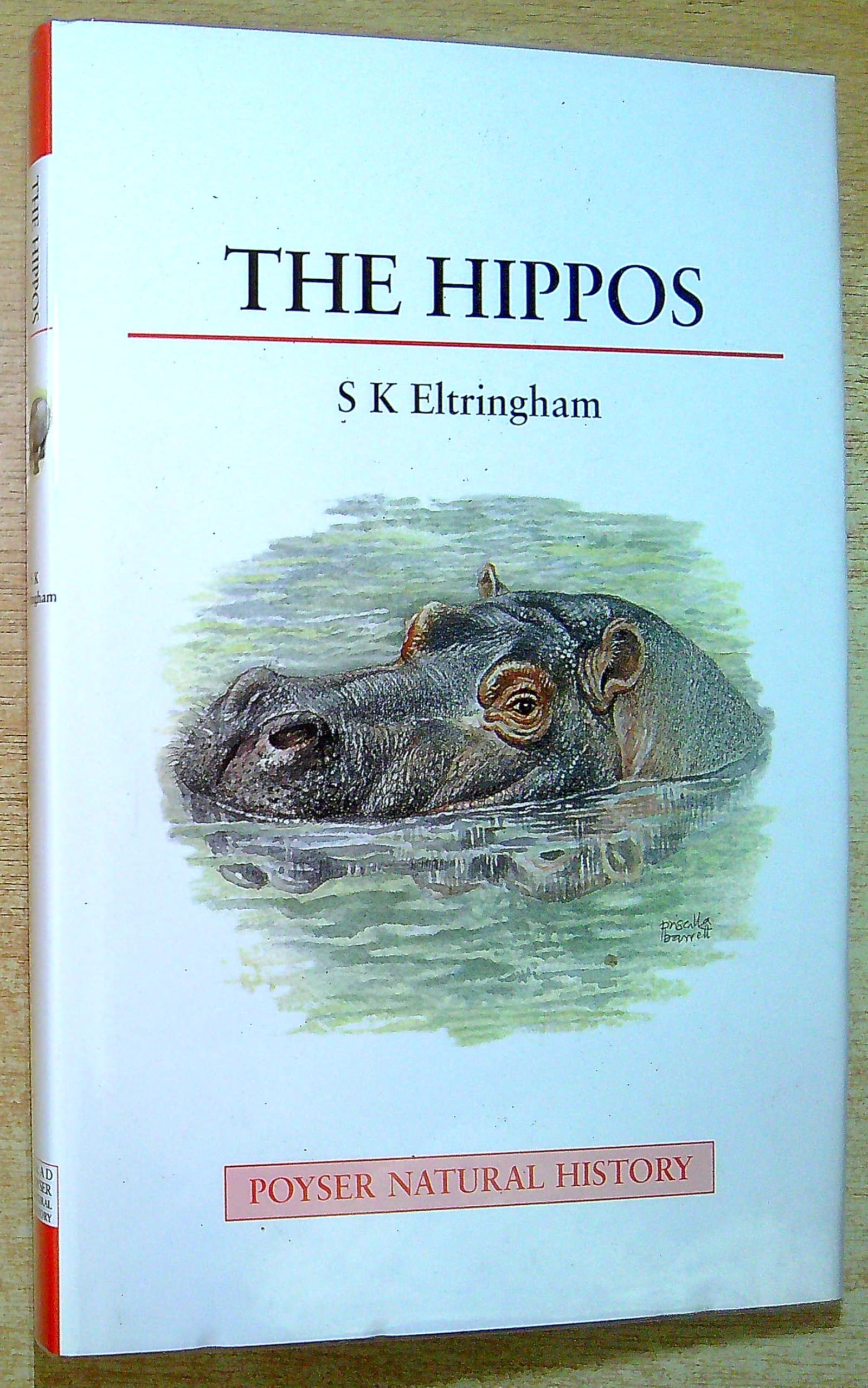
The Hippos: Natural History and Conservation (A Volume in the Poyser Natural History Series)
$71.12
by S. Keith Eltringham



Hippos are unusual in being genuinely amphibious and this has a fundamental effect on their physiology and way of life. Following a general introduction, there is a detailed description of hippo anatomy and physiology, including many fascinating and little known facts about their skin structure and physiology. The complex question of hippo stomach anatomy, and its impact on their diet and nutrition, is critically reviewed. Hippos have a four-chambered stomach similar to ruminants although, unlike them, they do not chew the cud. Hence they are often called "pseudoruminants." The fossil history of hippos is then considered and the recently claimed relationship with whales is examined. Subsequent chapters are devoted to their social biology and ecology, including descriptions of their breeding and feeding ecology. Several extraordinary instances of carnivory, including an instance of cannibalism, are described. A chapter on diseases and parasites also discusses the relations between hippos and other species, including crocodiles, to which they appear to be dominant. A consideration of the hippo's relationships with its human neighbors and the prospects for its long-term conservation gives an important view of current conservation concerns. The book closes with three chapters devoted to the results of the author's recent survey on the distribution and abundance of the common hippo throughout Africa. This is the first such estimate to have been made on a continent-wide basis and the total population of about 170,000 was so much smaller than many people had expected, that it resulted in the common hippo being given special protection under the CITES convention. Key Features: The first complete work on both species of hippo, the river hippo and the pygmy hippo Much of its data is drawn from the author's experiences while completing the IUCN Hippo Plan throughout Africa and in Uganda in particular All aspects of hippo biology are covered There has been no previous in depth study of the ecology and behavior of these mammals before "[This is the] first full account of the common hippopotamus, found in East and South Africa, and the pigmy hippopotamus, inhabiting the forests of West Africa. . . . A major contribution to mammalian and African wildlife literature, one which every mammalian and wildlife conservation collection should have." ― Choice "An enormous amount of information about the common hippototamus. . . . [A] readable, fascinating account, covering all know aspects of hippo biology, including taxonomy, anatomy, physiology, energetics, evolution, social behaviour, reproduction, diet and feeding, ecology, diseases, and parasites." ― Mammal News "There are two species of hippos in the world today. This book is a comprehensive account of the natural history and biology of both of them. An important part of the book is a survey of common hippo numbers and conservation status, country by country. The author concludes that, although it has a total population of c.174,000, the species is vulnerable; many of its populations may be too small to be viable and the species is comparatively poorly protected. In respect of the pygmy hippo, we don't even know how many there are; they occur in just a few scattered localities, probably in small numbers, making them very vulnerable. Let us hope that the clear picture presented by this book stimulates better protection and deeper study of these curious animals." ---Jeremy J. D. Greenwood, Habitat "You may feel that you have absolutely no need to know about hippos but this slim book makes for fascinating reading, especially as the common view of slow, gentle, wallowing animals, immortalized in fun by Flanders and Swann, hides an interesting ecology with even more interesting applied ecology questions." ― Bulletin of the British Ecological Society After national service with the Royal Air Force, S. Keith Eltringham worked as a laboratory assistant in the research section of the National Smelting Company, Avonmouth, before going to university to read Zoology. He studied the physiological ecology of the gribble, a marine wood-boring crustacean, for his Ph.D. but his first post was a Pilot Biologist at the Wildfowl Trust at Slimbridge, where he explored the role of aerial survey in counting wildfowl. This was followed by a period as Lecturer in Zoology at King's College, University of London, where he taught marine biology as well as introducing a course in conservation. He first went to Africa in 1966 and later became Director of the Nuffield Unit of Tropical Animal Ecology, based in the Queen Elizabeth National Park, Uganda. When the Nuffield grant expired, the Unit was passed to the Ugandan Government as the Uganda Institute of Ecology and he became its first Director as well as Chief Research Officer of the Uganda National Parks. He returned to England to take up a lectureship in Applied Biology at Cambridge University and, later, a lectureship in